











Lab‑grown meat and traditional organic meat might look similar once they’re on a plate, but under the surface they’re very different in how they’re made, regulated, and (potentially) how they affect your health and the planet. Some headlines paint cultivated meat as a clean, climate‑friendly savior; others warn it could be worse than beef and is being banned in some states. At the same time, “organic” labels sound wholesome but don’t automatically solve animal‑welfare or environmental problems.
Below is a clear, evidence‑based breakdown of what lab‑grown meat and organic meat actually are, how they compare on nutrition, safety, environment, ethics, and cost, and what “the real difference” means if you’re trying to choose what to eat.
What Exactly Is Lab‑Grown Meat?
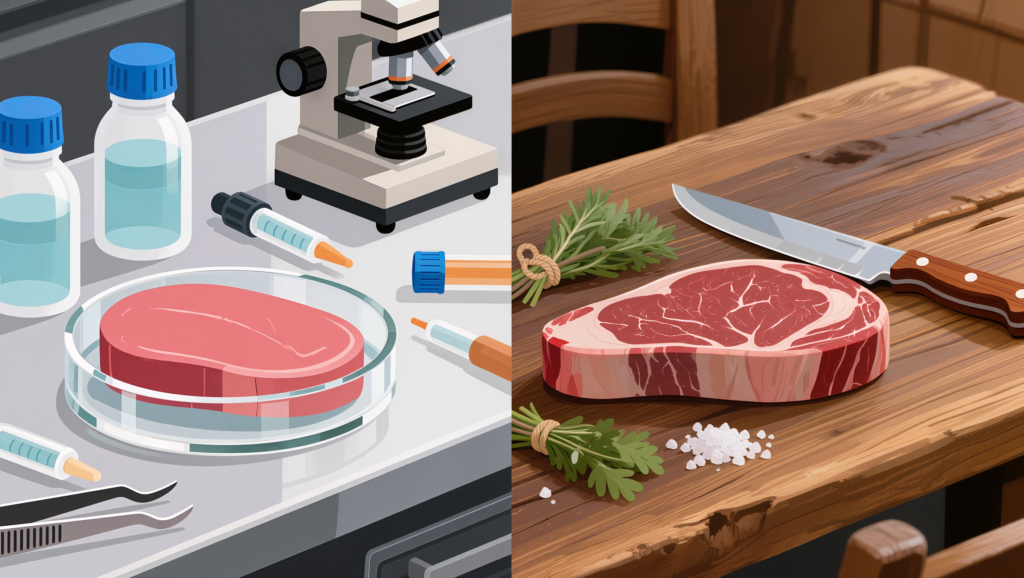
Lab‑grown meat (also called cultured, cell‑cultured, or cultivated meat) is made by growing animal cells outside the animal, in bioreactors:
- Companies start with a small sample of animal cells (muscle stem cells, fat cells, or pluripotent stem cells).
- These cells are placed in a nutrient‑rich growth medium (amino acids, sugars, vitamins, salts, growth factors) and kept warm, sterile, and aerated so they can multiply.
- Cells are sometimes grown on edible scaffolds that give structure, so you end up with something more like a nugget, fillet, or burger rather than a loose paste.
- The idea is to harvest the resulting tissue as “meat” without raising and slaughtering full animals.
From a biological standpoint, it is still meat: it’s made of animal muscle and fat cells, with the same basic proteins and fats as conventional meat. That also means it can carry the same downsides as meat—like saturated fat and cholesterol—unless companies deliberately reformulate the cell lines or growth conditions to change that profile.
Right now, cultivated meat is in its infancy: a few small‑scale approvals have occurred, but commercial production is limited, and some states have moved to ban it outright.
What Does “Organic Meat” Really Mean?
“Organic” meat is not about the animal’s species; it’s about how it was raised and what it was fed. In the U.S., the USDA National Organic Program (NOP) sets detailed rules:
- Animals must be raised under certified organic management and slaughtered at a USDA‑certified organic facility.
- They must receive 100% organic feed and forage—no GMOs, no synthetic pesticides or fertilizers, no sewage sludge, and no ionizing radiation used on the land producing their feed for at least three years.
- Routine antibiotics and most synthetic growth hormones are prohibited. If an animal needs antibiotics, it loses its organic status but must still be treated humanely.
- Animals must have access to the outdoors and be managed to accommodate natural behaviors, though the exact quality of that “access” can vary by farm.
The label “100% Organic” means all ingredients are organic; “Organic” means at least 95% of ingredients are organic by weight, and those products can carry the USDA Organic seal.
Organic rules do not guarantee grass‑fed, small‑scale, local, or perfectly humane treatment—but they do eliminate most synthetic inputs and tighten welfare and drug‑use rules compared with conventional feedlot meat.
Nutrition: Are They Different In Your Body?
Lab‑grown meat
Most cultivated meat prototypes aim to match conventional meat’s macronutrients:
- Similar protein content, amino‑acid profiles, and basic fats, including saturated fat and cholesterol—because they’re the same cell types.
- Same potential benefits (high‑quality protein, B12, iron) and same concerns (too much saturated fat and cholesterol for heart health) unless deliberately modified.
One advantage is that in theory, producers can tune the profile: for example, select fat cells with a healthier fat composition or reduce total fat while keeping texture. But that’s not yet widely available at supermarket scale, and every such change requires safety and regulatory review.
Organic meat
Organic meat’s core nutritional profile (protein / fat) is similar to conventional meat from the same species and cut. But some systematic differences show up:
- Grass‑fed organic beef often has slightly higher omega‑3 fats and a better omega‑6:omega‑3 ratio, plus more conjugated linoleic acid (CLA), compared with grain‑finished feedlot beef.
- Organic production reduces your exposure to residues of certain synthetic pesticides and fertilizers used in feed crops, though overall residue levels in conventional meat are usually low and within regulatory limits.
For most consumers, the bigger nutritional lever is how much meat you eat and what cut (lean vs fatty), not whether it’s organic vs cultivated—at least for now.
Food Safety and Public Health
Pathogens and contamination
Advocates of lab‑grown meat often argue that growing cells in closed bioreactors reduces the risk of pathogens like E. coli, Salmonella, and Campylobacter that thrive in animal guts and slaughterhouses. In theory:
- A well‑run sterile culture avoids fecal contamination, dirty processing lines, and carcass cross‑contamination.
- There’s no live animal to carry zoonotic viruses in crowded feedlot conditions.
But in practice:
- Cell cultures are extremely sensitive. If contamination occurs in a bioreactor, the batch may need to be discarded entirely.
- Large‑scale production will still require stringent HACCP‑style controls, sanitation, and monitoring, just like conventional plants.
Recognizing this, FDA and USDA have developed a shared regulatory framework:
- FDA oversees cell collection, cell banking, and growth/harvest of cultured meat.
- USDA’s Food Safety and Inspection Service (FSIS) regulates processing, inspection, and labeling of cultivated meat and poultry products.
Antibiotics & drug residues
- Conventional and some organic livestock systems use antibiotics (though organic bans routine use).
- Cultivated meat theoretically can avoid antibiotics entirely if kept sterile, but in some processes low‑level antimicrobials might be used in early cell banking or to protect culture media, which raises questions about residues and resistance.
Regulators and independent groups (e.g., the Cultured Meat Safety Initiative, funded by NSF and USDA) are now mapping out safety data gaps: growth‑factor breakdown, potential contaminants in media, scaffold safety, allergenicity, and long‑term exposure.
The bottom line: cultivated meat could reduce some food‑borne illness risks and antibiotic overuse, but its safety profile is still being actively studied, while organic systems reduce—but don’t eliminate—antibiotic and chemical exposure compared with conventional.
Environment: Climate, Land, and Water
Lab‑grown meat: Not automatically greener
Early marketing claimed cultivated meat would slash greenhouse gases, land, and water use compared with beef. More recent analyses are more cautious:
- A life‑cycle assessment from UC Davis found that with current and near‑term methods, especially when using pharmaceutical‑grade growth media, cultivated meat’s global warming potential could be 4 to 25 times higher than that of retail beef.
- The main driver is the energy and resource intensity of producing ultra‑pure media and running bioreactors under sterile, pharma‑style conditions.
Researchers emphasize that if the industry can switch to food‑grade media and less energy‑intensive processes, the environmental footprint could drop dramatically—but that is not guaranteed and has not yet been proven at scale.
In short: lab‑grown meat is not inherently better for the climate right now and could be worse than beef under some scenarios, though it still holds long‑term promise if the tech and supply chains change.
Organic meat: Better in some ways worse in others
Organic livestock avoids synthetic fertilizers and pesticides, which can reduce soil and water contamination and improve soil biodiversity. However:
- Organic cattle often rely more on pasture, which can be positive for soil and carbon if well‑managed, but they may grow more slowly and emit methane for more days, raising per‑kg emissions.
- Organic standards don’t cap total herd size; large organic operations can still have a sizable climate footprint and land demand.
Comparisons depend heavily on how animals are raised (rotational grazing vs feedlot, integrated agroforestry vs monoculture feed crops). Overall, switching from industrial beef to less meat overall + more plant foods + better managed herds matters more than organic vs cultivated alone.
Ethics, Animal Welfare, and Regulation
Animal welfare
- Cultivated meat still starts with animal cells, but if lines are maintained indefinitely, far fewer animals may be needed, and slaughter could be eliminated or greatly reduced.
- Organic standards require better conditions than conventional CAFOs (outdoor access, organic feed, limits on certain painful practices), but they do not ban confinement entirely or mandate pasture for all species year‑round.
If your primary concern is reducing slaughter and crowded factory farms, cultivated meat has strong ethical appeal if it can scale and if FBS (fetal bovine serum) and similar animal‑derived growth media are fully replaced with non‑animal alternatives.
Legal and political landscape
Cell‑cultured meat has become a political flashpoint:
- States like Florida and Alabama have passed laws banning the manufacture and sale of cultivated meat, citing concerns about tradition, rural economies, or perceived safety.
- Other states (e.g., Iowa, Oklahoma, Colorado, Utah, South Dakota) have focused on labeling rules, requiring clear distinction between conventional and cell‑cultured products.
- Federal agencies (FDA, USDA, EPA) are collaborating on a broader biotech oversight plan, including future guidance on labeling and safety testing of cultured meat.
Organic meat, by contrast, operates within a well‑established USDA NOP framework; the debates there are more about enforcement, scale, and welfare detail than about outright bans.
So, What’s the Real Difference For You?
1. How “natural” the process feels
- Organic meat: animals raised and fed under stricter organic rules, slaughtered and processed in inspected facilities—familiar and aligned with traditional farming, but still involves killing animals.
- Lab‑grown meat: cells grown in stainless‑steel tanks on refined media; no whole animal raising or slaughter after initial biopsies, but feels more biotech/pharmaceutical than pastoral.
Which feels more acceptable is as much about your values and comfort with technology as about science.
2. Predictability vs ecosystem complexity
- Cultivated meat: highly controlled environment; in theory, reproducible and free from many farm‑level variables but dependent on industrial inputs (energy, bioreactors, media).
- Organic meat: embedded in living ecosystems (soil, pasture, crop rotations). Outcomes are more variable but can contribute to regenerative systems if managed well—or to large‑scale, industrialized “big organic” if not.
3. Long‑term health uncertainties
- Organic meat: decades of data on meat consumption exist, and organic primarily reduces certain chemical exposures rather than changing the fundamental meat profile.
- Cultivated meat: short‑term safety is under active study; long‑term epidemiology simply doesn’t exist yet because the product class is new.
If you are risk‑averse about unknowns, you may prefer organic or plant‑based options until there is more real‑world usage data on cultured meat.
Practical Takeaways If You’re Choosing Between Them
- Don’t expect either option to be a “health food” by default.
Both lab‑grown and organic meat can be high in saturated fat and cholesterol; overconsumption of any red or processed meat is linked to higher cardiovascular and some cancer risks. Moderation and overall diet quality matter more than the production label. - If pesticides, antibiotics, and feed inputs worry you, organic is the known quantity.
Organic rules clearly reduce synthetic chemical use and routine antibiotics in your meat supply. - If your top priority is ending slaughter and shrinking factory farms, cultured meat is conceptually closer to your goal—but still emerging.
It avoids raising billions of animals in confinement if it scales, but it currently faces regulatory, economic, and environmental challenges and is restricted or banned in some regions. - For climate, neither is a silver bullet on its own.
Right now, cultured meat is not guaranteed to be greener than beef and may be worse under some production scenarios. Organic meat can be better in some systems but not automatically low‑emission. Cutting overall meat intake and emphasizing plant‑rich diets is still the strongest evidence‑based climate action. - Watch labels and policy changes.
Expect rapid evolution in how cultured meat must be labeled, where it can be sold, and how environmental claims are regulated. Organic labels are more stable, but scrutiny over “big organic” practices is growing.
Bottom Line
Lab‑grown meat and traditional organic meat are fundamentally different answers to the same questions: How do we feed people animal protein without wrecking the planet or abusing animals—or our own health? Cultivated meat re‑imagines meat as a biotech product; organic meat tries to clean up the existing farm model with stricter rules.
For now:
- Choose organic meat if you want conventional‑style meat with lower pesticide and antibiotic exposure and somewhat stronger welfare and environmental standards than typical feedlot meat.
- Keep an eye on lab‑grown meat as a promising but still experimental option that may, in the future, reduce animal slaughter and possibly improve nutritional profiles—but which currently carries significant uncertainty and uneven environmental performance.
Either way, your biggest lever is not which meat label you pick, but how much meat you eat and what else is on your plate. A diet centered on whole plant foods, with modest amounts of thoughtfully chosen meat—whether organic today or cultivated tomorrow—is still where science sees the clearest path to better health and a livable planet.