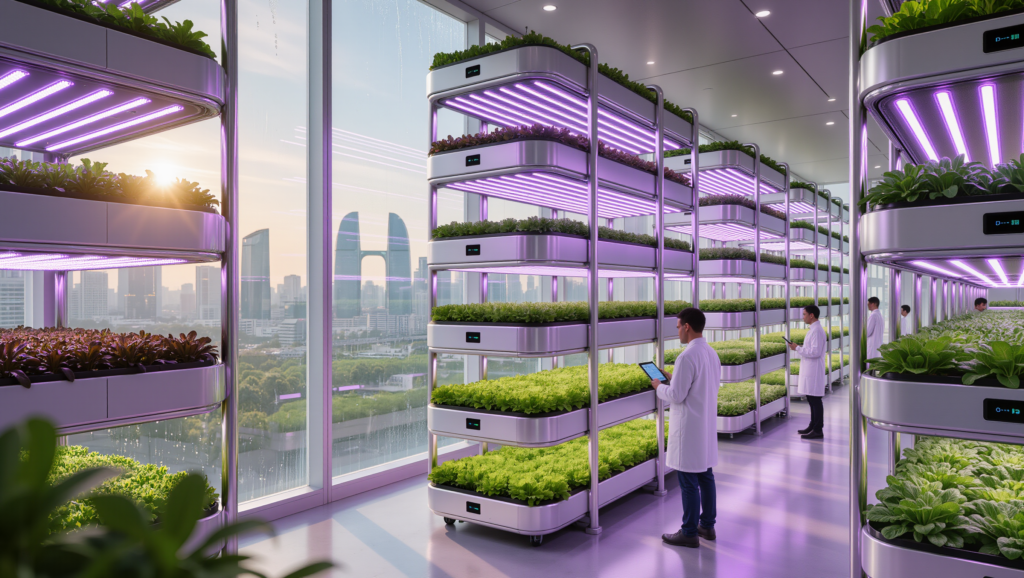












Vertical farming has some seriously glossy marketing: glowing pink LEDs, perfectly stacked greens, zero pesticides, hyper‑local salads grown in the middle of the city. The promise is huge—fresh “organic‑style” food for millions, with a fraction of the land and water of conventional farms. But under the hood, these farms run on algorithms, expensive real estate, and a lot of electricity, which raises a hard question: is this a genuine route to affordable, sustainable food, or a high‑tech niche feeding wealthy urban consumers while calling it a revolution?
Right now, the answer is: it’s both promise and hype. Vertical farms really can deliver clean, pesticide‑free produce and impressive resource efficiency, but energy use, costs, and organic‑certification debates keep them closer to premium salad for the few than staple food for the many.
What Vertical Farming Actually Does Well
Vertical farms are a specific form of controlled‑environment agriculture (CEA): crops grown indoors in stacked layers, under artificial light, with precise control of temperature, humidity, nutrients, and CO₂. They’re usually hydroponic or aeroponic, meaning plants grow in nutrient solution or mist rather than soil.
Resource efficiency and yield
Several analyses agree that vertical farms can outperform conventional fields on some key metrics:
- Land use: Because crops are stacked, yield per ground square meter is dramatically higher than in open fields. One container‑based model showed that vertically grown lettuce can produce far more output per footprint than conventional systems, even when accounting for equipment space.
- Water use: Recirculating hydroponic systems use a fraction of the water of field crops—often quoted as 70–95% less—because nearly all transpired water is captured and reused instead of evaporating or leaking away.
- Pesticide use: Indoor farms can keep out many pests and diseases, often eliminating the need for synthetic pesticides entirely, relying instead on sanitation, biological control, and physical exclusion.
- Predictability: With no weather shocks, farmers get highly predictable yields and can grow the same crop year‑round, which is attractive for retailers and restaurants.
A 2025 energy–yield–cost model for a vertical lettuce farm, for example, confirmed extremely high land and water efficiency—even as it exposed the energy challenges. That’s the core paradox: the physical resource story is excellent, but the electric bill is brutal.
Localisation and freshness
Another genuine win: proximity to cities.
- Vertical farms can be sited inside or near dense urban areas, cutting transport distance and cold‑chain storage.
- This reduces food miles and spoilage, potentially lowering total emissions for very perishable crops like baby greens when farms and customers are close together.
- Some operators supply retailers within a day of harvest, touting higher nutrient retention and flavour versus greens flown in from other regions.
On those dimensions, the promise is real: vertical farms can give cities fresher, clean greens with less land and water and fewer pesticides.
The Giant Elephant in the Room: Energy
Any honest assessment of vertical farming has to grapple with one word: electricity.
How much energy are we talking about?
A recent integrated Energy–Yield–Cost model for a standard vertical farm container growing lettuce found that:
- The specific electricity consumption was about 11.34 kWh per kg of lettuce.
- The resulting production cost was roughly $3.87 per kg, heavily driven by energy.
- The main energy hogs were LED lighting and dehumidification systems.
To meet the energy needs of that vertical farm with solar alone, the authors estimated you’d need about 2.35 m² of PV panels per m² of cultivation area. Another scenario analysis suggested around 4.7 m² of panels per square meter of vertical farm floor in a different configuration. Either way, that’s a lot of rooftop.
Life‑cycle and scenario studies echo the same pattern:
- Electricity is consistently the dominant factor in the environmental footprint of vertical farms, especially for greenhouse gas emissions.
- When power comes primarily from fossil fuels, the carbon footprint per kg of produce can rival or exceed that of efficient greenhouses or field production, even though water and land use look great.
A sustainability scenario from a European platform puts it starkly: vertical farms have “a promise of sustainability, yet their energy footprint dictates if they truly cultivate a greener future.
Energy, grid stress, and economic viability
The same scenario work warns that rapid expansion of energy‑intensive vertical farms can:
- Strain local electricity grids, especially during peak use.
- Push up electricity prices and, in worst cases, contribute to instability or outages if not planned well.
- Make farm operating costs highly sensitive to energy price volatility, undermining profitability and affordability.
A 2025 perspective in a scientific journal notes that high startup and operating costs, driven largely by energy, are reflected in two trends:
- Many vertical farms limit production to high‑value, high‑margin leafy greens and herbs to stay afloat.
- A “slew of bankruptcies” has hit previously well‑financed vertical farms that failed to reach profitability as energy and labour costs bit into margins.
So while a future where vertical farms run on dedicated solar microgrids and ultra‑efficient LEDs is technically plausible, today’s reality is mixed. In regions where electricity is expensive and fossil‑fuel heavy, the sustainability and cost case weakens quickly.
Can Vertical Farms Really Be “Organic”?
From a consumer perspective, one of the big hooks is the idea of pesticide‑free, organic‑equivalent greens grown close to home. But the organic label itself gets complicated indoors.
The soil vs. soilless debate
Organic farming regulations were originally written for soil‑based agriculture. Organic philosophy doesn’t just mean “no synthetic pesticides”; it emphasises:
- Living soil, with its microbial life and nutrient‑cycling.
- Ecological interactions, biodiversity, and broader ecosystem health.
That’s where vertical farms hit a philosophical and legal snag.
An in‑depth analysis of organic certification for indoor vertical farms highlights the divide:
- Proponents argue that many vertical farms meet the letter of organic rules: they avoid synthetic pesticides, use approved inputs, and can follow organic production and handling standards.
- Opponents argue that the absence of soil and natural light means vertical farming falls outside the “spirit” of organic agriculture, which is supposed to nurture soil ecology, not bypass it with nutrient solutions and LEDs.
In the US, the National Organic Standards Board has already voted not to ban all hydroponic systems from organic certification; so in practice, some soilless indoor farms can achieve organic certification under current rules, though it remains a grey area and a source of controversy.
In the EU, the rules are stricter:
- EU organic regulations require crops to be grown in soil, often specifically in connection with the subsoil and bedrock.
- As a result, indoor farms using water‑based or soilless systems are excluded from organic certification, even if they use no synthetic chemicals and follow many “organic‑style” practices.
One European overview states clearly:
“According to the EU’s Organic Food Certification Regulation, only farms that grow crops in soil can be granted organic certification. As a result, indoor farms utilizing water-based systems or other soil-free methods are excluded from certification, despite following organic practices like using natural fertilizers and avoiding harmful chemicals.”
This means:
- In the US and some other markets, you may see vertically farmed produce labelled organic, though the interpretation is contentious.
- In the EU, vertical farms can at best market their products as “pesticide‑free,” “residue‑free,” or “grown with clean inputs,” but not legally as organic if they are hydroponic.
Some researchers suggest a potential solution: creating a separate certification category for indoor vertical farms (e.g., “soilless organic,” “controlled‑environment organic‑style”), but regulators have yet to fully define or adopt such schemes, leaving legal grey zones and possible litigation risk for companies pushing the organic envelope.
Hype vs. Reality: Who Is Vertical Farming Feeding?
The big social promise of vertical farming is that it will “feed the world” or “provide organic food to millions.” Current data suggests a much narrower reality.
High-value greens for affluent markets
Analyses of the vertical farming sector note that, so far, most farms concentrate on:
- Leafy greens (lettuce, baby kale, spinach)
- Culinary herbs (basil, mint, coriander)
- Occasionally strawberries and microgreens
The reason is simple: these crops are:
- Fast‑growing and suitable for stacked systems.
- High value per kilogram, with premium price tolerance.
- Highly perishable—so the freshness/local angle has real economic value.
But they are not staple calorie or protein sources. A 2025 perspective points out:
“Truly tackling growing food demand would require that vertical farms produce protein- or carbohydrate-rich staples like grains, legumes or potatoes… To gain mainstream adoption, VF will need to compete with conventional agriculture on quality and price.”
So far, that’s not happening at scale:
- Energy and capital costs make it extremely hard for vertical farms to grow bulk staples like wheat, rice, or soy competitively.
- Most facilities are located in wealthy regions and cities, where customers can pay a premium for perfect, pesticide‑free greens.
This doesn’t mean vertical farms can’t play a role in food security, but it does mean that right now they are primarily polishing the top of the food pyramid rather than providing basic calories for low‑income populations.
Bankruptcies and investor disillusionment
The recent wave of collapses among “sustainability‑focused” vertical farms is a reality check.
A 2025 review in a science journal notes:
- A “slew of bankruptcies” among once‑well‑financed vertical farms.
- Persistent difficulty competing with conventional agriculture on profitability.
- High labour and energy costs as key bottlenecks.
Industry reports echo that the sector currently faces “high production costs, relatively low product margins, and high labour costs,” which have dampened investor and public enthusiasm after the initial hype.
There are success stories—companies like 80 Acres Farms and others have shown that vertical farming can be feasible and scalable in specific markets—but these are the exceptions, not yet the rule.
Under What Conditions Does the Promise Become Real?
For vertical farming to move closer to its promise—affordable, sustainable, possibly organic‑equivalent food at scale—several conditions have to line up.
1. Clean, cheap energy
Scenario work and energy‑cost models are unanimous: the sustainability story hinges on the energy mix.
- If vertical farms run on fossil‑based grid power, their carbon footprint can undermine claims of green superiority, and energy costs keep prices high.
- If farms are integrated into renewable microgrids (solar, wind, maybe geothermal) with on‑site generation and storage, the environmental profile improves dramatically.
One scenario describes a positive “ascend” pathway where vertical farms:
- Decouple from fossil fuel dependency.
- Use rooftop solar and other renewables to cover a large share of demand.
- Combine efficient LEDs and smart controls to push down kWh per kg of produce.
In that world, vertical farming might genuinely deliver low‑emission greens at scale, especially in sun‑rich regions and urban corridors.
2. Technological and operational efficiency
Continuous improvements are needed in:
- LED efficiency and spectra (more photons per watt, tuned to crop needs).
- Climate control systems (more efficient dehumidification, HVAC integration).
- Automation and robotics (reducing labour costs without compromising working conditions).
- Crop breeding for indoor conditions (varieties optimized for stacked environments, fast cycles, high density).
Experts note that vertical farming could learn more from traditional greenhouses—many of the same energy and cost challenges exist there, and decades of optimisation have already happened. Openness and data sharing, rather than secrecy and NDAs, will likely speed up progress.
3. Clear standards and honest marketing
On the organic/sustainability front:
- Regulators need to clarify what counts as organic or “organic‑equivalent” indoors, possibly via new categories—otherwise, consumer trust and farmer fairness suffer.
- Companies need to be transparent about energy sources, inputs, and certifications instead of leaning on vague sustainability claims.
A realistic narrative might be:
- “Pesticide‑free, water‑efficient, local greens grown on renewable energy,” rather than “This is the future of food for everyone.”
So, Organic Food for Millions, or Just Hype for the Few?
Right now, vertical farming is best described as a high‑potential, high‑cost niche:
- It genuinely excels at producing clean, consistent, pesticide‑free leafy greens and herbs with impressive land and water efficiency.
- It struggles with energy demands, high costs, and economic viability, limiting it mostly to premium markets and high‑value crops.
- Organic certification is possible in some jurisdictions but philosophically contested, and outright blocked for soilless systems in others (like the EU), complicating the “organic for millions” storyline.
The promise isn’t pure hype—but it’s also far from a solved answer to global food security. Vertical farms are likely to:
- Play an important role in urban food systems, supplying fresh greens with low pesticide use and minimal land.
- Complement, not replace, soil‑based organic and regenerative farms, which are still much better suited to grains, legumes, and broadacre staples.
- Become genuinely sustainable where they’re tightly integrated with renewable energy, smart grids, and honest standards.
Whether this becomes food for millions or remains salad for the privileged depends less on the LEDs themselves and more on policy, energy infrastructure, and whether the sector can move beyond glossy renderings and into tough, boring work: lowering costs, sharing data, and telling the truth about what vertical farming can—and cannot—do.