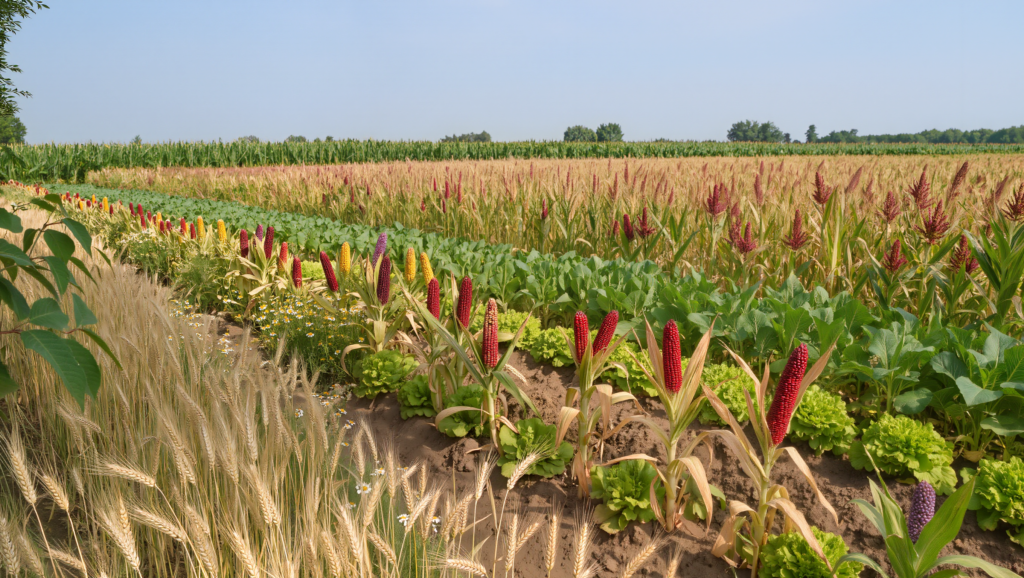












Planting the same high‑yield crop over and over may fill bellies, but it doesn’t truly nourish people—or protect them when climate or markets wobble. Diverse crops and rich genetic variety act like a “nutritional safety net”: when we grow a broader mix of species and varieties, we don’t just get prettier fields, we get more vitamins, minerals, and resilient nutrition flowing into our diets year after year.
The science is catching up to what traditional farming cultures already knew: genetic and species diversity on farms underpins nutrient diversity on the plate, and makes that nutrient supply far more stable in the face of shocks. Here’s how that works—and why crop diversity isn’t a “nice to have” but a non‑negotiable foundation for dense, reliable nutrition
Calories vs. Nutrition: Why Diversity Matters
For decades, food security was defined mostly as “enough calories.” That’s how we ended up with global systems dominated by a few big staples—rice, wheat, maize, soy—while thousands of traditional crops and landraces faded into the background.
Scientists are now blunt about the limits of that approach:
- A major analysis on crop diversity and nutrition notes that calories do not equate to food security, and that the real goal has to be nutritional diversity and stability—steady access to the full range of nutrients needed for health.
- Global nutrition reports emphasise that micronutrient deficiencies (iron, zinc, vitamin A, iodine, etc.) are widespread even in populations that technically get enough calories.
Crop diversification is emerging as a practical strategy to bridge that gap:
- A critical review of 23 studies in low‑ and middle‑income countries concluded that greater on‑farm crop species richness is associated with more diverse nutrients available from farms and small but measurable improvements in child growth.
- A 2025 systematic review on seasonal crop diversity found that more diverse cropping over the year correlates with better dietary diversity and lower rates of both under‑ and over‑nutrition, especially in vulnerable rural communities.
In everyday terms: when farmers grow more types of crops, households don’t just eat more food—they eat more kinds of nutrients and are less pinned to a single fragile staple.
Nutritional Stability In Farms: How Many Crops Do You Really Need?
One of the most interesting recent ideas is nutritional stability—a food system’s ability to keep delivering necessary nutrients even when one crop fails or disappears.
A 55‑year analysis across 184 countries did something clever:
- It built networks linking crops to their constituent nutrients at national scale.
- Then it simulated what happens to nutrient availability when crops are “removed” (due to pests, climate shocks, trade disruptions, etc.).
- This yielded a metric for how robust a country’s crop mix is at providing nutrients despite disturbance—its nutritional stability.
The key findings:
- There’s a positive, non‑linear relationship between crop diversity (how many distinct crops) and nutritional stability.
- Nutritional stability increases rapidly as you add crops, but then gains slow down once you reach roughly 7–16 unique crops in a crop–nutrient network.
- In other words, going from 3 to 10 crops greatly boosts nutrient resilience; going from 40 to 50 does much less.
- Across regions, about 83% of crop–nutrient networks already had all 17 key nutrients considered—but stability still depended on how many different crops provided those nutrients.
This matches smaller‑scale findings:
- In studies of farms in three African countries, on‑farm richness of edible species raised the diversity of nutrients produced, but beyond ~25 species, the gains plateaued.
The lesson is subtle but powerful:
- You don’t need hundreds of crops everywhere to feed people well.
- But you do need enough diversity that key vitamins and minerals aren’t dependent on just one or two fragile crops.
That’s what genetic and species diversity buys you: resilience in nutrient supply when the world throws curveballs.
Genetic Variety Inside a Crop = Different Nutrition
Diversity isn’t just about how many species you plant; it’s also about which varieties and landraces within a species you choose.
Research compiled by agricultural and nutrition experts shows that:
- Different rice varieties can vary markedly in iron and zinc content.
- Different wheat and maize lines differ in protein quality, micronutrients, and phytochemicals.
- Colourful “heritage” or traditional varieties (purple maize, red rice, orange sweet potatoes, black beans) tend to have higher levels of carotenoids, anthocyanins, and other protective compounds than highly standardised modern white/yellow staples.
A review on crop diversity and human health notes:
- There is “compelling evidence” that diverse diets including fruits, vegetables, nuts, berries, and varied staples are critical for optimising human health and preventing chronic disease.
- Strategies to address micronutrient deficiencies include dietary diversification and crop biofortification—breeding staples for higher zinc, iron, and other nutrients.
Biofortification itself relies directly on genetic diversity in crop gene banks and landraces:
- Organisations like the Crop Trust emphasise that crop diversity in seed banks and farms is what allows breeders to develop more nutritious, resilient varieties—for example, high‑zinc wheat or iron‑rich beans.
So planting a broader palette of varieties isn’t cosmetic—it literally changes the micronutrient profile of what ends up on your plate.
How Diverse Farms Translate Into Denser Nutrition
Researchers describe several mechanisms by which planting genetic and crop diversity leads to better nutrition:
1. Direct subsistence: more things to eat at home
On smallholder and subsistence farms:
- Greater on‑farm crop species richness means more kinds of foods are directly available for the household.
- Studies in Ethiopia, Malawi, and other countries find that households with higher crop diversity have more diverse diets and better child dietary diversity scores.
One review notes that each additional edible crop species modestly improves the diversity of nutrients a farm can supply, with strong gains up to a certain threshold.
For a child, that can mean:
- Not just maize porridge, but also beans (protein, iron), leafy greens (folate, vitamin K), orange sweet potatoes (beta‑carotene), and groundnuts (fat and protein).
- Over time, these combinations translate into better growth and reduced stunting.
2. Income pathways: diversity that funds better food
Crop diversification isn’t only about self‑consumption:
- Mixed cropping, integrating fruits, vegetables, pulses, and small livestock can raise incomes and smooth cash flow across seasons.
- Higher and more stable income then allows households to buy nutrient‑rich foods they don’t grow themselves.
The 2017 review by Jones concluded that agricultural diversification improves diets through both subsistence and income pathways and is a promising strategy for nutrition in low‑ and middle‑income countries.
3. Seasonal diversity: plugging nutrient gaps over the year
A 2025 systematic review focusing on seasonal crop diversity found that:
- Increased seasonal diversity—growing different crops in different seasons—helps maintain dietary variety and nutrient availability during lean times.
- This is especially important for vulnerable groups (pregnant women, young children) in regions with strong seasonality in food access.
- Communities with higher seasonal crop diversity had lower rates of both under‑nutrition and over‑nutrition, suggesting more balanced diets year‑round.
Different crops contribute different essential nutrients:
- Legumes add lysine and iron.
- Leafy greens add folate, calcium, vitamin K.
- Orange and red fruits/veg add carotenoids and vitamin C.
- Nuts and seeds provide vitamin E and healthy fats.
A genuinely diverse field across seasons acts like a slow, living multivitamin factory.
Diversity In Farms as Insurance Against Shocks
Nutritional stability isn’t just about “nice to have” variety—it’s about survival and health when things go wrong.
The global crop diversity–nutritional stability study highlights that:
- More diverse crop systems are more robust to disturbances—droughts, pests, market shifts—because losing one crop doesn’t wipe out entire nutrient categories.
- There’s a clear threshold where additional crops add less to stability, but below that threshold, low diversity makes nutrient supply fragile.
Other work on agrobiodiversity and crop diversification notes:
- Low agrobiodiversity makes food systems more vulnerable to climate change, new pests, and disease outbreaks.
- Diverse cropping systems improve soil health, pollinator support, and ecological resilience, which indirectly support yield stability and thus nutrient availability.
- Diversifying with under‑used, “forgotten,” or heritage crops can significantly boost local calorie and nutrient availability, especially in nutrition‑insecure regions.
The Crop Trust summarises it well: without crop diversity, plant breeders can’t develop new varieties that cope with heat, drought, salinity, or emerging diseases—which directly threatens future food and micronutrient security.
So diverse fields aren’t just prettier; they’re a defence system for keeping iron, zinc, protein, and vitamins flowing, even as the climate and economy shift.
Is More Always Better? The Threshold Effect
Both field‑level and national‑level studies show a similar pattern: the first increments in diversity bring big nutritional gains, but benefits taper off.
- On individual farms, nutrient output increases with species richness, but beyond ~25 edible species, improvements plateau.
- At national scale, nutritional stability improves as the number of crops grows, but gains slow after networks contain about 7–16 unique crops.
This has practical implications:
- For many regions, the priority isn’t to jump from 40 to 60 crops—it’s to move from 3–5 staples to a more balanced mix of 10–15 key crops that cover essential nutrients.
- Designing cropping systems for nutrition means identifying complementary nutrient profiles—for example, pairing cereals with pulses, vitamin‑A‑rich crops, leafy greens, and nutrient‑dense fruits.
It’s less about maximum species counts and more about smart, functionally diverse combinations.
What This Means for Eaters, Farmers, and Policy
For everyday eaters
You experience all of this diversity as choice on your plate:
- When your local food system has more kinds of grains, pulses, vegetables, and fruits, it’s easier (and usually cheaper) to eat a nutritionally dense, varied diet.
- Diverse crops in fields become diverse colours and textures in your meals—and study after study links diverse diets with lower risk of micronutrient deficiencies and chronic disease.
A simple way to lean into this science:
- Rotate your staples (try different grains and roots).
- Add at least one pulse, one leafy veg, and one coloured veg or fruit most days.
- Look out for heritage or under‑used varieties at markets—they often bring unique nutrients along for the ride.
For farmers and food systems
Diverse cropping can mean:
- Intercropping cereals with legumes and vegetables.
- Rotating crops seasonally to include nutrient‑dense “minor” crops.
- Preserving and reintroducing local landraces and under‑utilised species.
The benefits include not just more resilient yields, but more marketable nutrient‑dense foods, especially when combined with local demand and nutrition education.
For policy and research
Analyses in this field repeatedly call for:
- Integrating nutrition objectives into agricultural policy, not treating yield alone as the goal.
- Supporting agrobiodiversity conservation and breeding that focuses on nutrient density and resilience.
- Investing in market and value chain infrastructure so that nutritionally important but perishable crops (vegetables, fruits, pulses) can actually reach people, not rot in fields.
There’s also a push for more longitudinal research to track how crop diversification affects nutrition over many years, not just in one‑off snapshots.
The Big Picture: Genetic Variety as a Public Health Tool
When you zoom out, the story is surprisingly simple:
- Human bodies need a broad spectrum of nutrients.
- No single crop can provide all of them reliably.
- Fields planted with a narrow genetic and species palette produce narrow, fragile nutrition.
- Fields planted with a thoughtful mix of species and varieties produce denser, more resilient nutrition, especially for the most vulnerable.
The emerging science—from village‑level studies to 55‑year global analyses—backs up what Indigenous and traditional farmers have practised for generations: diversity in the field is the foundation of diversity in the diet, and diversity in the diet is the foundation of robust health.
In that sense, planting genetic variety isn’t just an agronomic choice; it’s a quiet, upstream public‑health intervention—one that starts in seed banks and fields, and ends with stronger, better‑nourished bodies.
Sources:
https://pmc.ncbi.nlm.nih.gov/articles/PMC5914317 https://pmc.ncbi.nlm.nih.gov/articles/PMC5914317/ https://pmc.ncbi.nlm.nih.gov/articles/PMC5914317/