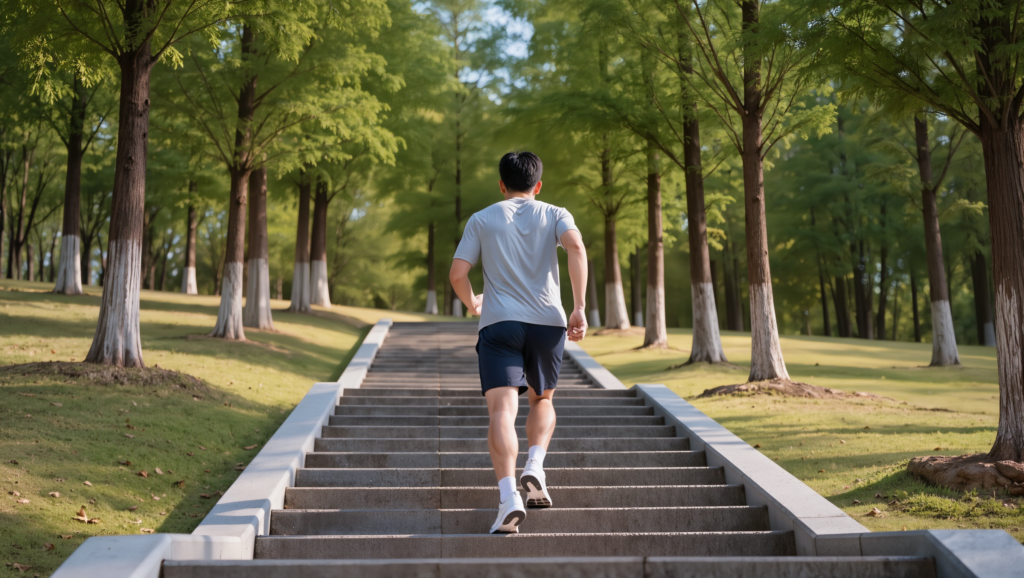












If you want a brutally honest snapshot of how your heart, lungs, and muscles are really doing, you don’t need a lab or a smartwatch. You just need a staircase. Being able to climb a few flights without gasping, stopping, or clutching the railing is a surprisingly powerful, real‑world benchmark of cardiorespiratory fitness—and that fitness level is one of the strongest predictors of your future health, independence, and quality of life.
Scientists and heart societies now talk about low fitness almost like a chronic disease. Cardiorespiratory fitness (CRF) is more predictive of how long you’ll live than smoking, blood pressure, or cholesterol, and even small improvements can sharply cut your risk of dying from any cause. A simple stair‑climb test turns that abstract VO₂ max number into something you can feel in your body.
Let’s break down what your ability to climb stairs is really telling you, how it connects to VO₂ max and longevity, and how to use this “free stress test” to guide your training.
Why Cardiorespiratory Fitness Is a Big Deal
Cardiorespiratory fitness is your body’s ability to take in oxygen, transport it through the blood, and use it in your muscles during sustained activity. The gold‑standard measure is VO₂ max (maximal oxygen uptake in mL/kg/min), but you don’t need a mask and treadmill to understand the principle.
High CRF means:
- Your heart can pump a lot of blood per beat.
- Your lungs can move air efficiently.
- Your blood vessels deliver oxygen well.
- Your muscles are good at using that oxygen.
And that matters more than most people realise.
Two huge datasets have changed how doctors look at fitness:
- A 2018 Cleveland Clinic study of 122,007 adults found that higher cardiorespiratory fitness was the strongest predictor of survival they measured—stronger than smoking, hypertension, or diabetes. The highest‑fit group had about a 70–80% lower mortality risk than the least fit.
- A 2022 analysis of over 750,000 U.S. veterans showed that each 1‑MET (≈3.5 mL/kg/min VO₂) increase in fitness was linked to about a 13–15% drop in mortality risk, across ages, sexes, and body sizes.
A 2016 statement from the American Heart Association went so far as to recommend that doctors treat low CRF as a “vital sign” and assess it routinely, the way they do blood pressure.
So when you ask, “Can I climb stairs without gasping?”, you’re really asking, “Is my heart‑lung‑muscle system at a level that protects my future health and independence?”
The Stair‑Climbing Test: A Real‑Life VO₂ Check
VO₂ max tests in labs are great, but they’re expensive and rare. Stairs are cheap and everywhere.
How stairs mirror formal fitness tests
Several studies have looked at how simple stair climbing compares with lab measurements:
- A 2024 paper developed a standardised Stair Climbing Test (SCT) using a 13.14 m staircase (about four floors). Participants ran up and down as fast as possible while being monitored. The SCT results correlated well with cardiopulmonary exercise testing (CPET), the gold standard for VO₂ max, in both healthy young people and patients with heart conditions.
- A study in people with COPD compared a 4‑flight stair climb (max 2 minutes) with the famous 6‑minute walk test. The two tests showed no significant differences in estimated VO₂ max, oxygen saturation changes, or heart rate responses, and dyspnea (breathlessness) ratings were strongly correlated.
Researchers concluded that stair‑climbing tests can effectively evaluate cardiorespiratory fitness without expensive equipment and with high relevance to daily life.
An older trial in older adults found that the number of flights people could climb was strongly related (r ≈ 0.94) to left‑ventricular ejection fraction (how well the heart pumps) and that better stair‑climbers had fewer postoperative respiratory complications and lower mortality.
Why stairs feel so brutally honest
Stair climbing is high power output per second in a functional movement:
- You’re lifting your body weight vertically against gravity.
- It demands coordinated heart, lungs, and leg muscles.
- It spikes heart rate and breathing faster than level walking.
A 2023 review notes that stair‑climbing interventions (as training) improved VO₂ by 8–33 mL/kg/min, lowered blood pressure, improved cholesterol and insulin sensitivity, and reduced waist circumference. That’s huge, and it’s why stairs feel like an instant truth‑serum for your fitness.
Gasping vs. Breathing Hard: What’s Normal, What’s Not
It’s totally normal to be breathing harder at the top of a few flights—especially if you went fast. The question is: how hard, how long, and how does it feel?
Signs you’re basically in a healthy range
If you can typically:
- Climb 2–4 flights of stairs (roughly 20–60 steps) at a steady pace
- Breathe hard but still talk in short sentences at the top
- Bring your breathing back to comfortable within about 30–60 seconds of stopping
- Do this without chest pain, dizziness, or unusual leg heaviness
…then your everyday functional CRF is probably in a reasonable, protective zone (assuming no medical conditions). This tends to correspond to a VO₂ max comfortably above the “frailty” threshold (~20 mL/kg/min), which is associated with much better independence and lower mortality.
Red flags: when gasping means “get checked”
On the other hand, you should talk to a doctor if you notice:
- You’re severely out of breath after one flight at normal pace.
- You have to stop, lean on the rail, or bend over after a single flight.
- Your breathing takes several minutes to recover from just a short climb.
- You feel chest pain, tightness, or pressure, arm/jaw pain, or unusual palpitations.
- You get lightheaded, dizzy, or near‑faint on the stairs.
- Your symptoms are new or rapidly worsening.
These can signal cardiovascular disease, lung disease (like COPD, asthma, interstitial lung disease), anemia, or even dysfunctional breathing patterns.
A 2022 study on dysfunctional breathing found that people with normal exercise capacity on lab tests still reported disproportionate breathlessness when starting to climb stairs or changing posture. So not all breathlessness is from poor fitness—sometimes it’s about breathing patterns—but either way, persistent, disproportionate symptoms deserve evaluation.
Why This Benchmark Predicts Quality of Life (Not Just Survival)
Being able to climb stairs without gasping isn’t just about lower heart‑attack risk; it’s about how independently and joyfully you can live.
Stair‑climbing capacity is tightly connected to:
- Activity of daily living – If one flight wipes you out, grocery shopping, carrying laundry, or visiting friends in walk‑up flats becomes a chore or impossible.
- Postoperative outcomes – Pre‑surgery stair‑climbing ability predicts who will struggle with respiratory complications and extended hospital stays. People who could climb more flights had lower postoperative morbidity and mortality.
- Functional reserve – CRF is your “buffer” for coping with illness, injury, or stress. Higher fitness makes pneumonia, Covid, or surgery less likely to knock you flat.
On the flip side, low CRF and poor stair tolerance are closely tied to:
- Reduced participation in social activities (you avoid stairs, hills, outings).
- Higher rates of depression and poorer self‑rated quality of life.
- Greater risk of frailty and loss of independence in older age.
In short: how you handle stairs today foreshadows how you’ll handle life’s bigger hills tomorrow.
A Simple At‑Home Stair Benchmark (No Lab Needed)
This isn’t a medical test, but you can get a rough sense of where you are with a simple, self‑paced check. Only do this if you’re generally healthy; if you already have heart/lung disease or worrisome symptoms, talk to your doctor first.
The informal “2–4 flight” check
Pick a familiar staircase—at home or work:
- 1 flight ≈ 10–15 steps.
- 2–4 flights = 20–60 steps (roughly similar to some research protocols)
Instructions:
- Warm up – Walk on flat ground for 3–5 minutes.
- Climb at a steady, comfortable pace – Don’t run; think “brisk but sustainable.”
- No handrail pulling (light fingertip support is okay if you need balance).
- At the top, note:
- Your breathing (can you speak in phrases? single words? not at all?).
- How many seconds it takes before you feel “normal” again.
- Any chest discomfort, dizziness, or unusual symptoms.
Very rough interpretation for relatively healthy adults:
- Good functional CRF: 2–4 flights, breathing hard but controlled; recovery in ~30–60 seconds; no worrying symptoms.
- Borderline: 1–2 flights, significant breathlessness or recovery >2 minutes; you feel “wrecked.”
- Concerning: 1 flight triggers severe gasping, chest pain, or dizziness—seek medical evaluation.
Again, this is not diagnostic, but it tracks reasonably with formal measures and gives you a tangible benchmark.
Can You Train This Benchmark Up? (Yes—Fast.)
The good news: cardiorespiratory fitness is highly trainable, and stair climbing itself is one of the most efficient ways to improve it.
A 2023 systematic review on stair‑climbing interventions found that regular stair climbing:
- Increased aerobic capacity (VO₂) by 8–33 mL/kg/min (huge range, depending on starting point and program).
- Improved blood pressure, cholesterol, insulin sensitivity, body composition, and waist circumference by roughly 9–15%.
- Required as little as 4–8 weeks to significantly alter cardiometabolic risk markers.
That means you can go from “gasping after one flight” toward “steady after a few flights” in a matter of weeks to months with consistent practice, assuming no serious underlying disease.
A simple progression to boost your stair fitness
Assuming your doctor has cleared you for exercise:
Weeks 1–2: Build tolerance
- Goal: Use stairs 3–4 days per week.
- Start with 1–2 flights, walking slowly.
- Rest fully between efforts; do this 3–5 times per session.
- Stop if you feel chest pain, dizziness, or extreme discomfort.
Weeks 3–6: Add volume and intensity
- Increase to 3–4 flights per bout if tolerated.
- Start timed repeats: climb 2–3 flights, rest until you can speak full sentences, repeat 4–6 times.
- On other days, add brisk walking or cycling for 20–30 minutes to build your aerobic base.
Weeks 7–12: Sharpen fitness
- Try intervals: 30–60 seconds of brisk stair climbing, followed by 60–90 seconds of easy walking, repeated 6–10 times.
- Combine with 1–2 longer moderate‑intensity cardio sessions per week.
Even modest improvements in your “stair score” likely reflect real gains in VO₂ max—and remember, each 1‑MET (~3.5 mL/kg/min) gain is associated with about 13–20% lower mortality risk in large datasets.
When Stair Breathlessness Is About More Than Fitness
Not every person who struggles on stairs is simply “out of shape.”
The 2022 stair‑climbing CPET study on dysfunctional breathing showed that some individuals:
- Have normal lung function and normal peak VO₂ (around 97% predicted),
- But experience disproportionate breathlessness at the onset of everyday tasks, like starting to climb stairs.
In these cases, the issue can be:
- Inefficient breathing patterns (over‑breathing, shallow chest breathing).
- Anxiety overlaying physical exertion.
- Underlying conditions like asthma that aren’t well controlled.
People with COPD, heart failure, or other chronic conditions can also experience exaggerated dyspnea on stairs. In COPD, stair climbing has been shown to correlate strongly with established tests like the 6‑minute walk, and it reveals how much stair tasks restrict daily activity.
If your breathing feels way worse than your overall fitness suggests—or if you’ve already been diagnosed with a heart or lung condition—get a proper evaluation. Sometimes fixing breathing mechanics, medication, or rehab can transform your stair experience.
The Take‑Home: A Tiny Habit with Massive Predictive Power
You don’t need to memorise VO₂ numbers to benefit from what the science is saying:
- Cardiorespiratory fitness is one of the strongest predictors of how long and how well you’ll live—stronger than many traditional risk factors.
- Being able to climb a few flights of stairs without gasping, stopping, or feeling wrecked is a simple, powerful proxy for that fitness.
- If one flight reliably leaves you struggling, it’s not just “being a bit out of shape”—it’s a sign to check in on your heart, lungs, and lifestyle.
- The fix isn’t mysterious: regular, progressive movement (including stair climbing itself) can significantly raise your fitness in weeks to months and improve blood pressure, lipids, insulin sensitivity, and waistline along the way.
So the next time you take the stairs, pay attention. That small, everyday effort is quietly answering a big question: How ready is your body for the next decade of your life?
Sources
https://pmc.ncbi.nlm.nih.gov/articles/PMC10887637 https://pubmed.ncbi.nlm.nih.gov/19543172/ https://pmc.ncbi.nlm.nih.gov/articles/PMC9549317/