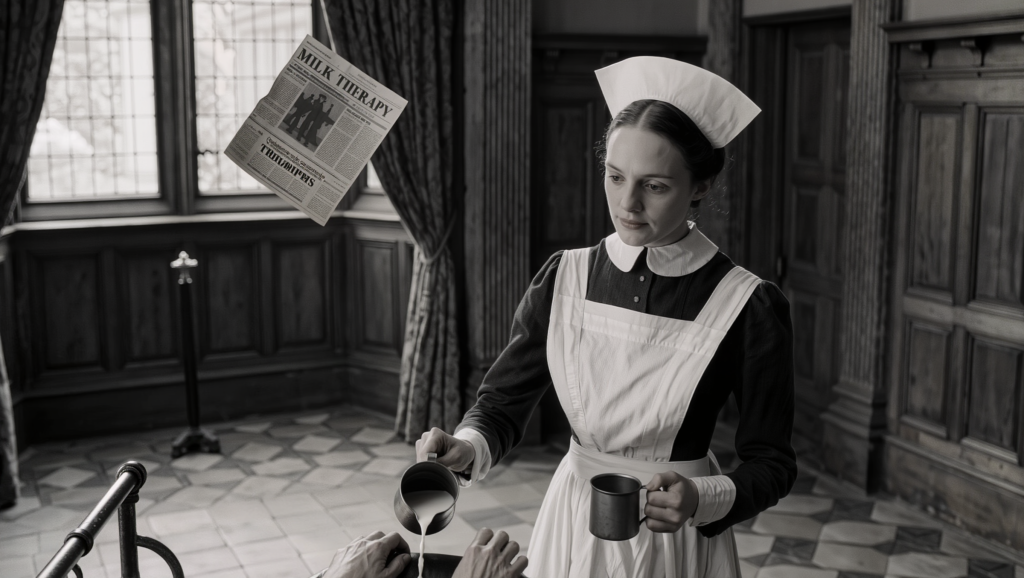












In the 1800s, some doctors genuinely believed that milk could help treat mental illness. Not as a metaphor, not as a comfort food, but as a real clinical intervention — a “milk cure” prescribed for people with nervous disorders, mania, melancholy, exhaustion, and a wide range of psychiatric complaints. To modern eyes, that sounds bizarre, but it makes more sense when you look at the medicine, nutrition ideas, and institutional culture of the time.
The short answer is: no, milk was not a cure for mental illness in the modern medical sense. But the “milk cure” still tells us something important about history, psychiatry, and the way people once tried to use diet to fix minds that were deeply suffering. It also reveals a surprisingly modern truth: nutrition, routine, and reduced stress can sometimes make people feel better, even if they do not “cure” the underlying disorder.
What Was the Mental Milk Cure in The 1800s?
The milk cure was a 19th-century treatment in which patients were given large quantities of milk, often as part of a highly restricted diet. Sometimes the regimen was used in boarding houses or private retreats. In other cases, it appeared in sanatorium-style settings where patients were isolated from daily life, overstimulation, and social stress.
The basic idea was simple:
- Milk was seen as pure, gentle, and nourishing.
- It was thought to “cool” the body and calm the nerves.
- It was often given in place of richer, heavier, or more stimulating foods.
- Patients sometimes spent a lot of time resting, walking, or being removed from stressful environments.
So the milk itself was only part of the intervention. The whole setup included food restriction, rest, regularity, and removal from the pressures of normal life. That’s a very different thing from simply telling someone today to drink more milk and expect psychiatric symptoms to disappear.
Why Doctors Believed It Might Work
To understand the milk cure, you have to think like a 19th-century physician. Modern psychiatry did not yet exist in its current form, and the causes of mental illness were often framed in vague or bodily terms. Doctors might blame “nerves,” digestive weakness, exhaustion, overwork, sexual excess, emotional strain, or “nervous irritation.” In that context, milk seemed plausible.
Milk had several virtues in the eyes of physicians of the era:
- It was nutrient-dense compared with many available foods.
- It was easy to digest for some patients.
- It was associated with infancy, innocence, and simplicity.
- It fit the belief that the body and mind could be restored through cleanliness and moderation.
The 1800s were full of therapies that tried to correct mental distress by correcting the body. That included baths, rest cures, diet systems, and retreat from urban life. The milk cure was one version of that wider medical fashion.
The Real Benefit May Have Been Routine, Not Milk
One of the most interesting things about the milk cure is that its effects may have had less to do with milk as a special substance and more to do with the overall structure of the treatment.
People who underwent milk cures often:
- Ate on a strict schedule.
- Reduced alcohol, stimulants, and heavy meals.
- Rested more.
- Left stressful environments.
- Got more attention from caregivers.
- Experienced a sense of order and control.
That matters because mental distress often worsens when life becomes chaotic. Even today, people with anxiety, burnout, depression, or stress-related symptoms often feel better when sleep, meals, movement, and environment become more regular. The 1800s milk cure may have worked partly because it imposed a calmer rhythm on a chaotic nervous system.
So the milk was not necessarily magic. The regimen around it may have been the real intervention.
Milk as a Symbol of Purity and Recovery in The 1800s
Milk carried symbolic weight in the 19th century. It was seen as wholesome, domestic, and fundamentally “natural.” In an era when doctors worried about overstimulated urban life, industrialization, and nervous collapse, milk represented a return to simplicity.
That symbolism mattered more than it might today. Treatments often reflect the values of their culture, and the milk cure fit the era’s obsession with:
- Purity.
- Simplicity.
- Mildness.
- Control of the body through diet.
It’s not hard to see why milk appealed to doctors. It looked like the opposite of the world many patients were living in: too much stress, too much stimulation, too much complexity, too much chaos. Milk was the edible version of “slow down.”
Why Modern Psychiatry Doesn’t Treat Milk as a Cure For Madness?
From a modern medical standpoint, the milk cure does not hold up as a treatment for mental illness. Psychiatric disorders are complex and usually involve a mix of genetics, brain chemistry, life events, trauma, social stress, medical conditions, and environmental factors. No single food can fix that.
Milk may still be useful for some people as part of a balanced diet, but there is no solid basis for claiming it cures:
- Depression.
- Bipolar disorder.
- Schizophrenia.
- Anxiety disorders.
- OCD.
- Trauma-related conditions.
At best, milk could support nutrition in some people if they tolerate it well. But even that is not universal. Some people are lactose intolerant, allergic to dairy, or simply do not benefit from dairy-heavy diets. The old idea that milk is inherently calming or restorative is not a scientific law.
Could Nutrition Help Mental Health at All?
Yes — just not in the simplistic “drink this and your mind is fixed” way. Nutrition affects energy, blood sugar stability, sleep quality, gut health, and overall physical resilience. Those factors can influence mood and mental performance.
A more modern way to think about the milk cure is this:
- Adequate calories can support recovery.
- Protein can help maintain physical strength.
- Calcium, vitamin B12, and other nutrients may matter for some people.
- Stable meal patterns can reduce stress in vulnerable individuals.
So while milk itself is not a psychiatric treatment, nutrition in general is part of mental health support. The old milk cure was a rough, historically limited attempt to do something that modern medicine still recognizes: support the body so the mind has a better chance.
The Hidden Problem: Restriction Can Be Harmful Too
There’s another important historical twist. Some “cures” for mental illness in the 1800s were not really nourishing at all; they were restrictive. Depending on the case, the milk cure could become an extreme diet, and extreme diets are not automatically helpful. In some patients, over-restriction may have worsened weakness, social isolation, or obsession around eating.
That’s one reason modern medicine is cautious about miracle diets for mental health. A food regimen that calms one person may destabilize another. And when a treatment becomes too rigid, it can itself create stress. The line between care and control is not always clean.
Why the Milk Cure For Madness Still Fascinates People
The milk cure keeps showing up in discussions of medical history because it sits at a strange intersection of:
- Nutrition.
- Psychiatry.
- Social control.
- Victorian ideas about purity and discipline.
- The human desire for a simple fix.
It’s a reminder that when medicine has limited tools, it often reaches for what seems safe, available, and intuitively soothing. Milk was cheap, familiar, and culturally loaded with meaning. That made it an easy candidate for treatment.
It also reveals something enduring: people with mental illness have always been vulnerable to theories that promise a simple solution. In the 1800s it was milk. Today it might be supplements, detoxes, restriction diets, or wellness hacks. The pattern is remarkably similar.
What the Milk Cure For Madness Gets Right?
Even though it wasn’t a real cure, the milk cure did accidentally get a few things right.
It recognized that:
- The body and mind are connected.
- Regular meals matter.
- Rest matters.
- Removing stress can help.
- Simplifying the environment can improve symptoms in some people.
Those insights are still relevant. The mistake was assuming that one food had special psychiatric powers. It didn’t. But the broader instinct — that physical care and mental care are linked — was not entirely wrong.
What the Milk Cure For Madness Gets Wrong?
The milk cure also missed a lot:
- It didn’t account for severe mental illness as a biological and psychosocial condition.
- It often replaced proper treatment with dietary theory.
- It could oversimplify suffering into a digestion problem.
- It ignored the importance of psychotherapy, medication, community support, and trauma-informed care.
That’s the danger of any “natural cure” story. It can begin with a real observation and end in an overreach. Milk may soothe some people. That does not mean it can treat complex psychiatric illness.
The Modern Lesson
The weirdness of the milk cure is not that people once tried milk for mental illness. The weirdness is how familiar the logic still feels. We still want a single food, supplement, or ritual that explains and fixes mental distress. We still like tidy answers. The 1800s just had a more literal version of the same impulse.
The real lesson is more grounded:
- Diet can support mental health.
- Routine can support mental health.
- Rest can support mental health.
- But mental illness usually needs more than a dietary theory.
That is a far less romantic answer than “milk cures madness,” but it is much closer to reality.
Bottom Line
Could drinking milk really cure mental illness? From a modern psychiatric perspective, no. The 1800s milk cure was not a true cure, and it does not stand up as a scientifically valid treatment for mental disorders today.
But it remains a fascinating historical artifact because it shows how doctors once tried to use diet, routine, and rest to treat distress they did not fully understand. It also shows that some of the basic ideas behind the milk cure — regularity, nourishment, reduced stress, and bodily care — still matter, even if the cure itself did not work.
Milk was never the answer. But the desire to heal the mind through the body is still very much with us.