











Vanilla is everywhere—ice cream, coffee, cookies, candles—but the pods we obsess over are in deep trouble. Global production struggles to keep up with demand, prices swing wildly, and climate change is hitting Madagascar (80% of supply) hard. Enter lab-grown vanilla: bioengineered vanillin that’s chemically identical to the real thing, produced at scale without orchids, hand-pollination, or six-month curing. It’s not just a backup plan; it’s poised to dominate by 2030 as natural supply stays volatile and consumers demand affordability. Market forecasts show the vanilla industry growing from $4.11 billion in 2026 to $5.31 billion by 2031, but with natural beans stuck at risky levels around 7,400 tons annually—lab tech could fill the gap and stabilise everything.
This isn’t sci-fi; companies like Conagen, Amyris, and Evolva are already scaling fermentation vats that churn out pure vanillin cheaper and greener than farming. Natural vanilla might become a luxury relic, like hand-harvested saffron today. Let’s break down why the crisis is real, how lab vanilla works, and if it can truly save our favorite flavor.
The Vanilla Supply Crisis: Why Natural Pods Can’t Keep Up
Vanilla isn’t just popular—it’s the second-most expensive spice after saffron, and demand outstrips supply by a mile. In 2023, global production hit about 7,433 tons, with Madagascar alone pumping out 3,114 tons (42%) and Indonesia 1,833 tons (24%). That’s barely enough for ice cream giants, bakeries, and cosmetics—natural vanilla makes up just 1% of total flavor use, with synthetics covering the rest.
The growing pains
Growing vanilla is brutal:
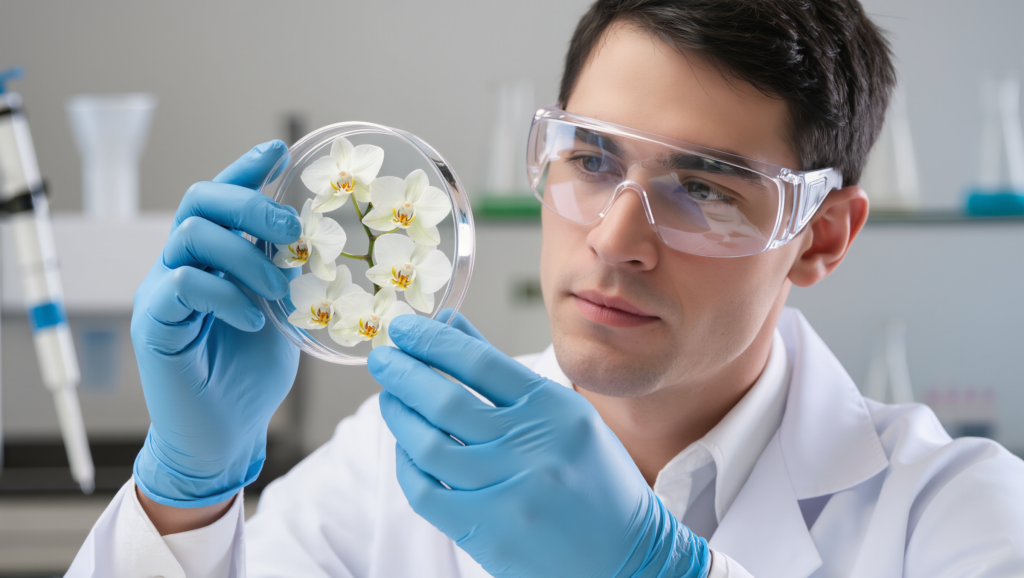
- Vanilla orchids (Vanilla planifolia) need tropical climates, shade, humidity, and hand-pollination since bees don’t do it naturally.
- Pods take 6 months to cure through sweating, drying, and fermenting—labor-intensive and weather-dependent.
- Madagascar’s cyclones, droughts, and theft spike prices: beans hit $600/kg in 2018, crashed to $50/kg recently, but volatility scares buyers.
2024 exports from Madagascar alone topped 2,400 tons in the first half, but 2025 production could drop 30% due to poor blossoming—leaving markets oversupplied short-term but tight long-term. The vanilla market’s valued at $4.11 billion in 2026, growing at 5.3% CAGR to $5.31 billion by 2031, but natural supply can’t scale fast enough.
Small farms (80% of production) face theft, climate shocks, and low incomes, pushing some to cut corners or abandon fields. Without intervention, shortages could make vanilla a “luxury flavor” by 2030.
What Makes Vanilla So Hard to Farm (And Why Lab Tech Steps In)
Vanilla’s magic is vanillin—95% of its aroma from a single phenolic aldehyde. Natural beans have trace vanillin plus 200+ compounds for nuance, but synthetics mimic it perfectly at scale.
Farming bottlenecks:
- Geography locked: Only Madagascar, Indonesia, Mexico, PNG, and China produce meaningfully (top 5 = 85%).
- Labor crisis: Hand-pollination yields ~500g/ha vs. coffee’s tons; curing needs skilled workers.
- Climate vulnerability: 2024’s heat in Indonesia hit maturity; Madagascar’s cyclones destroy 20-30% some years.
Lab-grown vanilla uses precision fermentation: yeast or bacteria engineered with vanilla orchid genes produce vanillin in tanks. Companies like:
- Conagen: Claims 95% cost reduction, pure vanillin at industrial scale.
- Amyris: Bio-vanillin for food/cosmetics, greener than petroleum synthetics.
- Evolva: Fermentation-derived, GRAS-approved for food use.
These aren’t “fake”—they’re biologically identical, often purer, without pesticides or curing waste.
Lab-Grown Vanilla: How the Tech Actually Works
Precision fermentation is like brewing beer, but for flavors:
- Gene insertion: Vanilla plant genes (for vanillin biosynthesis) go into yeast (Saccharomyces) or bacteria (E. coli).
- Fermentation: Fed sugar/molasses in vats at 30°C, microbes pump out vanillin.
- Extraction/Purification: Filtered, crystallized—pure vanillin ready for blending.
Output: tons per month vs. farms’ volatile harvests. Early pilots hit $100-200/kg; scaling drops to $20/kg—competitive with natural at $50-100/kg average.
Advantages over nature
| Aspect | Natural Vanilla | Lab-Grown |
|---|---|---|
| Yield | 7,433 tons/year global | Unlimited, consistent |
| Cost | $50-600/kg volatile | $20/kg stable target |
| Sustainability | Pesticides, water-heavy, monoculture | Uses waste sugars, low water/land |
| Quality | Variable vanillin (1-2%) | 99%+ pure, customizable |
Lab vanilla isn’t “diluted”—it’s engineered for full-spectrum profiles, blending synthetic vanillin with natural traces for “authentic” taste.
Market Forces: Why Lab Vanilla Will Dominate
The vanilla market’s exploding: $3.61B in 2024 to $5.17B by 2030 (6.2% CAGR), driven by food/bev (60% share). Natural grows at 5.89% CAGR, but synthetics/bio-vanillin lead volume.g
Forecasts:
- Vanilla extract: $5.89B (2026) to $9.27B (2033), synthetics 74.3% share.
- Global vanilla: $4.11B (2026) to $5.31B (2031), Asia-Pacific fastest at 6.52%.
Consumers want “natural,” but can’t pay premiums: bio-vanillin bridges with “fermentation-derived natural flavor” labeling (per FDA). Demand for sustainable/traceable vanilla grows, but only 15-20% certified now.
Big players (McCormick, Nielsen-Massey) test bio-vanilla; shortages push adoption. By 2030, lab-grown could claim 50%+ volume, natural as “premium.”
Taste Test: Does Lab Vanilla Really Measure Up?
Skeptics say lab lacks “complexity.” Truth: natural’s edge is subtle (200 compounds vs. vanillin’s 95%), imperceptible in most products.
Blind tests (industry reports): bio-vanillin matches natural in ice cream, beverages; outperforms synthetics (petrochem-derived). Custom strains add co-products like guaiacol for “smoky” notes.
Pros say: consistent year-round, no batch variation. In coffee/cola, difference is nil; artisanal bakeries might splurge natural.
Sustainability: Lab Vanilla’s Killer App
Natural farming’s footprint:
- Water/land: Vanilla needs 2,000mm rain/year, shade trees; monoculture erodes soil.
- Emissions: Curing’s energy-intensive; transport from Madagascar adds CO2.
- Social: Theft, low farmer pay (~$1-2/kg green beans).
Lab-grown:
- Low input: Waste sugars (molasses), CO2 capture possible.
- Scalable: 1 acre bioreactor = 100s farm hectares.
- Ethical: No exploitation; steady demand stabilizes prices.
As “clean label” rises, bio-vanillin wins: “nature-identical, fermentation-derived.”
Challenges: Regulation, Consumer Pushback, Tech Hurdles
Not smooth sailing:
- Labeling wars: “Natural” claims contested; EU/US allow “natural flavor” for fermented.
- Upfront costs: Fermenters pricey, but scale drops to $20/kg.
- Taste skeptics: Purists resist, but mass market doesn’t notice.
Farmers fear displacement, but hybrids (lab + natural traces) emerge. By 2030, dual supply likely: lab for volume, natural for prestige.
The 2030 Vanilla Landscape: What It Looks Like
- Everyday products: 70-80% lab-grown vanillin—stable, cheap ice cream/candy.
- Premium: Natural/artisanal at 5-10x markup, like extra-virgin olive oil.
- Market: $6B+, synthetics/bio dominant; Asia-Pacific leads growth.
- Innovation: Flavors like “vanilla 2.0” with amplified notes.
Verdict: Not the End, But a New Era
Natural vanilla won’t vanish—it’s too beloved for rarity. But lab-grown will save it by handling 99% demand, stabilizing prices (~$50/kg steady), and letting farms focus on quality.
Your grandkids’ vanilla shake? Lab core, natural kiss. Science doesn’t kill the flavor—it rescues it from extinction.