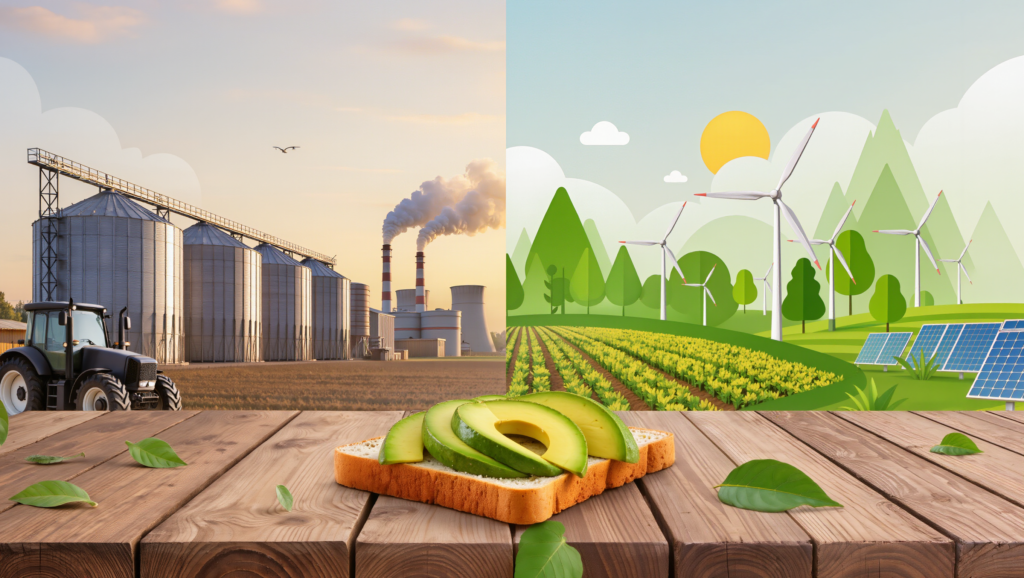












Your avocado toast is doing more than fueling your morning—it’s quietly swiping carbon from your budget. And while it’s nowhere near as bad as a steak, the combo of thirsty orchards, long‑distance shipping, and food waste means your “healthy” brunch has a bigger climate shadow than most people realize.
The good news: with a few smart tweaks, you can keep your guac and dramatically shrink its footprint without turning breakfast into a guilt trip.
How Big Is the Carbon Footprint of an Avocado?
Let’s put some numbers on the table so we’re not just hand‑waving about “impact.”
The carbon cost per fruit
Estimates vary depending on where and how avocados are grown and shipped, but several independent analyses land in the same ballpark:
- A UK assessment cited by Carbon Footprint Ltd found that two avocados (about 480 g) generate roughly 850 g CO₂‑equivalent, or ~0.42–0.45 kg CO₂e per avocado.
- A sustainability review summarizing transport data reports that truck freight from Mexico to the US adds around 2 kg CO₂e per kg of avocados—so ~0.2 kg CO₂e for a 100 g fruit just from trucking.
- A Journal of Environmental Management study (summarized by the World Avocado Organisation) estimated 2.4 kg CO₂e per kg of avocados across production, comparable to strawberries or plums and lower than raspberries or mangoes.
For perspective:
- 1 avocado ≈ 0.2–0.45 kg CO₂e in many consumer scenarios.
- 1 banana ≈ 0.08–0.11 kg CO₂e, so avocado can be roughly 2× as carbon‑intensive per piece.
- 1 kg beef can emit up to 60 kg CO₂e, dwarfing avocados by a factor of ~25–30.
So yes, your avocado has a tangible footprint—but it’s still far lower than animal products like beef, lamb, or cheese.
Where The Avocado Emissions Come From (It’s Not Just Transport)
1. Farming and water use
Avocados are thirsty and often grown in dry or stressed regions.
- Analyses of Mexican production estimate over 1,000 liters of water per kilo of avocados, with some consumer‑focused breakdowns citing ~272 liters per fruit for US‑bound avocados.
- A 2022 water‑footprint study in Europe noted that imported avocados frequently come from water‑scarce areas, magnifying local water stress and linked deforestation when orchards expand into forests.
Water use itself doesn’t emit carbon, but:
- Pumping, irrigation infrastructure, and land‑use change do.
- Deforestation to expand avocado orchards releases significant stored carbon and reduces future carbon sequestration.
This land‑use side rarely shows up on a café menu, but it’s a major part of the story.
2. Transport and “food miles”
Contrary to the myth, most avocados aren’t flown—they’re shipped or trucked.
- The World Avocado Organisation notes that European avocados are almost all shipped by sea, not air, and that sea freight emissions are 25× lower than vehicle transport and 145× lower than air freight per ton‑kilometer.
- For the US market, a typical avocado travels about 2,500 miles from Mexico by truck, generating about 2 kg CO₂e per kg of avocados just from trucking.
- A Spanish bank’s carbon footprint explainer estimates that importing a single avocado by ship generates roughly 80 g CO₂, with water and land‑use impacts on top.
Shipping is relatively efficient per kilogram, but distances add up—especially when demand drives year‑round global trade from Mexico, Peru, Chile, South Africa, and beyond.
3. Storage, ripening, and supermarket losses
Once harvested, avocados are:
- cooled
- stored in controlled‑atmosphere warehouses
- often ripened in centralized facilities using energy‑intensive systems
One lifecycle analysis estimated that in the US alone, supermarkets discard around 25,000 tons of avocado waste a year due to overripening and damage in transit. As these rot in landfills, they release methane, a greenhouse gas about 25× more potent than CO₂ over a 100‑year period.
In other words, a huge chunk of avocado‑related emissions come not from your toast, but from waste in the supply chain. Food that never gets eaten is pure climate loss.
Is Avocado Toast Worse Than a Burger?
Short answer: No.
Several independent comparisons show:
- 1 kg beef can emit 30–60 kg CO₂e, depending on production method; intensive systems are at the high end.
- Avocados, even including production and long‑distance shipping, average ~2–2.4 kg CO₂e per kg, and often less depending on the methodology.
- A UK review found one avocado ≈ 0.19–0.45 kg CO₂e, while an equivalent weight of beef comes out near 4 kg CO₂e, and cheese around 3.15 kg CO₂e.
So if your avocado toast is replacing:
- bacon, sausage, or ham at breakfast
- or a dairy‑heavy cheese toast
…you’re almost certainly reducing your meal’s carbon footprint, not increasing it.
The problem isn’t that avocados are “as bad as meat”—they’re not. The issue is that for a fruit, they’re on the high side, especially when flown or trucked long distances, and when mass demand encourages water‑stressed monocultures and waste.
Areas Where Avocados Actually Shine
To keep things balanced: avocados have some environmental upsides compared with many crops.
1. They grow on perennial trees
Avocados aren’t annuals; they grow on long‑lived trees:
- Trees may live up to 70 years, absorbing carbon and stabilizing soils.
- The World Avocado Organisation highlights that a mature avocado tree can absorb ~22 kg CO₂ per year, contributing to long‑term carbon capture.
- Perennial tree crops generally cause less soil erosion and can build soil carbon better than annual row crops when managed well.
This doesn’t erase the footprint, but it means a well‑managed orchard can be a carbon sink and food source, compared with bare annual fields.
2. Their footprint is modest among “indulgent” foods
When compared with other high‑value or trendy foods:
- Avocados have a carbon footprint ~25× lower than beef, ~10× lower than lamb or cheese, and ~7× lower than coffee per kilo.
- Their footprint is comparable to other imported fruits like berries and mangoes, and in some analyses lower than raspberries.
So if you’re making climate swaps, cutting red meat and high‑impact dairy will almost always matter more than cutting the one avocado on your weekend toast.
The Real Issue: Scale, Seasonality, and Waste
What turns your toast into a climate concern is less the single fruit and more the system that keeps it on your plate all year.
- Year‑round demand pushes production into increasingly marginal, water‑stressed regions, with accompanying deforestation and water conflicts.
- Just‑in‑time ripening means retailers over‑order and over‑ripen, leading to massive waste when demand or timing is off.
- Consumers treat avocados as disposable: buy three, throw one or two away when they go brown—effectively doubling the per‑eaten‑avocado footprint.
This is where you, as the eater, have real leverage.
How to Shrink the Carbon Footprint of Your Avocado Toast
You don’t need to break up with avocado; you just need to get smarter about when, where, and how you buy and eat it.
1. Buy fewer, but make sure you eat them
The single biggest win: stop wasting them.
- If you routinely throw avocados out, you’re effectively doubling or tripling the emissions per actual serving you eat.
- Plan backward from when you’ll eat them: buy different ripeness levels (one ripe today, one firm for later).
- Store ripe avocados in the fridge to slow ripening and buy yourself several extra days.
Given the methane punch of landfill food waste, eating every avocado you buy may be more impactful than agonizing over its country of origin.
2. Choose regional or closer‑grown avocados when possible
If you live somewhere that produces avocados (Spain, southern United States, parts of South America and Africa, etc.):
- Choose regionally grown avocados over very long‑haul imports.
- A Spanish carbon‑footprint breakdown notes that importing Mexican avocados adds significant emissions and suggests locally grown Spanish avocados as a lower‑impact choice for European consumers.
- Climate tools show that avocados grown in Spain for the local market can have a footprint as low as 0.29 kg CO₂e per kg, in part due to minimal transport.
You don’t need to be perfect about this, but defaulting to closer sources where labeled chips away at transport and cold‑chain emissions.
3. Treat avocados as a sometimes fruit, not a staple in winter
Seasonality matters:
- Peak seasons in your region or nearest producer often mean more efficient shipments, less storage, and lower spoilage.
- Off‑season avocados tend to travel further or sit longer in energy‑hungry storage and ripening facilities.
Practical move:
- Enjoy avocado toast as a highlight, not a daily non‑negotiable.
- In low‑season months, rotate in lower‑impact spreads: hummus, local nut/seed butters, mashed beans, or seasonal roasted veg.
You’ll spread your carbon load across more sustainable options without giving up the treat entirely.
4. Pair avocados with low‑impact, plant‑forward toppings
The footprint of “avocado toast” is not just the avocado.
You can keep the avocado and still slash the plate’s emissions by:
- skipping bacon, smoked salmon, or heavy cheese toppings, which drastically raise total CO₂e
- using whole‑grain local bread instead of imported, long‑shelf‑life ultra‑processed loaves
- building the rest of the plate around legumes, seasonal veg, and local greens
Given that beef and lamb can have footprints 10–25× higher per kilo, swapping animal toppings for plant‑based ones has more impact than skipping the avocado.
5. Support better farming, not just better transport
When you have the option:
- Look for certifications or producer info that emphasize water stewardship, agroforestry, or diversified orchards, not just large monocultures.
- Some experimental systems in Europe are exploring avocado greenhouses heated with waste heat to cut both water and carbon footprints.
These aren’t yet mainstream, but directing your money toward producers who talk openly about water and land use encourages practices that matter more than shaving 100 km off shipping.
Smarter Toast: Putting It All Together
If you want to keep eating avocado toast and still sleep at night, a realistic “low‑guilt” pattern might look like this:
- 1–2 times per week, not every day.
- Buy only what you know you’ll use in 3–5 days; refrigerate when ripe.
- Favor regional or closer‑grown avocados when labeled.
- Top with plant‑based extras (chickpeas, tomatoes, sprouts, herbs) instead of meat or heavy cheese.
- Offset by keeping the rest of your week’s meals lower‑carbon: more legumes, grains, seasonal plants; less beef, lamb, and cheese.
In that context, your avocado toast looks less like a climate villain and more like a small indulgence inside a generally climate‑sane diet.
The Real “Shocking” Part
The carbon footprint of your avocado toast is not trivial—but it’s also not the biggest thing on your plate.
What’s genuinely shocking is how much you can do without giving it up:
- Stop wasting avocados.
- Eat them less often and more intentionally.
- Pair them with lower‑impact foods.
- Nudge your buying toward closer, better‑grown fruit where you can.
Most of your personal food‑carbon wins will still come from eating fewer high‑impact animal products, wasting less food overall, and cooking more plant‑rich meals. Within that bigger picture, a thoughtfully chosen avocado on your toast becomes a manageable luxury, not a climate catastrophe.