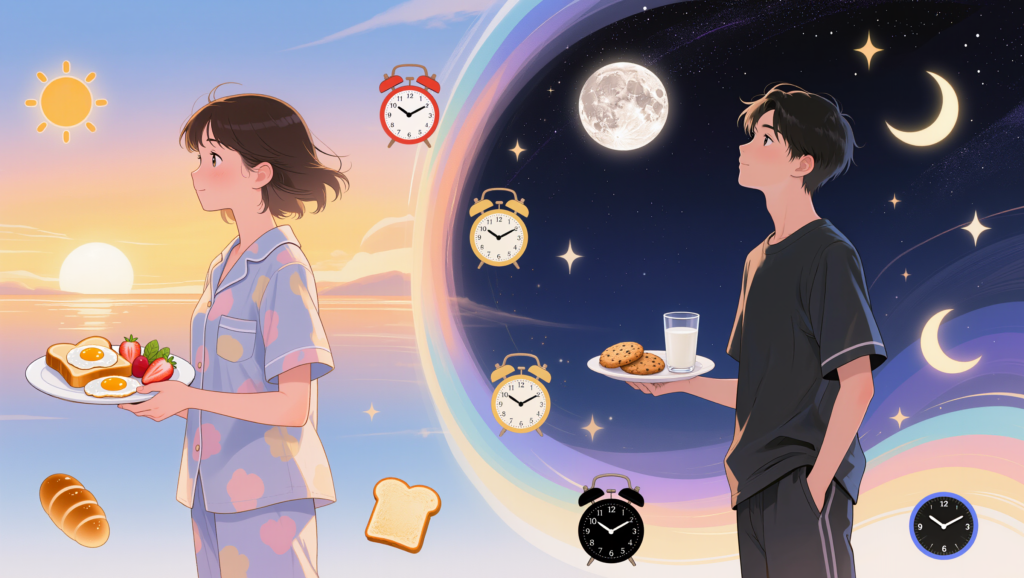












Your sleep chronotype—whether you’re an early bird, night owl, or somewhere in between—isn’t just about when you like to sleep. It quietly shapes what you crave, when you eat, and how your body handles those calories. That means your chronotype should absolutely influence your recipes, meal timing, and even macronutrient balance. Ignoring it is like running your metabolism permanently out of sync.
Research in the growing field of chrononutrition shows that morning and evening types consistently eat differently, respond differently to the same foods, and carry very different risks for weight gain, blood sugar issues, and metabolic disease. Let’s unpack what that means—and how to eat like your internal clock actually matters.
Chronotype 101: Why Your Body Clock Belongs in Your Meal Plan
Your chronotype is your biological tendency to wake, feel alert, and get sleepy at certain times:
- Morning type (“lark”) – naturally up early, peak focus earlier, prefer earlier bed and meal times.
- Evening type (“owl”) – naturally alert later, prefer late nights and later meals.
- Intermediate – somewhere in the middle.
Chronotype is biologically driven (genes, hormones, light exposure), but modern life forces many of us into schedules that don’t match our clock. That mismatch—called social jetlag—is strongly linked with worse diet quality, higher BMI, and metabolic issues.
A large systematic review concluded that chronotype meaningfully influences food choice, meal timing, diet quality, and metabolic health, and that personalized meal plans should consider it.
How Early Birds and Night Owls Actually Eat (According to Data)
Across studies in adults, children, and different cultures, consistent patterns emerge.
Morning types (early birds) tend to:
- Eat earlier in the day and have an earlier “last meal.”
- Have more regular meal timing.
- Consume:
- More total carbohydrates and fiber
- Less saturated fat and animal protein
- More whole‑grain staples (like bread in some cohorts)
- Show better metabolic markers: lower BMI, waist circumference, fasting glucose, and triglycerides, and better overall metabolic health—even after adjusting for age and lifestyle.
Evening types (night owls) tend to:
- Eat later (including late‑night snacks).
- Have more irregular eating patterns, often skipping breakfast and “catching up” at night.
- Prefer:
- Higher fat and animal protein
- More added sugar and sugary foods
- Fewer vegetables and less fiber
- Are more likely to be overweight/obese and metabolically unhealthy (higher triglycerides, glucose, and waist circumference).
- Show higher social jetlag (bigger mismatch between preferred and actual schedules), which independently relates to poor diet and weight gain.
One review described evening types as less likely to follow an “antioxidant‑rich” pattern and more likely to fall into a “high‑fat” or low‑quality pattern, even when calorie intake is similar.
Translation: your chronotype quietly pushes you toward certain timing and types of food. If you don’t compensate for that, your recipes and habits can work against your biology.
Why Chronotype + Food Timing Matter for Metabolism
It’s not just what you eat, but when you eat relative to your clock.
Key concepts:
- Your circadian system sets daily rhythms of insulin sensitivity, gut motility, digestion, and hunger hormones.
- You’re generally more insulin‑sensitive earlier in the day and less able to handle large carb loads late at night.
- Eating out of sync with your internal clock is tied to higher obesity risk, elevated blood sugar, and dyslipidemia—even with similar calories.
Morning types naturally line up meals with their most metabolically favorable hours—big advantage. Evening types often eat heavily during their biological “night”, when metabolism is sluggish and glucose handling is worse.
This is why studies repeatedly associate evening chronotype with:
- Higher sugary food and lower vegetable and fiber intake—even in preschoolers.
- Greater odds of metabolic syndrome and poorer metabolic profiles in adults.
So no, early birds and night owls should not eat the same way—or at the same times—if they want to optimize health.
How Your Chronotype Should Dictate Your Recipes and Eating Style
Now the practical part: how to actually eat in a chronotype‑smart way.
If You’re a Morning Type: Front‑Load the Good Stuff
Morning types already have some metabolic tailwinds, but they can still sabotage themselves with ultra‑processed foods or under‑eating early.
What research suggests suits early birds:
- You tolerate more carbs earlier in the day and naturally eat earlier.
- You often have a more “balanced” pattern with higher fiber and lower fat.
- Your last meal tends to be earlier, which aligns well with circadian metabolism.
Morning‑type strategy
1. Make breakfast and lunch your power meals.
Aim for:
- A high‑fiber, moderate‑protein breakfast: oats with nuts and berries; eggs with whole‑grain toast and veggies.
- A carb‑inclusive lunch anchored in whole grains, legumes, and plenty of plants.
Morning chronotypes in one study ate more carbs and fiber and less fat overall, and had better metabolic health markers.
2. Keep dinner lighter and earlier.
You’re naturally inclined to eat earlier—lean into that. Aim for:
- A lighter, earlier dinner (3–4 hours before bed), focusing on vegetables, lean protein, and modest carbs.
- Minimal late‑night snacking; use herbal tea or a small protein‑rich snack if needed.
3. Don’t fear carbs—but choose quality.
Data suggest early birds can do well with a higher percentage of calories from carbs, especially whole‑food ones, without the same metabolic penalty seen in late‑night carb eaters. So:
- Emphasize whole grains, beans, fruit, and starchy veg.
- Limit refined carbs and added sugars, especially outside the first half of the day.
Sample early‑bird day
- Breakfast 7:00: Greek yogurt or tofu, berries, chia, oats
- Lunch 12:00: Lentil or quinoa bowl with veg and olive oil
- Snack 15:00: Apple + nuts
- Dinner 18:00: Baked fish or tempeh, lots of veg, small serving of brown rice
If You’re an Evening Type: Tighten Timing and Upgrade Late‑Day Choices
Night owls face more friction: biology pushes them later, while social schedules often force early alarms. That combo is linked with later eating, more sugar, and higher metabolic risk, even in kids.
But you can design recipes and routines that work with your preferences and protect your metabolism.
What the research shows about evening types:
- More prone to higher added sugar and lower vegetable and fiber intake.
- More likely to skip or skimp breakfast and overcompensate at night.
- Tend toward higher fat and animal protein and lower adherence to Mediterranean‑style patterns.
- Have higher odds of overweight/obesity and unfavorable metabolic markers.
Night‑owl strategy
1. Protect your first meal, even if it’s late.
If you naturally rise later, your “breakfast” might be at 9–10 a.m. That’s fine—but don’t skip it. When owls skip breakfast, studies show they compensate with more sugary and fatty foods later.
Your first meal should be:
- High in protein and fiber to stabilize cravings: think veggie omelet, tofu scramble, chia pudding with nuts and berries.
- Lower in refined carbs and sugar.
2. Shrink the late‑night sugar/fat bomb.
Evidence from children to adults shows that later chronotypes gravitate toward sugary snacks and lower veggie intake, especially later in the day. You can’t change the tendency, but you can swap what’s available:
- Pre‑prep evening‑friendly recipes: hearty vegetable soups, bean stews, roasted chickpeas, air‑popped popcorn, Greek yogurt with cinnamon.
- Make your go‑to “late” foods at least high‑protein, high‑fiber, low‑sugar.
3. Gradually drag dinner earlier (within reason).
You probably won’t become a 5 p.m. eater, but even moving your main meal 30–60 minutes earlier and closing the kitchen 2–3 hours before sleep can help align eating with your internal clock and improve metabolic markers.
4. Lean harder into Mediterranean‑style patterns.
Studies find evening types are less likely to adhere to Mediterranean diets and less likely to consume antioxidant‑rich, plant‑dominated patterns. That means you benefit even more from:
- Extra vegetables at every meal
- Swapping red/processed meat for fish, legumes, tofu
- Using olive oil instead of butter or shortening
- Adding nuts, seeds, herbs, and spices generously
Sample night‑owl day
- First meal 10:00: Veggie scramble with beans or tofu + whole‑grain toast
- Mid‑afternoon 14:00–15:00: Lentil salad or leftover grain bowl
- Early evening 19:00: Large Mediterranean‑style dinner (fish/legumes, lots of veg, whole grain)
- Optional late snack 21:30: Greek yogurt or hummus + veg instead of cookies or chips
Same calories as a typical day—but radically different metabolic impact.
Why Sleep Chronotypes Matters for Weight, Hormones, and Long-Term Health
A 2024 study in a Ukrainian cohort found that morning chronotypes had lower BMI, waist circumference, fasting triglycerides, and glucose, and better overall metabolic health—even after adjusting for age, sex, and activity. Importantly, morning types:
- Ate earlier
- Consumed more carbs and fiber and less fat and animal protein
- Had an earlier last eating occasion
A systematic review comparing morning and evening types concluded that evening types are more likely to be overweight/obese and metabolically unhealthy, and that chronotype should be considered in long‑term diet planning.
Even in preschoolers, those with an evening tendency consumed more added sugar and fewer vegetables and fiber, independent of sleep duration and physical activity. That suggests chronotype‑linked diet risk starts early—and that tailoring food environments early could help.
How to Start Eating With Your Chronotype (Without Going Crazy)
You don’t need a lab test to act on this. Use these simple steps:
- Identify your bias.
- Do you naturally wake refreshed before the alarm and get sleepy early? You’re likely a morning type.
- Do you get your best ideas at 10 p.m. and loathe early mornings? You’re probably an evening type.
- Align your biggest, healthiest meal with your best metabolic window.
- Morning types: front‑load breakfast and lunch; keep dinner simple and earlier.
- Evening types: protect a solid first meal and shift some calories earlier in the day instead of back‑loading everything.
- Use recipes that match your vulnerable times.
- If your danger zone is late evening, batch‑cook high‑protein, high‑fiber, low‑sugar options for that slot.
- If mornings are rushed, prep overnight options (chia puddings, hard‑boiled eggs, oat jars) so you don’t skip and then binge at night.
- Mind the clock, not just the macros.
- Prioritize at least 2–3 hours between last bite and sleep, especially if you’re an evening type.
- Try to keep a consistent eating window (e.g., 8–10 hours) that respects your chronotype instead of fighting it.
- Refine, don’t reinvent.
- Keep your favorite foods; shift when and how much you eat them.
- For example, night owls can still enjoy carbs—just move more of them earlier and pair them with protein and fiber.
The Bottom Line: Your Diet Should Be on Your Clock, Not the Other Way Around
Early birds and night owls live on different circadian schedules—and your metabolism knows it. Studies consistently show that morning types naturally gravitate toward earlier, higher‑fiber, lower‑fat intake and have better metabolic profiles, while evening types favor later, higher‑fat, higher‑sugar patterns and face more metabolic risk.
You can’t change your core chronotype easily—but you can:
- Time meals more intelligently
- Adjust recipes to your weak spots (late snacking vs. early skimping)
- Choose macros and food quality that support, rather than fight, your clock
When your recipes and routines start to match your biological rhythm, you stop white‑knuckling your appetite and start letting circadian biology work for you. That’s chrononutrition in real life—and a smarter way to eat for energy, weight, and long‑term health.
- https://pmc.ncbi.nlm.nih.gov/articles/PMC10757331/
- https://pmc.ncbi.nlm.nih.gov/articles/PMC9356714/
- https://pmc.ncbi.nlm.nih.gov/articles/PMC6981497/