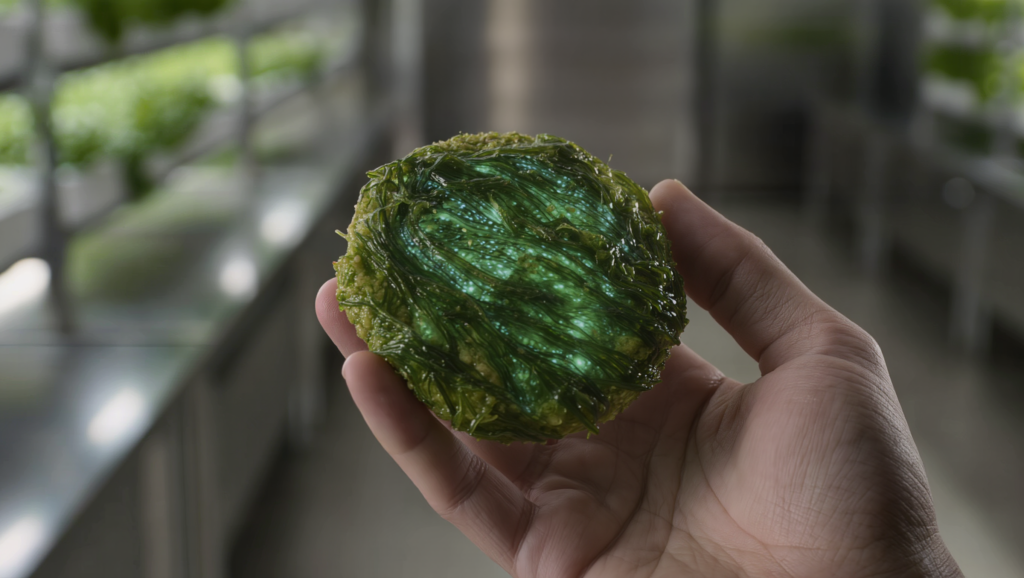












By 2050, it’s very likely your grandkids will think nothing of ordering an algae burger that’s neon‑green, subtly ocean‑umami, and grown in a vertical tank rather than a pasture. It sounds sci‑fi, but algae is quietly moving from supplement shelves into the center of the plate—driven by hard numbers on climate, land use, nutrition, and food security, not just foodie curiosity.
Global market reports show algae products and algae proteins growing steadily as mainstream food ingredients, with strong interest from big food, biotech, and climate‑focused investors. At the same time, researchers argue that replacing even a slice of livestock production with algae could help feed 10 billion people while dramatically shrinking agriculture’s environmental footprint. Put simply: algae burgers solve problems that beef burgers create—and that’s why they’re coming for your bun by mid‑century.
Let’s unpack the science and economics behind that future menu.
Why Humanity Needs a New Type Of Burger by 2050
By 2050, we’re projected to have 9–10 billion people on the planet, all needing protein, calories, and micronutrients. If we try to meet that demand using the current, meat‑heavy system, we run into some ugly math:
- Conventional livestock—especially beef—uses huge amounts of land, water, and feed, and is a major source of greenhouse gases like methane and nitrous oxide.
- There simply isn’t enough arable land to scale cattle, soy, and maize the way we have been and keep biodiversity and climate within safe limits.
That’s why climate‑food reports keep circling back to “alternative proteins”: lab‑grown meat, insects, mycelium, and yes, microalgae.
One modeling study found that shifting a significant portion of global protein production from livestock to algae could feed 10 billion people with far less land and water, while slashing agricultural emissions. That alone explains why algae patties are suddenly interesting to governments and big food companies—not just health
What Exactly Is an Algae Burger?
We’re mostly talking about microalgae here: microscopic, single‑celled organisms like Chlorella, Spirulina and others, grown in bioreactors or ponds.
When you make a “burger” from algae, you’re usually combining:
- Algae protein (concentrates or isolates)
- Algae oils (rich in omega‑3s), fibres and pigments
- Plant binders (pea protein, starches, fibres)
- Flavourings and colours (often also algae‑derived)
The “glow” is only half a joke: some algae naturally carry intense green, blue‑green, or even reddish pigments—phycocyanin, chlorophylls, carotenoids—that can make patties look more sci‑fi than brown. Companies can dial that up or down, but visually distinct algae burgers are very possible.
Unlike soy or wheat patties, algae burgers start from a water‑grown organism that doesn’t need soil, ploughs or pesticides and can be produced year‑round in enclosed systems.
The Nutrition Play Of Algae: Tiny Organisms – Huge Nutrient Density
Algae are nutritional overachievers. Market and science reports highlight that algae proteins are:
- Rich in complete protein, with all essential amino acids.
- High in omega‑3 fatty acids (especially certain species used for DHA and EPA).
- Packed with antioxidants, pigments, vitamins and minerals often missing in typical diets.
A 2025 market analysis describes algae protein as “rich in essential amino acids, omega‑3 fatty acids, and antioxidants,” and notes growing use in plant‑based meat alternatives and functional foods because of this dense profile.
Microalgae‑based foods are being positioned as functional foods—not just calorie sources, but carriers of bioactive compounds that can support heart, brain and metabolic health. That’s a very different story from conventional burgers, which are often high in saturated fat, with little fibre and limited
By 2032, the global microalgae food market alone is projected to almost double (from around USD 670 million to about USD 1.3 billion), with strong growth driven by its use in snacks, drinks, and meat alternatives. Algae protein as a category is forecast to grow from roughly USD 884 million in 2025 to about USD 1.54 billion by 2035, with a CAGR of ~5.7%.
The Earth loves algae. Your grandkids’ diet will, too.
The Climate & Land‑Use Side: Why Algae Wins on Resource Efficiency
If we only cared about protein grams, algae would already be a star. But the real reason it’s being groomed as a 2050 staple is resource efficiency.
Analyses of algae farming vs traditional agriculture show:
- Algae can produce far more protein per hectare than soy, peas, or livestock—often in non‑arable land (deserts, coastal zones) using brackish or seawater.
- Algae farming can be vertically stacked and located close to cities, cutting transport and storage costs.
- Some algae cultivation systems can be carbon‑negative—using CO₂ from industrial sources as feedstock and locking it into biomass.
- Water use per unit of protein can be drastically lower than for beef or even some plant crops.
A 2025 popular science piece summarised modeling work arguing that replacing a portion of global livestock with algae could free up huge swaths of grazing land and significantly reduce deforestation and emissions, while still meeting protein needs for 10 billion people.
Market outlooks line up with this: one forecast for algae products overall projects the sector growing from about USD 5.85 billion in 2025 to over USD 10.28 billion by 2035, driven by demand for sustainable ingredients in food, fuels and materials. Another report projects the broader algae products market reaching around USD 5.8 billion by 2031, with major players like Cargill, ADM, BASF and DSM already involved.
When the same big firms that supply soy and corn ingredients start betting on algae, you can assume burgers made from this stuff won’t remain niche.
Consumer Psychology: Will People Actually Eat Green Burgers?
Right now, consumer research says people are… cautiously curious.
A European study on algae burgers found that consumers expect them to be healthier and more environmentally friendly than beef burgers—but also less tasty. That’s the big hurdle: taste and texture.
But those perceptions tend to shift once products become more common and formulation improves. We’ve seen the same curve for:
- Plant‑based burgers (initially “cardboard,” now widely accepted).
- Sushi (once seen as “raw fish weirdness,” now mainstream).
- Soy milk and oat milk (from health‑store oddities to café defaults).
According to market analyses, food and beverage companies are already weaving algae proteins into:
- Plant‑based meat alternatives
- Protein snacks and bars
- Functional beverages
- 3D‑printed foods and personalised nutrition products
The more algae quietly appears in familiar formats (nuggets, patties, mince), the less mental friction your grandkids will have. They may well grow up with algae burgers the same way many of us grew up with soy burgers: just another option in the freezer aisle.
How Tech Is Making Algae Burgers Better (and Cheaper)
Algae burgers in 2050 won’t be the same slightly fishy patties you might imagine now. The technology pipeline is intense.
Analysts predict that between 2025 and 2035, algae protein production will be transformed by:
- Precision fermentation – using engineered microbes and algae to boost protein yields and tune flavour profiles.
- AI‑driven bioprocess optimisation – algorithms managing light, nutrients, CO₂ and harvesting to maximise efficiency and cut costs.
- Autonomous algae farms – IoT‑enabled bioreactors, real‑time nutrient and growth monitoring, and self‑adjusting systems.
- Decentralised production hubs – localised, modular units that can supply cities or regions without relying on long supply chains.
One report describes future algae production as “fully autonomous algae farms, IoT‑enabled bioreactors, and real‑time nutrient optimisation with AI,” combined with decentralised, carbon‑negative operations.
All that tech matters because right now, algae still faces high production costs and scalability challenges, which analysts explicitly flag as a key constraint. Automation, better strains, and bigger scale are the levers that will make algae patties price‑competitive—even cheaper than beef—in the long run.
By the 2040s, when lab‑grown meat is predicted to potentially hold a third of the meat market, algae protein is expected to be fully integrated into mainstream meat alternatives and functional foods, not just niche superfood powders.
How Algae Burgers Will Likely Fit Into Everyday Life
So what does a 2050 algae burger world actually look like?
Based on current trends and forecasts:
- Fast food chains: Offer algae‑based patties as default or on par with beef, marketed as “climate‑smart” with ocean‑green branding and boosted omega‑3.
- School and hospital menus: Use algae burgers where nutrition per penny matters—high protein, high micronutrients, low environmental impact.
- Home cooking: Frozen algae mince, burgers, and nuggets become normal, especially in regions where climate policies or prices nudge people away from red meat.
- Personalised nutrition: AI‑optimised algae blends—higher in specific amino acids, omega‑3, or fibre—show up in meal plans and 3D‑printed foods tailored to your microbiome, age, or activity level.
The “glow” factor might become a feature, not a bug: brands could lean into luminous colours from natural algae pigments as visual proof of “alive,” nutrient‑dense, future‑friendly food—like the next step after spirulina smoothies.
Why 2050 Burgers Won’t Look Like Today’s Beef
Your grandkids’ glowing algae burgers will be different on purpose:
- Shorter supply chains – grown in local bioreactors, not shipped from distant feedlots.
- Transparent traceability – some analysts even envision blockchain‑secured sourcing and real‑time quality monitoring for algae ingredients.
- Custom nutrient profiles – not just protein and fat, but tailored micronutrients, added fibre, and bioactives for heart, brain, or gut health.
- Climate labelling – menus showing carbon and water footprints, where algae products clearly outperform beef.
When you put all of this together—resource efficiency, climate advantages, nutrient density, tech‑driven cost drops, and growing consumer openness—it becomes hard to imagine a 2050 food system without algae-based burgers taking a meaningful share of the market.
They won’t replace every steak or smash burger. But as the default, everyday patty in cafeterias, fast food, meal kits, and global school programs? That’s exactly where algae shines.
And yes, some of them will probably glow a little. Not because the future is fake, but because we finally leaned into one of nature’s oldest, tiniest, most efficient food factories—and taught it to sit happily between two buns.