











Remote work was supposed to free us from the worst parts of office life. In some ways, it did. But for a lot of people, the home office quietly swapped one set of problems for another: less walking, more snacking, worse posture, blurred meal boundaries, and a creeping sense that the day is always “on.” Over time, that combination can absolutely make you feel worse.
The short version is this: your home office can sabotage movement and nutrition in ways that slowly chip away at energy, metabolism, and mood. The fix isn’t to abandon remote work. It’s to redesign the way you work, eat, and move so your body doesn’t get trapped in a chair all day.
Why Remote Work Feels So Good at First
Remote work removes commuting, bad office coffee, random interruptions, and the weird social theater of the workplace. That’s the pleasant part. The less pleasant part is that a lot of the built-in movement of office life disappears too. No walking to meetings. No stairs to the break room. No commute. No lunch trip. No natural time stamps that tell you when to stand up, eat, or stop working.
At home, the body can drift into a very efficient but very unhealthy pattern:
- Wake up.
- Sit down.
- Work.
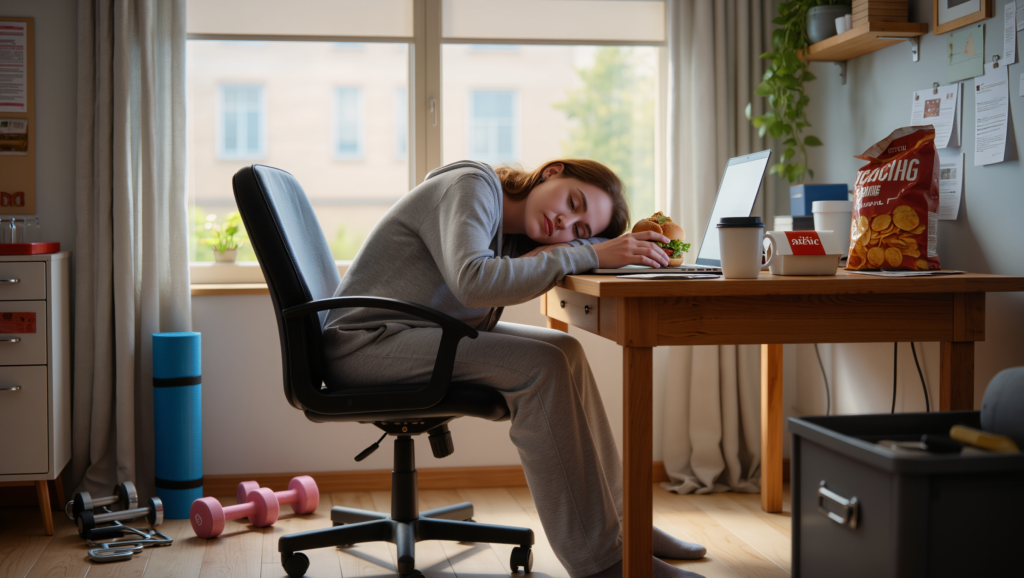
- Eat near the computer.
- Keep working.
- Snack because food is nearby.
- Move less because nothing forces movement.
- Finish the day feeling oddly tired, bloated, and mentally flat.
That doesn’t sound dramatic, but it matters. Bodies are pattern machines. If you repeat a low-movement, high-snacking schedule five days a week, the effects add up.
The Movement Problem: Sitting Is Sneakier at Home
One of the biggest remote-work problems is that sedentary time becomes invisible. In an office, you may at least walk between rooms, stand for meetings, or leave the building for lunch. At home, you can go from bed to desk to sofa with almost no steps in between.
That matters because the body is designed to benefit from frequent movement, not just a single workout at night. Long, uninterrupted sitting is linked to poorer glucose control, weaker circulation, stiffness, and lower energy. Even if you exercise for 30 or 60 minutes, that doesn’t fully cancel out eight or ten hours of sitting.
Remote work also encourages what I’d call “accidental stillness”:
- You stay seated because your setup is comfortable.
- You skip walking because you’re already home.
- You delay standing because you don’t have a reason.
- You snack instead of taking a break.
- You keep working because there’s no commute to end the day.
The body interprets that as a low-demand environment. Over time, that can mean lower calorie burn, worse glucose handling, and more fatigue.
The Nutrition Problem: Your Kitchen Is Too Close
If the office pantry is dangerous, the home kitchen can be downright treacherous. At home, you have constant access to food with no natural separation between work and eating. That sounds convenient, but convenience is often the enemy of structure.
When the kitchen is steps away, people are more likely to:
- Eat without planning.
- Snack out of boredom, stress, or habit.
- Choose quick foods instead of balanced meals.
- Eat while working.
- Lose track of portions.
- Keep drinking coffee instead of eating real food.
The result is often not “too much food” in one obvious meal, but a pattern of loosely structured eating that leaves you undernourished in some ways and overfed in others. You might not be getting enough protein, fiber, or micronutrients, but you’re still taking in a steady stream of easy calories.
That pattern can lead to:
- Afternoon crashes.
- More sugar cravings.
- Mood swings.
- Brain fog.
- Weight gain over time.
- A weird sense of being both full and unsatisfied.
Why Remote Work Makes You Eat Worse
A lot of remote workers don’t actually eat more because they’re hungrier. They eat differently because their environment is less structured.
Here’s what often happens:
- Breakfast gets skipped or replaced by coffee.
- Lunch is eaten late and rushed.
- Snacks appear between meetings.
- Dinner is bigger because the day felt chaotic.
- Food becomes a coping mechanism for stress, boredom, or loneliness.
This is less about lack of discipline and more about environmental design. In an office, eating has boundaries. At home, those boundaries dissolve. You can start work early, eat whenever, and keep going until evening without a clear pause.
That makes it harder to notice true hunger and fullness. Instead of eating because your body needs fuel, you eat because the food is there, the day is stressful, or your brain wants a break.
The Hidden Energy Drain
People often assume remote work should make them healthier because it saves time. But saving time isn’t the same as supporting health. If that saved time turns into more sitting, more screen exposure, more stress, and less food structure, your body can end up paying for it.
The first thing many remote workers notice is fatigue. Not the “I need sleep” kind only, but the drained, flat, unmotivated feeling that comes from too little movement and too many unstructured meals. When you sit too much and eat too randomly, energy regulation gets messy.
You may also notice:
- Neck and back pain.
- Slower digestion.
- More bloating.
- Afternoon sugar cravings.
- Trouble focusing.
- Restless sleep.
That’s the body telling you the setup is off.
The Meal Boundary Problem
In a healthy workday, meals act like anchors. They tell the body and brain that one phase of the day is over and another is beginning. Remote work often destroys those anchors.
Instead of breakfast, lunch, and dinner being clear events, they become blurred and flexible:
- You eat at the desk.
- You answer emails while chewing.
- You snack during calls.
- You delay lunch because you’re in flow.
- You graze after dinner because your work brain never shut off.
This blurring matters because digestion works better when the nervous system is not constantly in work mode. Eating while distracted also makes it easier to overeat or feel unsatisfied. The body likes rhythm. Remote work often replaces rhythm with drift.
The Mental Side: Stress Eating and Decision Fatigue
Remote work can also increase stress eating in a subtle way. Without the social structure of an office, some people feel isolated or mentally “always on.” Others feel pressure to prove they’re working enough, which leads to longer hours and fewer breaks.
That creates decision fatigue. By mid-afternoon, you may not have the mental energy to plan a real meal or step away from your computer. So you grab whatever is easiest. Often that means ultra-processed foods, leftover sweets, or another coffee instead of actual nourishment.
This isn’t because remote workers are lazy. It’s because cognitive load changes behavior. When the brain is overloaded, it defaults to whatever is quickest, most available, and most rewarding.
What a Remote Work Health Collapse Looks Like
A lot of people don’t notice the damage because it creeps in slowly. You don’t wake up one day and feel like remote work ruined your health. It happens in layers.
You may start out fine, then gradually notice:
- You walk less.
- You snack more.
- You drink more coffee.
- You eat lunch later and later.
- Your sleep gets lighter.
- Your posture gets worse.
- Your clothes fit differently.
- Your energy dips after meals.
- Your motivation to exercise drops.
That’s not random. It’s the predictable effect of a low-structure environment on movement and nutrition.
How to Fix the Remote Work Movement Problem
The solution is not to become a fitness extremist. It’s to rebuild movement into your day in small, repeatable ways.
Try this:
- Stand up every 30–45 minutes.
- Walk for 3–5 minutes after meals.
- Take calls while walking if possible.
- Put your printer, water, or trash can farther away on purpose.
- Use a timer for stretch breaks.
- Add one short morning walk before work.
- Treat lunch as a real pause, not a desk event.
The goal is to break the “all-day sitting” pattern. Even small movement snacks matter because they interrupt the sedentary trap and help reset your brain.
How to Fix the Remote Work Nutrition Problem
Remote work gets much better when meals have structure again.
A few practical rules:
- Eat at roughly the same times each day.
- Don’t work through lunch.
- Keep protein at every meal.
- Make fruit, nuts, yogurt, and whole-food snacks more visible than chips and sweets.
- Avoid eating directly from containers while working.
- Put a hard stop between work and dinner.
A solid remote-work meal pattern might look like:
- Breakfast with protein and fiber.
- Lunch away from the screen.
- One or two planned snacks.
- Dinner not too late.
- Minimal mindless grazing after work.
If you work from home most days, your kitchen needs to function like part of your health strategy, not like a 24/7 vending machine.
Design Your Home Like a Worksite, Not a Lounge
This is the biggest mindset shift. If your home office is too cozy, too convenient, and too close to the kitchen, you will start living in a low-movement, high-snacking loop.
A better setup includes:
- A real desk and chair, not the sofa.
- Water within reach, but food out of reach.
- Clear work hours.
- A space for meals that is not the desk.
- Good lighting so your body knows when it’s daytime work.
- A visible reminder to stand, stretch, or walk.
You don’t need a perfect office. You need an office that doesn’t make health harder than it has to be.
Why This Matters Long-Term
The consequences of remote-work habits are not just cosmetic. A body that moves less and eats less intentionally tends to become less metabolically flexible. That means energy crashes hit harder, recovery gets worse, and weight management becomes more difficult.
The good news is that the damage is reversible if you catch it early. Most of the problem is behavioral and environmental, which means the same thing that caused it can also fix it. If your space pushes you toward sitting and snacking, redesign the space so it pushes you toward standing, walking, and real meals instead.
The Bottom Line
Remote work is not the villain. The unstructured remote-work lifestyle is. If you don’t deliberately build movement and nutrition back into the day, your home office can quietly make you feel worse over time.
The fix is simple, but not effortless:
- Move more often.
- Sit less continuously.
- Eat with structure.
- Stop working through meals.
- Separate work from food.
- Design your home so healthy behavior is easier than lazy behavior.
That’s how you keep the flexibility of remote work without letting it slowly wreck your body.