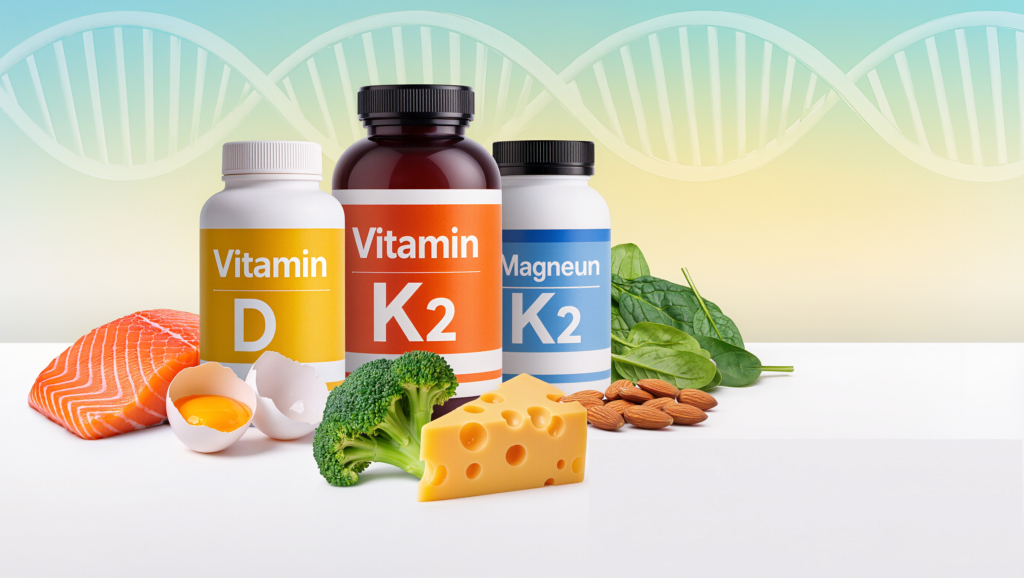












Most people treat vitamin D like a solo hero: test your levels, pop your D3, and wait for your mood, immunity, and bones to magically improve. But biologically, vitamin D is more like the lead singer in a band—it only really works when vitamin K2 and magnesium are playing in sync behind it. Taken in isolation and at high doses, vitamin D can even create new problems with calcium and heart health if the other players are missing.
Here’s the core idea:
- Vitamin D pulls more calcium into your bloodstream and turns on genes that make calcium‑handling proteins.
- Vitamin K2 activates those proteins, so calcium goes into bone and teeth instead of arteries and soft tissues.
- Magnesium is the cofactor for every major enzyme that activates and transports vitamin D; without enough magnesium, vitamin D can’t be properly converted or used.
Let’s break down why D, K2, and magnesium belong together, what the science actually says, and how to use them intelligently (without falling for fear‑based “you’ll calcify overnight” marketing).
What Vitamin D Does For The Body (And Why It’s Not Enough Alone)
Vitamin D exists mostly in two forms in your body:
- 25(OH)D – the storage form made in the liver.
- 1,25(OH)₂D – the active hormone made mainly in the kidney, which binds to vitamin D receptors and regulates gene expression.
Active vitamin D:
- Increases calcium and phosphate absorption from the gut.
- Influences bone remodeling, immune function, muscle, and brain health.
- Up‑regulates the production of several vitamin‑K–dependent proteins like osteocalcin (in bone) and matrix Gla protein (MGP) (in vessels).
That last bullet is crucial. Vitamin D increases the quantity of these proteins, but they’re inactive until vitamin K2 “switches them on” via carboxylation.
So if you supplement vitamin D heavily in a context of low K2, you can end up with:
- More calcium circulating.
- More calcium‑binding proteins—but many of them in inactive form.
- A higher theoretical risk that calcium could drift into the wrong places (arteries, kidneys) instead of bone.
That’s the so‑called “calcium paradox”: strong bones and calcified arteries sitting side by side when calcium regulation is skewed.
Vitamin K2: The Traffic Controller For Calcium
Vitamin K is a family; K1 (phylloquinone) comes mostly from leafy greens, while K2 (menaquinones) comes from fermented foods and some animal products. K2, especially MK‑7 and MK‑4, is the main player in vitamin D synergy.
How K2 works with D3
K2 activates (carboxylates) specific proteins:
- Osteocalcin – made by osteoblasts (bone‑forming cells). Once activated by K2, it binds calcium into the bone matrix, improving bone density and strength.
- Matrix Gla Protein (MGP) – made by vascular smooth muscle cells; once activated, it binds and clears calcium from vessel walls, inhibiting arterial and soft‑tissue calcification.
Vitamin D:
- Increases the production of osteocalcin and MGP.
- Enhances calcium absorption from the gut.
Vitamin K2:
- Turns those proteins “on” so they can actually do their job.
- Directs calcium into bone and teeth, and keeps it out of arteries and soft tissues.
One functional summary puts it this way:
Vitamin D3 loads the calcium “gun”; vitamin K2 aims it.
What the human data show so far
Evidence is strongest in bone health, with emerging but less conclusive data in cardiovascular health:
- Several trials in postmenopausal women and osteoporosis patients show that adding K2 to D3 + calcium yields greater increases in bone mineral density or better fusion rates than D alone.
- Reviews of animal and human research describe a synergistic effect: vitamin D supplies calcium and turns on bone‑building genes, while K2 activates the proteins that lock calcium into bone.timesofindia.
- Early cardiovascular studies suggest that vitamin D3 + K2 may slow progression of coronary or aortic valve calcification, but results are mixed and long‑term outcome data are still limited.
A 2020 review of calcium, Vitamin D, Vitamin K2, and magnesium in skeletal health concluded:
- D and calcium are clearly beneficial in at‑risk people.
- Evidence for K2 and magnesium is “encouraging but remains uncertain”—more large RCTs are needed.
So, while it’s an overstatement to claim “vitamin D without K2 will calcify your arteries,” there is plausible mechanistic and early clinical evidence that D3 works more safely and effectively in the long term when K2 is adequate.
Magnesium: The Master Cofactor Behind Vitamin D
If K2 is the traffic controller for calcium, magnesium is the mechanic for vitamin D itself. Every major step in vitamin D metabolism is magnesium‑dependent.
Why Vitamin D’s life cycle is magnesium‑dependent
Research and reviews outline it like this:
- Intestinal absorption
- Vitamin D from food or supplements is absorbed in the small intestine.
- Uptake involves magnesium‑dependent enzymes. Low Mg can reduce absorption efficiency.
- Conversion to 25(OH)D in the liver
- Enzyme: 25‑hydroxylase (CYP2R1) – magnesium‑dependent.
- If magnesium is low, you may convert less of your D into the measurable storage form.
- Conversion to 1,25(OH)₂D in the kidney (active form)
- Enzyme: 1α‑hydroxylase (CYP27B1) – also magnesium‑dependent.
- Magnesium deficiency impairs activation and can alter degradation via CYP24A1.
- Transport to target tissues
- Vitamin D binding protein (VDBP) activity is magnesium‑dependent as well.
A major review in The American Journal of Clinical Nutrition concluded:
- Magnesium is essential for vitamin D activation and function; deficiency affects both synthesis and degradation enzymes.
- Magnesium status modifies the association between vitamin D levels and health outcomes; in some cohorts, vitamin D was protective only when magnesium intake was adequate.
Newer educational summaries note that for every 1,000 IU of vitamin D you supplement, your magnesium requirement may increase by ~50–100 mg, because the enzymes processing D ramp up their Mg use.
Why low magnesium can blunt (or distort) vitamin D effects
If your magnesium is low:
- You may not raise 25(OH)D very efficiently despite supplementation.
- You may accumulate more unmetabolized vitamin D or get erratic levels of active hormone.
- You may be more prone to muscle cramps, palpitations, and anxiety when starting vitamin D, because D can increase calcium flux in a context of poor magnesium buffering.
Magnesium and vitamin D also form a feedback loop: active vitamin D improves intestinal magnesium absorption, so once you correct both, the system runs more smoothly.
Do You Have to Take K2 and Magnesium With Vitamin D?
Short answer:
- You don’t need K2 and magnesium to take a modest, evidence‑based dose of vitamin D safely in the short term.
- But for long‑term, higher‑dose or therapeutic vitamin D, and for people at risk of deficiency, ensuring adequate K2 and magnesium is smart physiology, and likely improves both efficacy and safety.
A 2025 clinical summary on vitamin D + K2 + Mg suggests:
- For adults:
- Vitamin D3: 600–800 IU/day for maintenance; 1,500–4,000 IU/day for at‑risk individuals under medical guidance.
- Vitamin K2: ~100 µg/day (MK‑4 or MK‑7) is a common adjunct dose in bone studies.
- Magnesium: around 300–400 mg/day (e.g., magnesium glycinate or citrate), adjusted for dietary intake and tolerance.
The same source notes:
- Evidence for mandatory co‑supplementation is limited, but the combination of D3 (1,000 IU) + Mg (360 mg) + K2 (100 µg) has been studied for up to 12 weeks without significant adverse effects.
- Hypercalcemia can occur with high‑dose D even without obvious toxicity, so monitoring calcium is prudent when using large doses for months.
A 2020 skeletal health review adds that while data for K2 and Mg are promising, the field still needs larger RCTs to nail down exact protocols.
So the “you must never take D without K2 and Mg” narrative is overstated—but the “D is not a standalone story” narrative is accurate.
Practical Ways to Stack Vitamin D, K2 and Magnesium Intelligently
1. Get your baselines if you can
Ideal but not always necessary:
- 25(OH)D blood level.
- Serum magnesium (note: not perfect; RBC Mg or clinical assessment also matter).
- Basic calcium and kidney function if you plan high‑dose D.
This helps tailor dose and avoid flying blind, especially if you’re thinking about >2,000 IU/day for months.
2. Hit reasonable vitamin D targets, not megadoses
- For most adults, 800–2,000 IU/day of D3 is a sweet spot, with up to 4,000 IU/day considered safe as a general upper limit without close medical supervision.
- Avoid huge single boluses (e.g., 300,000–500,000 IU annually), which have been associated with increased falls and fractures in some elderly populations.
3. Make sure K2 is “on board”
You can do this via food or supplements:
- Foods: nattō (richest source), certain aged cheeses, fermented foods, pasture‑raised egg yolks and meats (for MK‑4).
- Supplements: K2 MK‑7 (50–150 µg/day) or MK‑4 (e.g., 45 mg/day in osteoporosis protocols in some countries).
K2 may be especially important if:
- You’re taking calcium + vitamin D for bone health.
- You have existing arterial calcification, kidney stones, or high cardiovascular risk, and your clinician supports D therapy.
Avoid high‑dose K2 without medical input if you’re on warfarin or other vitamin K–antagonist anticoagulants—interactions are real.
4. Don’t ignore magnesium
Given how central Mg is, consider:
- Aiming for 300–400 mg/day from diet + supplements (within the tolerable upper intake; high‑dose Mg can cause diarrhea).
- Using well‑absorbed forms like magnesium glycinate, malate, or citrate.
- Emphasizing Mg‑rich foods: dark leafy greens, nuts, seeds, legumes, whole grains, dark chocolate, mineral water.
Watch for symptoms of low Mg when starting D: twitching, cramps, palpitations, increased anxiety. These can sometimes calm down when Mg is corrected.
5. Think in systems, not silos
Bone and cardiovascular health come from patterns, not single pills:
- Adequate protein for bone matrix.
- Weight‑bearing and resistance exercise for bone and vascular health.
- Reasonable calcium intake from foods.
- Vitamin D sufficiency with K2 and Mg support when needed.
Supplements can only do so much if sleep, diet, and movement are way off.
Red Flags and When to Get Medical Supervision
You should definitely involve a clinician if:
- You’re planning vitamin D doses >4,000 IU/day for more than a short course.
- You have kidney disease, sarcoidosis, hyperparathyroidism, or a history of hypercalcemia.
- You’re on warfarin or other vitamin K antagonists (K2 can interfere).
- You have unexplained bone pain, frequent fractures, or very low energy despite “normal” D on paper—this may call for a deeper look at Mg, K2, parathyroid, or gut absorption.
The Take‑Home
Vitamin D is excellent marketing as a one‑pill fix—but physiology doesn’t work in single lines.
- Vitamin D raises calcium availability and turns on calcium‑handling proteins.
- Vitamin K2 activates those proteins, steering calcium into bones and away from arteries and soft tissues.
- Magnesium is required at every step of vitamin D absorption, activation, transport, and function; low Mg can blunt D’s benefits and increase side‑effect risk.
So your D supplement isn’t a standalone act—it’s part of a triad. When you respect that and bring K2 and magnesium along for the ride (ideally with a solid diet and lifestyle), you’re not just “boosting D”; you’re building a more coherent, safer, and more effective nutrient system for your bones, vessels, and whole body over the long term.
Sources: