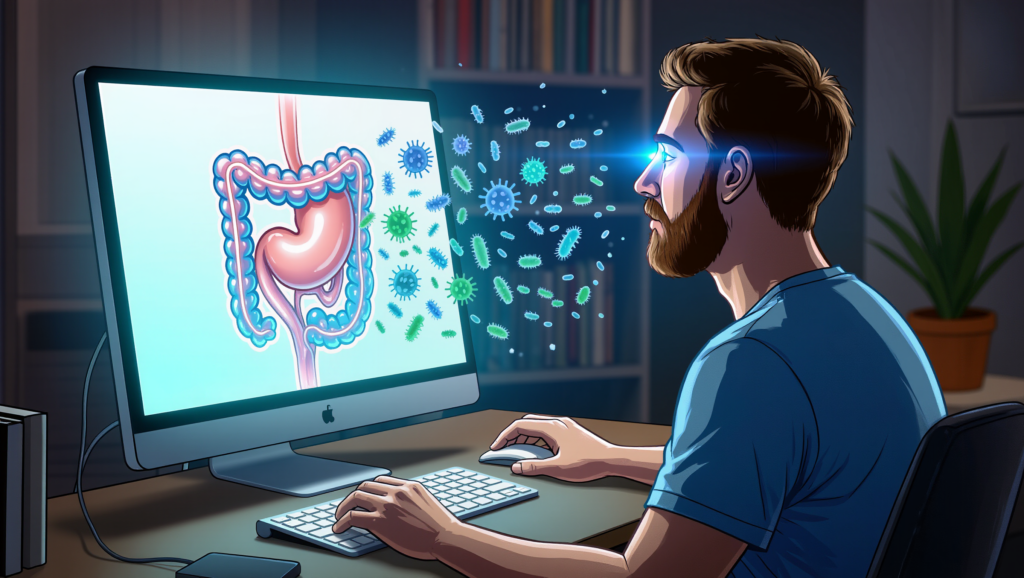












Blue light from your screens isn’t just making your eyes feel fried after a long day—it’s also quietly messing with your hormones, your sleep, and, through that pathway, the health of your gut microbiome. It’s not as simple as “your phone is killing your gut bugs,” but the chain reaction from late‑night blue light exposure to circadian disruption to microbiome imbalance is getting harder to ignore in the research.
Let’s unpack what blue light is actually doing to your eyes, how it hijacks your internal clock, and why that, in turn, can degrade the quality and diversity of your gut microbes over time.
What Exactly Is Blue Light?
Blue light is part of the visible light spectrum, with short wavelengths (about 400–500 nm) and relatively high energy. It’s everywhere:
- Sunlight (by far your biggest source)
- LEDs and fluorescent lighting
- Phone, tablet, laptop, and TV screens
Blue light isn’t inherently “bad.” In the right dose and timing it:
- Helps regulate your circadian rhythm (wake‑sleep cycle).
- Supports alertness, mood, and cognitive performance during the day.
The problem is the when and how much—constant exposure, especially in the evening and at night, pushes intensity and timing beyond what your biology evolved to handle.
How Blue Light Affects Your Eyes
1. Retinal and ocular surface stress
Short‑wave blue light (roughly 415–455 nm) can penetrate the cornea and lens to reach the retina and, at sufficiently high intensities or prolonged exposures, can cause photochemical damage.
Mechanisms include:
- Oxidative stress: Blue light triggers overproduction of reactive oxygen species (ROS) in corneal, conjunctival, and retinal cells, which can damage DNA, lipids, and proteins.
- Inflammation and apoptosis: ROS can activate inflammatory pathways (e.g., NLRP3 inflammasome) in corneal epithelial cells, promoting cell death and ocular surface inflammation.
- Photoreceptor vulnerability: High‑energy blue light accelerates photoreceptor damage via mitochondrial stress and lipid peroxidation in the retina.
Animal and cell studies clearly show that intense or prolonged blue‑violet exposure can injure retinal cells. However, major ophthalmology reviews emphasize that normal use of screens and domestic LED lighting doesn’t appear to be acutely retinotoxic in humans. The bigger concern is cumulative exposure over decades, especially for children and light‑sensitive populations.
2. Digital eye strain and dry eye
Even at normal screen intensities, blue‑rich light contributes to:
- Visual fatigue and eye strain: Short‑wave blue light scatters more and focuses slightly in front of the retina, increasing aberrations and making sustained near work more tiring.
- Dry eye symptoms: In vitro and in vivo work shows blue light can reduce corneal cell viability and promote ocular surface inflammation, potentially aggravating dry eye disease. Combine that with decreased blink rate when staring at screens, and you’ve got a recipe for burning, gritty, tired eyes.
3. Potential link to macular degeneration (still emerging)
Some researchers suggest that long‑term blue light exposure may contribute to age‑related macular degeneration (AMD) through chronic oxidative stress and free radical formation in the retina. However:
- Current evidence doesn’t prove that normal screen use directly causes AMD in humans.
- Sunlight and high‑intensity sources (like welding arcs) are far more potent blue‑light hazards than phones.
So yes, your screens can strain and inflame your eyes, and long‑term cumulative exposure is a reasonable concern—but the more immediate and well‑documented damage is happening through another route: your circadian system.
Blue Light, Melatonin, and Your Body Clock
Your retina contains special cells (intrinsically photosensitive retinal ganglion cells) that are most sensitive to blue‑turquoise light around 460–480 nm. These cells send signals directly to your brain’s master clock (the suprachiasmatic nucleus), which controls:
- Melatonin secretion
- Cortisol rhythms
- Core body temperature
- Sleep–wake timing
Evening blue light exposure—especially from screens held close to your face—can:
- Suppress melatonin production, the hormone that signals sleep onset.youtube
- Delay circadian phase, making you fall asleep later and shortening total sleep.
- Increase evening alertness when your brain should be winding down.
Reviews and clinical studies consistently find that even 2 hours of bright tablet or smartphone use before bed can significantly reduce melatonin and delay sleep, compared with dimmer, warmer light or no screens.
Over time, chronic night‑time blue light exposure can create a state of social jetlag and circadian misalignment, where your internal clock and your actual sleep/wake times are out of sync. That’s where your gut starts to pay the price.
From Retina to Microbiome: How Blue Light Wrecks Your Gut (Indirectly)
Your gut microbiome isn’t seeing blue light directly—but it is exquisitely sensitive to light‑driven rhythms in your body.
1. Circadian disruption reshapes the microbiome
Animal and human studies show that the gut microbiome follows a daily rhythm, with shifts in:
- Species abundance
- Metabolic activity
- Production of short‑chain fatty acids (SCFAs) like butyrate
These microbial rhythms are coordinated by your host circadian system and feeding–fasting cycles.
When blue light disrupts your sleep and circadian clock, it also:
- Shifts meal timing (later dinners, more late‑night snacking).
- Alters gut motility, gastric emptying, and digestive secretions.
- Disturbs hormonal signals (insulin, cortisol, GLP‑1, ghrelin), all of which influence the gut environment.
Chronic circadian misalignment is linked with:
- Reduced microbial diversity
- Increased representation of pro‑inflammatory and obesogenic taxa
- Disrupted SCFA production and gut barrier integrity
While most of this evidence comes from shift‑work models and irregular sleep patterns, late‑night blue light can produce similar circadian distortions—just to a lesser, but chronic, degree.
2. Poor sleep quality harms gut composition
Multiple human studies associate short sleep duration and poor sleep quality with:
- Lower microbial diversity
- Higher Firmicutes:Bacteroidetes ratios (often linked to obesity)
- Enrichment of species associated with insulin resistance and low‑grade inflammation
Given that blue‑rich evening light reliably worsens sleep quality and delays onset, your nightly scrolling can indirectly shift your microbiome toward a more inflammatory, less resilient profile.
3. Stress and HPA axis activation spill into the gut
Blue light at night doesn’t just block melatonin; it also:
- Can increase cortisol and adrenocortical hormone production, especially when exposure is intense or extended into your biological night.
- Raises evening alertness and arousal, feeding chronic sympathetic activation.
Chronically elevated cortisol and sympathetic tone:
- Alter gut permeability (“leaky gut”).
- Change gut motility patterns.
- Favor growth of stress‑associated microbial species.
That creates a feedback loop where circadian disruption → stress hormones → gut dysbiosis → more inflammation and metabolic dysfunction.
So, while blue light isn’t zapping your microbes directly, it destroys the environment they depend on: regular circadian cues, restful sleep, calm nervous system, predictable feeding–fasting windows.
Symptoms You Might Notice Long Before Disease
You don’t need a microbiome sequencing report to see the effects. The combination of heavy evening blue light, circadian disruption, and low‑grade microbiome stress often shows up as:
- Fragmented or non‑restorative sleep
- Brain fog, irritability, or mood dips
- Increased cravings for sugar and ultra‑processed foods (especially late at night)
- Bloating, irregular bowel habits, or IBS‑like symptoms
- Subtle weight gain around the middle despite unchanged calories
All of these are early warning signs that your light–sleep–gut axis is off.
How to Protect Your Eyes and Your Gut from Screen Blue Light
You don’t need to move to a cabin and smash your phone. But you do need a strategy.
1. Respect the “digital sunset”
Aim for a screen curfew 1–2 hours before bedtime.
- Replace scrolling with analog wind‑downs: reading paper books, stretching, low‑light conversation, journaling.
- If you must use devices, prefer larger screens at arm’s length over phones inches from your eyes.
Even partial reductions in evening blue exposure improve melatonin and sleep onset, which in turn supports healthier microbiome rhythms.
2. Use warm‑tone and night‑shift settings
Most devices now offer:
- “Night Shift,” “Night Mode,” or “Blue Light Filter” options that shift displays toward warmer hues.
- Adjustable brightness—turn it way down in the evening.
Evidence suggests these modes don’t completely eliminate circadian effects, but they significantly reduce melatonin suppression compared with standard bright, blue‑heavy displays.
3. Get bright, natural light early in the day
Morning blue‑turquoise light is beneficial: it anchors your circadian clock, boosts daytime alertness, and improves mood.youtube
- Spend 15–30 minutes outside within a couple of hours of waking if possible.
- Open blinds fully and work near natural light.
A strong daytime light signal makes your internal clock more robust and less vulnerable to small evening light insults.
4. Protect your eyes directly
- Follow the 20‑20‑20 rule: every 20 minutes, look at something 20 feet away for 20 seconds.
- Blink consciously when working on screens to reduce dryness.
- Use artificial tears if you have dry eye symptoms, and talk to an eye‑care professional if they persist.
- Consider blue‑light‑filtering lenses if you have high screen time and eye strain—though reviews note that their benefit is mostly for comfort, not proven disease prevention.
5. Align your gut with your light
Because your microbiome listens closely to your circadian rhythm:
- Keep a consistent eating window, ideally 10–12 hours, and avoid heavy meals within 2–3 hours of bedtime.
- Let your last meal be earlier and lighter if your evenings are inevitably screen‑heavy.
- Prioritize fiber‑rich, plant‑forward meals (veggies, legumes, whole grains, nuts, seeds) that feed beneficial microbes and buffer stress from poor sleep.
Good food can’t fully rescue a shredded sleep schedule—but it gives your gut a fighting chance.
6. Reduce total screen load where it’s easiest
You might not be able to change your job, but you can:
- Cut back mindless evening scrolling, not essential work time.
- Batch notifications and check them at set times instead of constant grazing.
- Use audio (podcasts, audiobooks) instead of visual media late in the day.
Every hour of light you shift from late night → daytime is a win for both your retina and your gut.
The Bottom Line
Blue light isn’t a cartoon villain—it’s a powerful biological signal that your body needs in the right dose and timing. But the way modern screens deliver that signal—late, long, and up‑close—is a triple hit:
- Eyes: more oxidative stress, inflammation, digital eye strain, and possibly higher long‑term retinal risk in susceptible people.
- Clock: suppressed melatonin, delayed circadian rhythms, and chronic social jetlag.
- Gut: downstream disruption of sleep, hormones, and feeding patterns, which gradually reshapes your microbiome in a less favorable direction.
You don’t have to fear every pixel—but you should absolutely treat light like nutrition: dose, timing, and quality matter. Protect your eyes, give your brain a real night, and your gut microbes will quietly thank you—with better digestion, steadier energy, and a more resilient body over the long term.
- https://pmc.ncbi.nlm.nih.gov/articles/PMC6288536/
- https://pubmed.ncbi.nlm.nih.gov/36808601/
- https://pmc.ncbi.nlm.nih.gov/articles/PMC9420367/