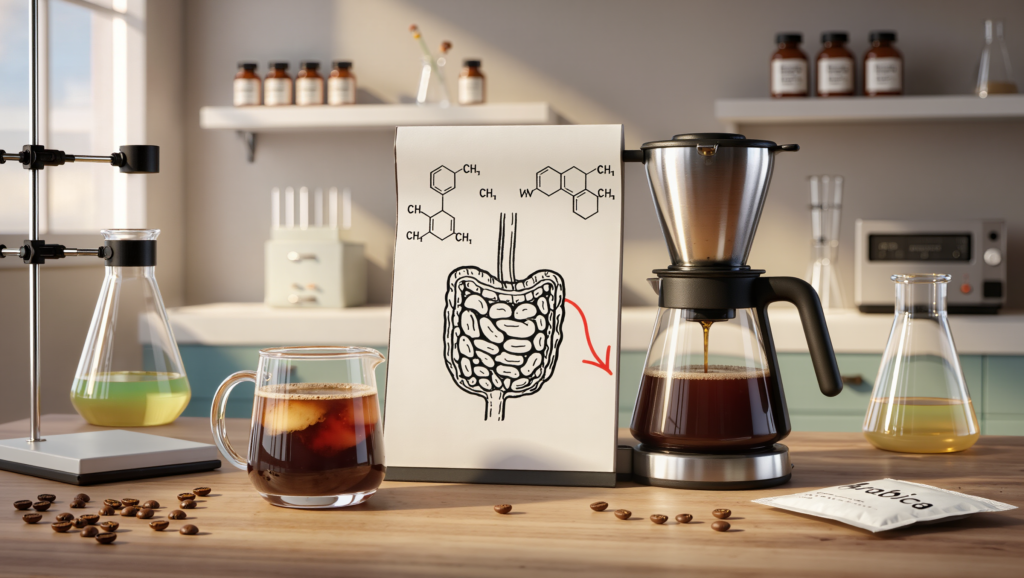












Most people switch to cold brew because they’ve heard it’s “low acid” and easier on the stomach. Then they drink a glass, skip the sugar, and still end up with heartburn, chest tightness, or that sour feeling creeping up the throat. What’s going on if the pH is supposedly gentler?
The short version: cold brew is usually chemically less acidic than hot coffee, but “acid issues” in your body are about much more than pH or how sour something tastes. Specific compounds in coffee, the way you brew it, how concentrated it is, how much caffeine and oils it contains, and the state of your own gut and esophageal sphincter all determine whether a particular cold brew feels smooth or sets your digestion on fire—even without sugar.
Below is a deep dive into the science of why some cold brew still bothers your system, and what you can tweak if you love the taste but hate the fallout.
Why Cold Brewed Coffee Is Only Less Acidic… on Paper
Let’s start with the part that’s actually true.
pH and total acidity
Studies comparing cold brew and hot brew show:
- The pH of cold brew and hot coffee is often very similar, commonly around 4.8–5.1 for both. That’s acidic, but nowhere near as harsh as soda or citrus juice.
- The big difference is usually in total titratable acidity (TTA)—a measure of all the acid compounds present, not just free hydrogen ions that affect pH.
A 2018 study in Scientific Reports (“Acidity and Antioxidant Activity of Cold Brew Coffee”) found that:
- Hot-brewed coffee had 28–50% higher total acid concentration than cold brew made from the same beans.
- Cold brew therefore contains fewer total acidic compounds like chlorogenic acids and certain organic acids, even when pH is similar.
Other research and industry summaries report:
- Cold brew typically falls around pH 4.85–5.13, depending on origin and bean species.
- Hot brews often show higher titratable acidity, meaning more acid molecules that can react in your mouth or stomach, even if the pH number is similar.
So, yes: chemically, cold brew tends to have fewer total acids and a smoother, less “bright” acidity compared with hot coffee. It’s less aggressive on enamel and taste buds for many people.
But that’s only half the story.
Why “Less Acidic” Coffee Can Still Cause Acid Problems
Many people equate “acid issues” with one number: pH. Your body doesn’t. Several other factors matter a lot more when it comes to reflux, stomach upset, or throat burn.
1. Concentration: cold brew is often a caffeine and compound bomb
Most people don’t realise that:
- Cold brew is frequently made as a concentrate, using a high coffee‑to‑water ratio and 12–24 hours of steeping.
- Even though cold water extracts acids less aggressively, that long steep still pulls out plenty of caffeine, bitter compounds, and oils.
Depending on how you drink it:
- A glass of undiluted or lightly diluted cold brew can deliver more caffeine and more total dissolved solids per serving than a standard hot coffee.
- Caffeine is a known lower esophageal sphincter (LES) relaxant, meaning it makes the valve between stomach and esophagus a bit looser. A loose LES = easier reflux.
So even if the brew is “low acid” in a lab sense, a big glass of strong cold brew can:
- Stimulate gastric acid secretion.
- Relax the LES via caffeine and other compounds.
- Increase the volume of liquid in your stomach.
That combo is ideal if you’re trying to get coffee into your bloodstream fast; it’s awful if you’re prone to heartburn or GERD.
2. Coffee’s “acid effects” aren’t just about pH
When people say coffee “feels acidic,” they’re often responding to:
- Irritation of the gastric and esophageal mucosa (the lining) from coffee compounds.
- Bitter and astringent molecules that interact with sensory nerves.
- The downstream effect of gastric acid secretion and reflux, not the pH of the coffee itself.
Key players include:
- Chlorogenic acids (CGAs) – major coffee acids that break down into quinic acid and caffeic acid, especially in hot brewing. Cold water extracts fewer of these and forms fewer breakdown products, which is one reason cold brew tastes smoother.
- Other organic acids – citric, malic, acetic, etc. Hot brewing pulls out more of these bright, fruity acids, making hot coffee taste sharper. Cold brew extracts fewer, again improving taste smoothness.
But cold brew doesn’t remove:
- Caffeine – still stimulates acid production and LES relaxation.
- Diterpenes (cafestol, kahweol) and oils – more likely to be present when you use metal filters or no filter. These don’t directly change pH, but they can alter gut motility and, in some people, irritate the stomach lining.
- Polyphenols and other bioactive compounds – some are beneficial, some can be irritating depending on your gut sensitivity.
So your stomach and esophagus can still experience that drink as “aggressive,” even if the titratable acidity is lower.
3. Bean choice, roast, and grind matter more than people think
Cold brew is not a single chemical category; its composition changes a lot depending on:
- Bean species and origin – Arabica vs robusta, high‑altitude vs low, washed vs natural all affect organic acid and CGA content. Some origins (like certain Ethiopian coffees) naturally produce more acidic cold brew than, say, Myanmar or Brazil.
- Roast level – darker roasting generally reduces citric and some chlorogenic acids, but increases certain bitter breakdown products if pushed too far. For sensitive people, a medium or medium‑dark roast often feels smoother than very light roasts.
- Grind size and brew time – finer grinds and longer steeps extract more of everything: acids, caffeine, oils, phenolics. An over‑steeped, fine‑grind cold brew can be chemically intense, even if it still tastes round.
If you’ve only tried cold brew made with:
- Very light, high‑acidity single origins,
- Very fine grind,
- Very long steep (24+ hours),
- Minimal dilution,
…it’s not surprising that your body might complain.
Why You Might React to Some Cold Brew Coffee But Not Others
Two people can drink the same cold brew and have totally different experiences. And the same person can tolerate one shop’s cold brew but not another’s. That’s because “acid issues” sit at the intersection of chemistry and your own physiology.
Here are some common reasons cold brew still triggers symptoms:
1. Individual sensitivity of your LES and esophagus
If you have:
- GERD,
- A naturally looser LES,
- A hiatal hernia, or
- A very sensitive esophageal lining,
even relatively gentle triggers can cause:
- Burning behind the breastbone,
- Regurgitation or sour brash,
- Chronic throat clearing, hoarseness, or cough.
A large cold brew:
- Increases pressure in the stomach.
- Relaxes the LES via caffeine and other compounds.
- Gives any refluxed content a coffee‑rich, bitter chemical profile that can feel harsher than plain water.
This is true even without sugar. Sugar can worsen reflux by increasing gastric volume and fermentation, but it’s not required to trigger symptoms.
2. Speed and context of drinking
You’re more likely to get “acid issues” if you:
- Chug a large cold brew on an empty stomach.
- Combine it with other triggers: spicy food, fatty meals, chocolate, alcohol, or lying down soon after.
- Use coffee as your first and only “breakfast.”
A large bolus of cold brew in an empty stomach is like pushing the accelerator on acid production and LES relaxation at the same time. It’s not the pH that’s the problem; it’s the physiological response pattern.
3. Additives that aren’t sugar
You might skip sugar but still add:
- Oat milk or other emulsified plant milks with gums and stabilisers.
- Flavoured syrups (even sugar‑free), which contain acids and flavour chemicals.
- Heavy cream, which can slow gastric emptying and increase reflux if you’re sensitive to fat.
Any of these can change how long coffee sits in your stomach and how much acid is produced.
4. Underlying gut or histamine issues
Some people with:
- Irritable Bowel Symdrome (IBS)
- SIBO,
- Histamine intolerance, or
- Gastritis
react to coffee not primarily because of pH, but because of:
- Motility changes (coffee can speed up transit),
- Histamine or histamine‑releasing potential,
- Overall irritant load to an already inflamed mucosa.
For them, cold brew might be slightly gentler than hot coffee but still problematic, especially if it’s very concentrated.
How to Choose and Brew Cold Brew Coffee That’s Not Harmful to Your Gut
If you love cold brew but not the aftermath, there are concrete levers you can pull.
1. Start with the right beans
- Prefer 100% Arabica over Robusta if you’re sensitive; Arabica tends to have lower harsh bitterness and different CGA profiles.
- Choose medium or medium‑dark roasts rather than very light, high‑acidity roasts. These usually result in smoother, less tangy brews.
- Experiment with origins: many people find Brazil, Guatemala, some Indonesian and Central American coffees smoother than high‑acidity East African beans in cold brew.
2. Adjust grind size, ratio, and steep time
- Use a coarse grind. Fine grinds massively increase surface area and extraction of compounds that can irritate.
- Don’t over‑concentrate: something like 1:6 to 1:8 coffee:water by weight for the initial brew, then dilute to taste, is friendlier than ultra‑concentrated recipes.
- Keep steep time in a sensible window, e.g. 12–16 hours in the fridge; ultra‑long steeps can drag more phenolics and bitter compounds into the cup.
If a particular cold brew is regularly giving you issues, try:
- Cutting your concentrate more heavily with water or milk (if tolerated).
- Reducing your serving size (e.g., 150–200 ml instead of a huge tumbler).
- Spreading intake over more time instead of slamming it.
3. Mind timing and food pairing
- Have some food first—especially something with protein and fat—to buffer the stomach.
- Avoid combining your cold brew with big, greasy, or very spicy meals if you’re reflux‑prone.
- Don’t lie down or bend over deeply soon after drinking it; give gravity time to help keep contents down.
4. Consider filtration and oils
- If you have issues with lipids or high‑oil brews, favour paper‑filtered cold brew systems over metal‑mesh or cloth, which let more oils through.
- Some people find that paper‑filtered cold brew feels gentler on their stomach and chest, even if the flavour is slightly lighter.
When to Suspect Gut Troubles Is Not Just the Coffee
If you’re getting frequent:
- Heartburn,
- Regurgitation,
- Chronic cough or throat clearing,
- Chest discomfort that isn’t clearly muscular,
it’s worth talking to a clinician. Coffee—cold brew or otherwise—might be exposing an underlying problem, not causing it from scratch.
Conditions to rule out include:
- GERD and laryngopharyngeal reflux
- Hiatal hernia
- Peptic ulcers or gastritis
- Significant motility disorders
- Cardiac issues if pain is atypical or severe
In those cases, no amount of tweaking grind size will fully solve the issue until the underlying condition is addressed.
The Takeaway: “Low Acid” ≠ “No Acid Response”
The marketing claim that “cold brew is low acid and therefore easy on everyone’s stomach” is an oversimplification:
- Chemically, cold brew usually has lower total acidity (fewer acid molecules) and a smoother, less bright flavour than hot coffee.
- But caffeine, concentration, oils, and individual physiology drive most real‑world “acid issues,” not just pH.
- A strong cold‑brew concentrate, chugged on an empty stomach by someone with a sensitive LES or inflamed gut, can absolutely cause heartburn or discomfort—even if it’s unsweetened and technically “low acid.”
If you’re one of those people who loves cold brew but gets punished for it, experiment with:
- Different beans and roast levels
- Coarser grinds and shorter steeps
- More dilution and smaller servings
- Drinking it with food and avoiding other triggers
Cold brew isn’t automatically a digestive villain, but it’s also not a magic bypass of coffee’s fundamental effects on your stomach and esophagus. Once you understand that, you can tune your brewing and habits so that your cold brew feels as smooth in your body as it does on your tongue.