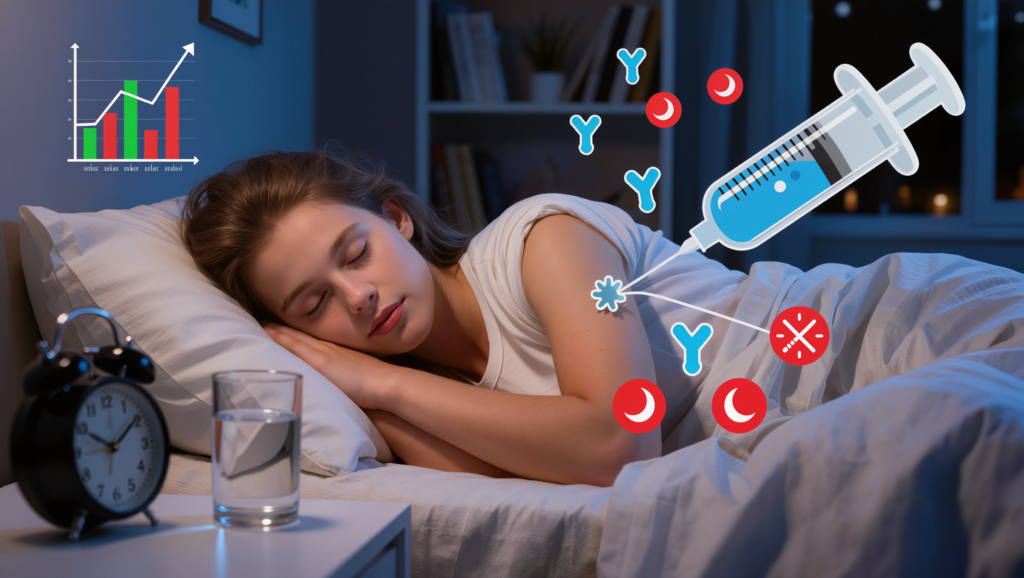












If you have ever been told to “get a good night’s sleep before your vaccine,” you might have brushed it off as generic advice. But the science is starting to back it up. Sleep deprivation—especially in the days right before and after vaccination—can measurably reduce your antibody response.
This does not mean your vaccine will “fail” if you have one rough night. But it does mean that chronic short sleep, or acute sleep loss around the time of your shot, may leave you with a weaker and shorter-lasting immune response than you would otherwise have.
In this post, we’ll break down the science of sleep and vaccine response, what the research shows, and how you can use this knowledge to get the most out of your next vaccination.
Why Sleep Matters For Immunity
Sleep is not just “downtime” for your body. It is an active period when your immune system does some of its most important work:
- Memory formation: Your immune system “remembers” pathogens it has encountered.
- Antibody production: B cells produce antibodies that target specific pathogens.
- Cytokine release: Chemical messengers that coordinate the immune response.
When you are sleep-deprived, these processes are disrupted.
How Sleep Deprivation Affects Antibody Response
The relationship between sleep and vaccine response is complex, but the evidence points to a few key mechanisms:
1. Reduced antibody production
Sleep deprivation can directly reduce the number of antibodies your body produces after vaccination:
- Short sleep (<6 hours/night) is associated with lower antibody titers.
- Acute sleep deprivation (like pulling an all-nighter) can cause a temporary drop in antibody levels.
2. Impaired immune memory
Sleep is critical for forming immunological memory:
- Without adequate sleep, your immune system may not “remember” the vaccine as well.
- This can lead to a weaker and shorter-lasting response. [
3. Increased inflammation
Ironically, sleep deprivation can increase inflammation:
- C-reactive protein (CRP) and interleukin-6 (IL-6) rise after just a few nights of restricted sleep.
- This chronic low-grade inflammation can interfere with the vaccine response.
What Science Research Says About Sleeping And Vaccine Efficacy
The evidence for sleep and vaccine response is growing, but it is still relatively new.
The landmark meta-analysis
A 2023 meta-analysis published in Current Biology is one of the most comprehensive studies to date. It looked at 7 studies (304 participants) and found:
- Objectively measured short sleep (<6 hours/night) was associated with a significant decrease in antibody response to hepatitis and influenza vaccines.
- The effect was stronger in men (effect size 0.93) than in women (0.42, not statistically significant).
- Self-reported sleep did not show the same effect, suggesting that objective measures (like actigraphy) are more reliable.
Short-term vs. long-term effects
The timing of sleep deprivation matters:
- Sleep in the 1–2 nights before vaccination appears to be especially important. [
- Acute sleep deprivation the night after vaccination can cause a temporary drop in antibody levels, but this often recovers by day 10–17.
- Chronic short sleep (over weeks or months) may have more lasting effects.
Specific vaccine studies
- Influenza vaccine: One study found that people who slept less than 4 hours for 4 consecutive nights after vaccination had less than half the antibody levels of those who slept normally.
- Hepatitis B vaccine: Shorter sleep duration was associated with a lower secondary antibody response.
- Hepatitis A vaccine: Sleep on the night after vaccination improved antibody response compared to sleep deprivation.
Who Is Most At Risk Of Vaccine Efficacy Loss Due To Sleep Deprivation?
While anyone can be affected by sleep deprivation, some groups are more vulnerable:
1. Men
- The meta-analysis found a larger effect in men than in women.
- The reasons for this sex difference are not fully understood.
2. People with chronic insomnia
- Insomnia is associated with lower antibody levels after vaccination.
- This suggests that ongoing sleep problems may have a cumulative effect.
3. Immunocompromised individuals
- People with weakened immune systems may be especially sensitive to sleep deprivation.
- Ensuring adequate sleep in the nights after vaccination may be particularly important for this group.
4. Older adults
- While not specifically studied in the meta-analysis, older adults often have more fragmented sleep, which could affect vaccine response.
How To Optimize Sleeping To Enhance Vaccine Efficacy
If you want to get the most out of your next vaccine, here are some practical tips:
1. Prioritize sleep in the days before and after
- Aim for at least 6 hours of sleep per night in the 1–2 days before and after vaccination.
- If possible, aim for 7–9 hours for optimal immune function.
2. Avoid pulling all-nighters
- Acute sleep deprivation (like staying up all night) can temporarily reduce antibody levels.
- If you must stay up, try to catch up on sleep as soon as possible.
3. Address chronic sleep problems
- If you have ongoing insomnia or sleep apnea, talk to your doctor.
- Treating these conditions can improve both sleep and immune function.
4. Time your vaccination wisely
- If you have a choice, schedule your vaccine for a time when you can get adequate sleep afterward.
- Avoid scheduling it right before a period of known sleep deprivation (like a night shift).
5. Combine with other healthy habits
- Exercise regularly: Helps improve sleep quality and immune function.
- Eat a balanced diet: Supports overall immune health.
- Manage stress: Chronic stress can disrupt sleep and immunity.
Sleep As A Modifiable Risk Factor For Vaccine Response
Sleep is a modifiable risk factor for vaccine response. Unlike age or genetics, you can take steps to improve your sleep.
Why this matters
- Public health: Improving sleep could enhance vaccine effectiveness at a population level.
- Personal health: Better sleep means better protection for you.
- Health equity: Addressing sleep disparities could reduce differences in vaccine response.
What We Still Don’t Know About Sleeping And Vaccine Efficacy
While the research is promising, there are important caveats:
- Most studies are small and short-term.
- Results are inconsistent across vaccine types.
- The exact window of time when sleep is most important is still being defined.
- More research is needed to confirm long-term effects and optimal sleep recommendations.
To Finalize
Sleep deprivation can measurably reduce your antibody response to vaccines, especially if you are consistently getting less than 6 hours of sleep per night. While one bad night will not ruin your vaccine, chronic short sleep or acute sleep loss around the time of vaccination can weaken and shorten your immune response.
Key takeaways:
- Sleep is critical for antibody production and immune memory.
- Short sleep (<6 hours/night) is associated with lower antibody titers.
- The effect is stronger in men than in women.
- Sleep in the 1–2 nights before and after vaccination is especially important.
- Addressing chronic sleep problems can improve vaccine response. [
If you are due for a vaccine, consider making sleep a priority in the days before and after. It is a simple, low-cost way to support your immune system and get the most out of your vaccination.
Your immune system works hard for you—give it the rest it needs to do its job.