











You are standing in the nursery aisle (or scrolling through an online catalog) with two options in front of you: a bare-root sapling that looks like a bundle of sticks with some roots, and a lush, leafy plant in a plastic pot that already looks “real.” One is cheaper and dormant; the other is more expensive and ready to impress. Which one will actually grow faster in its first year in your garden?
The answer is not as simple as “potted always wins” or “bare-root is best.” Growth speed in the first year depends on species, planting time, root quality, and how each type handles transplant shock. But research and field experience do show clear patterns: in many cases, bare-root plants establish their root systems more quickly when planted correctly in the dormant season, while potted (container-grown) plants often show more visible top growth early on but can lag in root expansion if they are pot-bound or planted at the wrong time.
Here is an in-depth look at how bare-root and potted transplants differ in their first year, what the science says about establishment and growth rates, and how to choose the right option for your goals.
What Are Bare-root And Potted Transplants?
Bare-root transplants
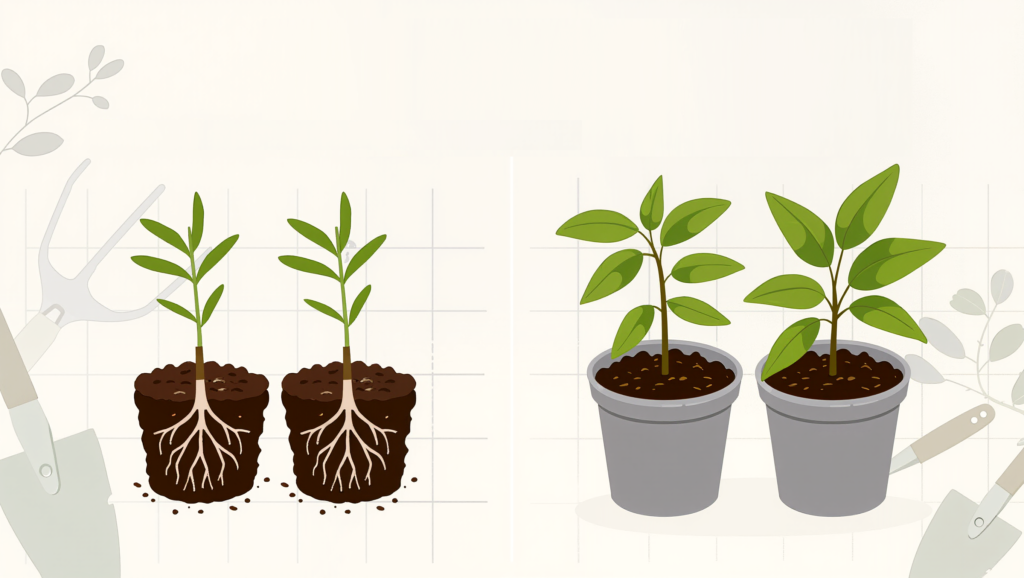
Bare-root plants are grown in nursery fields and then dug up during dormancy (late fall through early spring, depending on climate). The soil is shaken or washed off the roots, and the plants are stored and shipped without any growing medium around the roots.
Common examples:
- Fruit trees (apples, peaches, pears, plums).
- Berries (strawberries, raspberries, blackberries).
- Many deciduous trees and shrubs (roses, some ornamentals, forest tree seedlings).
Key features:
- Dormant at planting (no leaves or very few).
- No container, no soil ball—just roots and stem.
- Usually cheaper and lighter to ship.
- Must be planted quickly and kept moist; roots cannot dry out.
Potted (container-grown) transplants
Container-grown plants are produced in pots filled with soilless media or soil mix. They can be sold and planted at almost any time of year when the ground is workable, and they arrive with an intact root ball.
Common examples:
- Most ornamental shrubs and trees at garden centers.
- Many fruit trees sold in 3–15 gallon containers.
- Vegetable and herb transplants in plugs or pots.
Key features:
- Often in leaf and actively growing at purchase.
- Roots contained within a pot; may be well-developed or pot-bound.
- More flexible planting window (spring through fall, sometimes winter in mild climates).
- Generally more expensive than bare-root.
Transplant Shock: The Hidden Factor In First-Year Growth
Before comparing growth rates, it is crucial to understand transplant shock—the stress plants experience when moved from nursery to landscape.
Bare-root transplant shock
Bare-root plants undergo significant root disturbance:
- Many fine roots are lost during digging and handling.
- Roots are exposed to air and can desiccate quickly if not kept moist.
- The entire root system must regenerate in new soil.
However, because they are dormant:
- The plant is essentially “asleep,” so the shock occurs while metabolic demand is low.
- If planted during the correct window (dormant season), roots can begin growing in the new site before shoots break dormancy in spring.
When handled well (roots kept moist, planted promptly, proper planting technique), bare-root plants can recover from shock and establish a well-spread root system relatively quickly.
Potted transplant shock
Container plants have an intact root ball, so:
- Roots are not exposed or dried out during transplant.
- There is less immediate root loss compared to bare-root.
But they can still suffer shock due to:
- Root circling or pot-binding, where roots grow in circles inside the container and fail to grow outward into landscape soil.
- Sudden changes in environment (light, wind, moisture) when moved from controlled nursery conditions to the garden.
- Planting during hot, dry periods when water demand is high.
In some studies, intact-root (plug or paper-pot) transplants showed higher growth rates in the first several weeks after transplanting compared to bare-root, precisely because they avoided the severe shock of root exposure. However, if container roots are congested and not corrected at planting, long-term establishment can be slower.
First-Year Growth: What Scientific Studies Show?
The question “which grows faster?” depends on what you measure: root establishment, height growth, trunk caliper, or overall vigor. Here is what studies and field trials tell us.
Root establishment speed
Several sources indicate that bare-root plants can establish their root systems faster in the first season—provided they are planted during dormancy and handled correctly.
- One field comparison noted that bare-root trees established roots within four weeks of autumn planting, while container trees remained largely static until soil temperatures rose above 10°C. By late spring, bare-root trees showed noticeably stronger shoot growth and leaf vigor.
- Extension resources note that bare-root plants, being dormant, begin establishing roots in their new home before the top “wakes up” in spring, giving them a head start on root expansion.
- In forestry and reforestation contexts, air-pruned container seedlings can establish very rapidly, sometimes outperforming bare-root in harsh, competitive sites. But in side-by-side trials, first-year establishment success for container-grown seedlings was about twice that of spring-planted bare-root seedlings in some disturbed land scenarios—largely due to survival, not necessarily growth rate.
So for root establishment in typical garden conditions, bare-root often has an edge when planted in the dormant season, while container plants may lag until soil warms.
Height and top growth in year one
For visible top growth (height, leaf production), container plants frequently appear ahead early in the season because they start with leaves and an existing canopy.
- In a black walnut orchard study, container seedlings (over 1 m tall at planting) showed a small but significant increase in height during the first growing season, while bare-root seedlings (~0.5 m at planting) showed no significant height increase in year one. By years 2–4, however, bare-root annual height increases matched or exceeded container stock.
- In tobacco transplant trials, intact-root (plug or paper-pot) plants had higher growth rates for the first several weeks after transplanting than bare-root plants, with mean growth rates around 11.4% per day in the early weeks. Overall growth rate of intact-root plants was superior in all experiments, though final yield and value were similar.
- Anecdotal and extension reports often note that potted trees may look more impressive at planting (already flowering or leafed out) but can spend the first year or two recovering from transplant shock and spreading roots, while bare-root trees, though initially “wimpy,” can catch up and surpass them in vigor after establishment.
So in year one, container plants often show more immediate top growth, especially if planted in spring or early summer. Bare-root plants may put more energy into root establishment first, with stronger shoot growth appearing in the following spring.
Survival and establishment success
Survival is a prerequisite for growth, and here container plants often have an advantage, especially in challenging conditions.
- In trials on drastically disturbed lands, first-year establishment success for container-grown seedlings was approximately twice that of spring-planted bare-root seedlings. Survival rates for container-grown bur and northern red oak were around 90% vs. 35% for bare-root.
- Container-grown seedlings allow a 5–6 month planting season vs. a 4–6 week window for bare-root, and fall-planted container seedlings can continue root growth through fall and winter, better withstanding summer drought and weed competition.
- However, in standard landscape or orchard settings with good site preparation and watering, bare-root trees can achieve equal or better long-term growth once established, especially when smaller caliper trees are used.
In short: containers often win on first-year survival in tough sites; bare-root can match or exceed growth once established in more favorable conditions.
Which Plants Do Better: Bare-root vs. Potted?
Not all species respond the same way. Some tolerate bare-root handling well; others really benefit from being container-grown.
Species that often do well bare-root
Extension and nursery guidance commonly list these as good bare-root candidates:
- Deciduous fruit trees: apples, peaches, pears, plums, cherries (when planted dormant).
- Berries: strawberries, raspberries, blackberries, blueberries (some sources still prefer container for blueberries).
- Many deciduous shade trees and shrubs: oaks, maples, roses, some ornamentals, especially when small caliper/size.
These species tend to:
- Tolerate root pruning and dormant handling.
- Establish quickly when planted in the correct window.
- Benefit from the wider root spread possible with bare-root planting.
Species that often do better container-grown
Some plants are more sensitive to root disturbance or have specific requirements:
- Citrus, avocados, and other evergreen subtropicals.
- Some broadleaf evergreens and conifers.
- Transplant-sensitive species like pawpaws, pecans, persimmons (some sources recommend container for these).
These benefit from:
- An intact root ball and continuous growth.
- Ability to plant outside the narrow dormant window.
- Reduced shock in climates where dormancy is less pronounced.
If you are unsure, local extension services and reputable nurseries can advise which format performs better for your specific species and region.
Planting Timing: Why Your Planting Season Changes Everything
Planting time is arguably as important as plant type.
Bare-root: a narrow but powerful window
Bare-root plants must be planted during dormancy:
- Late fall after leaf drop, through early spring before bud break (exact timing depends on climate).
- Roots must not dry out; plants should be soaked and planted within a day or two of arrival, or temporarily “heeled in” if planting is delayed.
Advantages of dormant-season bare-root planting:
- Roots can establish in cool, moist soil before summer stress.
- Lower water demand while the plant is leafless.
- Often results in strong spring growth once temperatures rise.
Miss this window, and you generally must wait another year; bare-root is not a summer planting option.
Container: flexible timing, but not all times are equal
Container plants can be planted:
- Anytime the ground is not frozen, in theory.
- Practically, fall and early spring are still best for most climates, allowing root growth before summer heat.
Caveats:
- Planting in hot, dry summer increases water stress and transplant shock.
- Planting too late in fall in cold climates may not allow enough root establishment before freeze.
Some trials show container trees planted in autumn can remain relatively static until soil warms above ~10°C, while bare-root planted at the same time may start root growth sooner, leading to stronger spring vigor.
Practical Implications For Your Garden During Bare-Root or Potted Transplants
So, which should you choose if your goal is faster growth in the first year?
Choose bare-root if:
- You are planting deciduous trees, shrubs, or berries that are known to perform well bare-root.
- You can plant during the dormant season (late fall to early spring).
- You are comfortable handling roots carefully and planting promptly.
- Your priority is long-term vigor and cost-effectiveness over immediate “look.”
Expect:
- Less impressive appearance at planting (no leaves, smaller size).
- Potentially faster root establishment in the first season.
- Strong shoot growth in the following spring once roots are established.
Choose container-grown if:
- You need flexibility in planting time (spring through fall).
- You are working with species that are sensitive to bare-root handling (citrus, some evergreens, certain nuts).
- You want immediate visual impact and are willing to pay more.
- Your site is challenging (disturbed soil, high weed competition, limited ability to water consistently).
Expect:
- More immediate top growth and visual presence.
- Possibly slower root spread if the plant is pot-bound and roots are not corrected.
- Better first-year survival in harsh conditions, especially with air-pruned or well-managed containers.
Tips to maximize first-year growth, whichever you choose
For bare-root:
- Keep roots moist from purchase to planting; soak roots before planting.
- Plant as soon as possible; if delayed, heel in temporarily.
- Spread roots out in the planting hole; avoid bending or circling.
- Mulch and water regularly through the first growing season.
For container:
- Inspect roots at planting; tease out or slice circling roots to encourage outward growth.
- Plant at the correct depth; do not bury the root flare.
- Water thoroughly at planting and maintain consistent moisture, especially in the first months.
- Avoid planting in extreme heat or drought if possible.
Bottom line
Which grows faster—bare-root or potted transplants? In the first year, the answer depends on what you mean by “faster” and under what conditions you are planting.
- Root establishment: Bare-root plants often establish their root systems more quickly when planted correctly during dormancy, setting the stage for strong growth in subsequent seasons.
- Top growth in year one: Container-grown plants frequently show more visible height and leaf growth in the first season because they start with an existing canopy and avoid the initial shock of bare-root handling.
- Survival in tough conditions: Container plants, especially air-pruned or well-managed stock, often have higher first-year establishment success and survival in disturbed or competitive sites.
- Long-term vigor: For many deciduous trees and shrubs in typical garden or orchard settings, bare-root plants can match or exceed container plants in growth after the first year or two, especially when smaller caliper stock is used.
If your priority is immediate visual impact and flexible planting times, potted transplants are the practical choice. If you can work within the dormant-season window and want cost-effective, potentially faster-rooting plants with strong long-term vigor, bare-root is often the smarter bet.
In either case, proper planting technique, timely watering, and attention to root health will matter far more in the first year than the simple label of “bare-root” vs. “potted.”