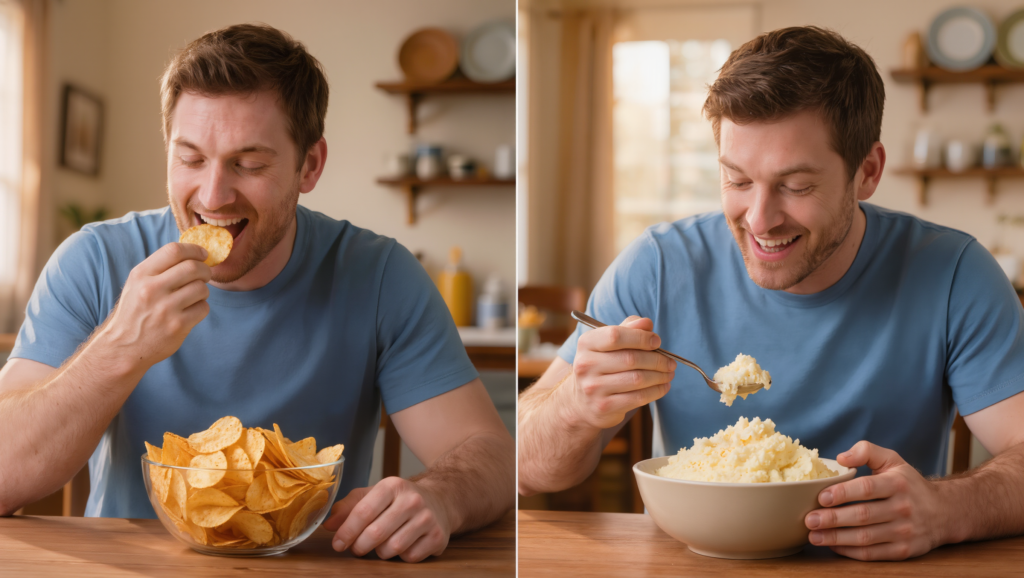












You have probably noticed that a bowl of creamy soup leaves you hungry again much faster than a big salad with lots of crunch, even if the calorie counts are similar. Or that a smoothie disappears in minutes, while a chunky, fibrous meal keeps you satisfied for hours. This is not just in your head. Food texture—how hard, soft, crunchy, chewy, or viscous a food feels in your mouth—plays a powerful role in how full you feel, how much you eat, and even how your satiety hormones respond.
For years, nutrition advice has focused on macros (protein, fat, carbs), fiber, and calories. But an emerging body of research shows that the physical and sensory properties of food—especially texture and how long you spend chewing it—can significantly influence satiation (feeling full during a meal) and satiety (feeling full after a meal).
In this deep dive, we will unpack the science behind crunchy vs. soft foods, how texture shapes your eating rate and oral exposure time, and how all of this ties into key satiety hormones like GLP-1, PYY, CCK, and ghrelin.
The Basics: Satiation vs. Satiety
First, a quick distinction:
- Satiation is the feeling of fullness that builds during a meal and eventually makes you stop eating.
- Satiety is the lingering sense of fullness after a meal that delays the next eating occasion.
Texture affects both. Harder, chewier, more complex textures tend to:
- Slow down eating rate.
- Increase the number of chews and oral processing time.
- Enhance satiation (you stop eating sooner).
- Prolong satiety (you feel full longer).
By contrast, soft, smooth, or liquid textures are typically:
- Eaten faster.
- Chewed less (or not at all).
- Less satiating per calorie.
- More likely to lead to higher overall energy intake.
How Texture Changes How You Eat
Eating rate and bite size
One of the most consistent findings in texture research is that harder, chewier, and more viscous foods are eaten more slowly and in smaller bites than soft or liquid foods.
For example:
- Solid and high-viscosity foods reduce hunger more than liquid and low-viscosity foods in meta-analyses.
- Softer textured foods are normally ingested quickly, have shorter oro-sensory exposure time, tend to be eaten with larger bites, and have lower satiety on a calorie-for-calorie basis compared to harder textured foods.
- In controlled studies, soft-textured meals led to significantly greater food intake (in grams) than hard-textured meals, even when palatability was similar.
This matters because eating rate is strongly linked to energy intake. Faster eating is associated with:
- Higher total calorie consumption in a single meal.
- Weaker satiation signals.
- Greater risk of weight gain over time.
Oral processing time and chewing
“Oral processing” refers to everything that happens in your mouth: biting, chewing, mixing with saliva, and forming a bolus ready to swallow. Texture directly determines how long this takes.
Research shows that:
- Increasing the number of chews or prolonging mastication significantly reduces self-reported hunger and often reduces subsequent food intake. A meta-analysis of 13 trials found that prolonged mastication significantly reduced hunger, with many experiments showing reduced later intake.
- A comprehensive review of 42 studies concluded that short-term satiety increased with longer eating time, longer food residency in the mouth, and a higher number of chews.
- Harder, chunkier, more viscous, and more solid foods reduce the weight and energy consumed in a meal, even when palatability is unchanged.
In other words, making food “work harder” in your mouth tends to make you eat less of it and feel fuller afterward.
Textural complexity
It is not just about hard vs. soft. “Textural complexity”—the number and dynamic progression of individual textures perceived from the first bite through to swallowing—also matters.
In one study, participants who ate a starter with high textural complexity (layered gel with particulate inclusions) consumed less food in a subsequent two-course meal compared to those who had a low-complexity starter, even though flavor, energy density, and oral processing time were matched. This suggests that varied, interesting textures may enhance satiation beyond simple hardness or chewiness.
The Hormone Connection: How Texture Influences GLP-1 – PYY – CCK And Ghrelin
Texture does not just change how you behave; it changes your physiology. The act of chewing and the duration of oral exposure influence the release of key gut hormones that regulate appetite.
Key satiety hormones
The main players are:
- Cholecystokinin (CCK): Secreted by I-cells in the duodenum and jejunum; promotes early satiation and reduces meal size.
- Peptide YY (PYY): Released from L-cells in the ileum and colon; inhibits gastric motility and emptying, reduces appetite, and promotes satiety.
- Glucagon-like peptide-1 (GLP-1): Also from L-cells; enhances insulin secretion, slows gastric emptying, and increases feelings of fullness.
- Ghrelin: Produced mainly in the stomach; increases pre-meal hunger and initiates eating. Levels typically fall after a meal.
What happens when you chew more?
Multiple studies show that increased chewing and longer eating times shift these hormones in a more satiety-promoting direction:
- Higher GLP-1 and PYY: Postprandial (after-meal) responses of plasma PYY and GLP-1 were higher after a 30-minute meal compared to a 5-minute meal, indicating that slower eating enhances the release of these anorexigenic (appetite-suppressing) hormones.
- Lower ghrelin (in many studies): A meta-analysis and several individual trials report that increased chewing reduces ghrelin levels, though not all studies agree. Overall, the trend is toward decreased orexigenic (appetite-stimulating) signaling with more oral processing.
- Higher CCK: While data are more mixed, some studies show that longer eating times and more chewing increase CCK secretion, contributing to earlier satiation.
One overview summarizes: “The observation that the number of chews by which a meal is eaten also influences entero-endocrine secretion, with an increase in the secretion of the anorexic hormones GLP-1 and PYY and decrease in the secretion of the orexigenic hormone ghrelin in many, although not all studies… provides additional support for a significant role for mastication in appetite control.”
Hard vs. soft texture and hormones
Direct comparisons of hard vs. soft textures show:
- Increased levels of fullness and decreased hunger after consuming harder textured foods that require more chewing and have longer oro-sensory exposure time.
- In one study, ghrelin concentrations were actually higher when chewing hard-texture model foods compared to soft, yet fullness and satiety ratings still increased—suggesting that sensory and neural signals may override or interact with hormonal cues in complex ways.
- A 2026 study found that a “hard-ultra-processed meal” delivered significantly higher post-meal satiety than softer or less processed meals, despite similar calorie content.
The overall pattern: harder, chewier textures tend to boost satiety hormone responses (GLP-1, PYY, sometimes CCK) and/or blunt hunger signals, contributing to reduced intake and greater fullness.
Why Crunchy And Chewy Foods Feel More Filling
Several mechanisms explain why crunchy, chewy, and fibrous foods promote greater satiety:
1. Longer oro-sensory exposure time (OET)
OET is the duration of chewing and taste exposure from ingestion to swallowing. Longer OET:
- Gives your brain more time to register taste, texture, and fullness cues.
- Allows satiety hormones more time to rise before you finish the meal.
- Enhances the sensory-specific satiety that makes you feel “done” with that food.
Soft, smooth, or liquid foods have short OET, so you can consume many calories before your brain and gut “catch up.”
2. Slower gastric emptying
Solid and viscous foods generally empty from the stomach more slowly than liquids. This:
- Prolongs gastric distension, activating stretch receptors that signal fullness.
- Extends the time nutrients remain in the small intestine, sustaining CCK, GLP-1, and PYY release.
3. Greater cognitive awareness of intake
Harder, textured foods demand more attention:
- You notice each bite more.
- You are more aware of how much you have eaten.
- This heightened awareness can reduce mindless overeating.
By contrast, soft or liquid calories (smoothies, sodas, soups) are easy to consume quickly with less conscious tracking, making overconsumption more likely.
4. Energy density and food structure
Often, harder or crunchier foods are also:
- Less energy-dense (e.g., raw vegetables, whole fruits, nuts in moderation).
- More fibrous, adding bulk without many calories.
- Less processed, with intact food matrices that slow digestion.
However, texture effects on satiety can occur even when energy density is matched, indicating an independent role of physical form.
Practical Implications: Using Texture To Support Appetite Control
You do not need to turn every meal into a chewing marathon, but small texture tweaks can meaningfully influence fullness and intake.
Favor harder, chewier, and more complex textures
Examples:
- Choose whole fruits over juices or smoothies.
- Opt for al dente pasta or chewy whole grains instead of very soft, overcooked versions.
- Include crunchy vegetables (carrots, celery, bell peppers) and fibrous salads.
- Pick nuts and seeds (in reasonable portions) for their crunch and chew.
- Prefer chunky soups and stews over completely pureed ones.
Slow down intentionally
Even with softer foods, you can mimic some benefits of hard textures by:
- Taking smaller bites.
- Chewing each bite more thoroughly (aim for 20–30 chews for solid foods).
- Putting your fork down between bites.
- Setting a minimum meal duration (e.g., at least 20 minutes).
Studies show that simply instructing people to eat more slowly can reduce intake and enhance satiety, especially when combined with texture modifications.
Be cautious with ultra-soft, ultra-processed foods
Many ultra-processed foods are engineered to be:
- Very soft or melt-in-the-mouth.
- Low in fiber and structural complexity.
- Easy to eat quickly and in large amounts.
This combination makes them particularly prone to driving overconsumption. When possible, choose less processed versions with more intact structure and texture.
Use texture strategically for weight management
If you are trying to lose or maintain weight:
- Build meals around foods that require more chewing and have higher textural complexity.
- Limit liquid calories and very soft, highly processed options.
- Combine texture strategies with adequate protein, fiber, and overall balanced nutrition for best results.
What About Special Populations?
Texture manipulation can be especially relevant for:
- Older adults: Those with dental issues or dysphagia may rely on soft or pureed diets, which can reduce satiety and increase risk of under- or over-nutrition. Careful formulation (e.g., adding viscosity, fiber, or textural elements where safe) can help.
- People with obesity: Faster eating and preference for soft, energy-dense foods are common. Texture-based interventions (harder, chewier options; eating rate training) may support appetite control.
- Children: Early exposure to a variety of textures may shape long-term eating behaviors and satiety responsiveness.
Limitations And Nuances
While the evidence is compelling, a few caveats matter:
- Not all studies agree. Some find no difference in subsequent meal intake despite changes in texture or eating rate, or inconsistent hormone responses. Individual variability is real.
- Palatability matters. If harder or chewier foods are less enjoyable, people may compensate by eating more later or seeking other rewarding foods. Texture changes should not come at the cost of acceptability.
- Context is key. Texture is one factor among many (protein, fiber, energy density, sleep, stress, activity). It is a tool, not a magic solution.
Bottom line
Yes, food texture significantly affects how full you feel. Harder, chewier, crunchier, and more texturally complex foods tend to:
- Slow your eating rate and increase chewing.
- Extend oral sensory exposure time.
- Enhance the release of satiety hormones like GLP-1, PYY, and CCK, and often reduce ghrelin.
- Increase feelings of fullness during and after meals, and reduce subsequent energy intake.
Soft, smooth, and liquid foods do the opposite: they are eaten faster, chewed less, and are generally less satiating per calorie, making overconsumption more likely.
This does not mean you must avoid all soft foods or turn every meal into a chewing workout. But if you struggle with hunger, cravings, or portion control, paying attention to texture is a simple, evidence-based lever to pull. Choosing more crunchy, chewy, and structurally complex foods—and eating them slowly—can help your brain and gut hormones do what they evolved to do: tell you when you have had enough.
Sources:
- https://pmc.ncbi.nlm.nih.gov/articles/PMC8323852/
- https://pmc.ncbi.nlm.nih.gov/articles/PMC8365638/
- https://pmc.ncbi.nlm.nih.gov/articles/PMC7395742/
- https://pmc.ncbi.nlm.nih.gov/articles/PMC7353031/