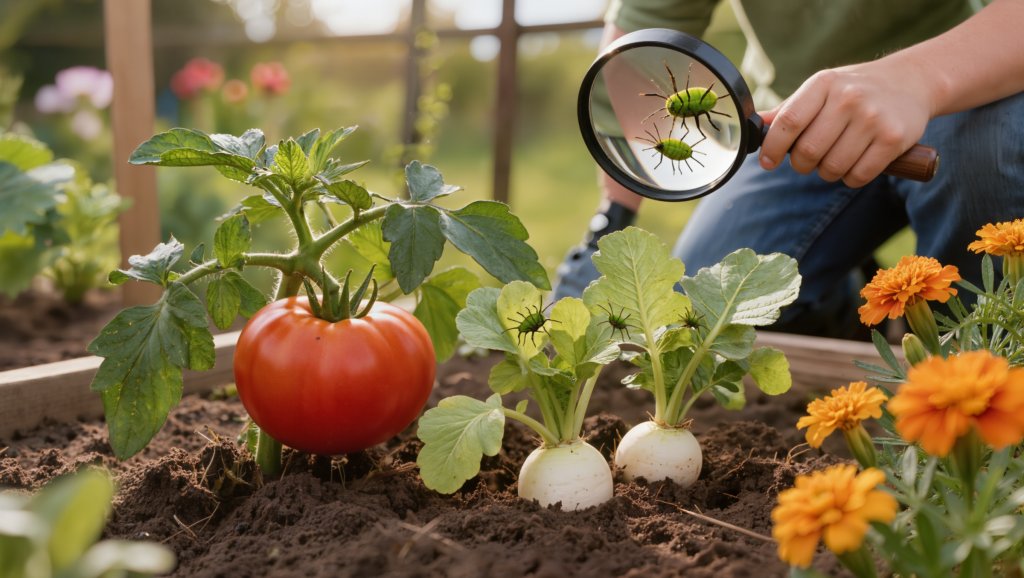












If you have ever found a kale leaf covered in tiny green bugs, or watched aphids turn your beans and peppers sticky and curled, you know how fast an aphid invasion can get out of hand. Before reaching for chemical Pest Control or a broad-spectrum spray, there is a smarter, more organic garden-friendly strategy: it’s called trap cropping.
Trap crops are sacrificial plants you deliberately grow to lure pests—like aphids—away from your main vegetables. Think of them as decoys in a garden-scale defense system. The aphids find the trap crop more attractive, cluster there, and you manage the infestation before it spreads to your prized lettuce, broccoli, beans, or tomatoes.
This is not magic or a guaranteed cure, but it is a well-supported, low-chemical tool in integrated pest management (IPM). Used correctly, trap crops can reduce aphid pressure on your main crops and give you more time to respond with targeted, gentle controls.
Here is how it works, which plants to use, and how to set up a trap-crop system that actually helps.
What Is A Trap Crop?
A trap crop is a plant that:
- Is more attractive to a target pest than your main crop.
- Draws the pest away from the crop you want to protect.
- Concentrates the pest in a manageable location.
- Is then removed, treated, or otherwise managed before the pest moves on.
In simple terms: you give aphids a “better deal” somewhere else in the garden, so they leave your main vegetables alone.
This is different from companion planting, which may involve subtle chemical or ecological interactions. Trap cropping is more direct: you are planting a specific decoy because you know (or suspect) that aphids prefer it.
Why Trap Crops Work Against Aphids
Aphids are highly mobile and can reproduce quickly. They are attracted to certain plants by:
- Visual cues: Color and shape of leaves and stems.
- Chemical cues: Volatile compounds released by plants.
- Nutritional quality: Some plants offer better sap or more tender growth.
Trap crops exploit these preferences. By planting a species that aphids find especially appealing, you create a “sink” that draws them away from your main crop.
Research supports this approach. A review of companion plants for aphid management notes that trap plants can attract pests and keep them away from the main crop, provided they are more attractive and planted strategically.
Another key point: trap crops must be managed. If you just let aphids multiply on the decoy, they will eventually spread to your main crop. The goal is to concentrate and then remove or treat the infestation.
Best Trap Crops For Aphids
Not all plants work equally well. Here are some of the most commonly recommended trap crops for aphids in vegetable gardens:
Nasturtiums
Nasturtiums (Tropaeolum majus) are one of the most popular aphid trap crops.
- Aphids are strongly attracted to them.
- They are easy to grow from seed.
- They can be planted as borders, in rows, or scattered through beds.
One gardener source notes that nasturtiums can draw aphids away from tomatoes, beans, and brassicas.
Calendula
Calendula (Calendula officinalis) is another favorite.
- It attracts a wide range of aphids.
- It is especially useful near leafy greens like kale, chard, and mustards.
Okra
Okra (Abelmoschus esculentus) is sometimes used as a trap crop for aphids, particularly in warmer climates.
- It can be interplanted with tomatoes to reduce aphid pressure.
Mustard
Mustard (Brassica spp.) can attract aphids and some caterpillar pests.
- It is often used around cabbage and other brassicas.
Other options
Depending on your region and pest species, other trap crops may include:
- Sunflowers for certain aphid species.
- Radishes in some systems.
- Marigolds for a broader pest-deterrent effect (though not always a true trap crop).
The key is to match the trap crop to the aphid species you are dealing with. Local extension services or experienced gardeners can help you choose the best fit.
How To Set Up A Trap-Crop System
Trap cropping works best when it is planned, not just thrown into the garden randomly. Here is a step-by-step approach.
1. Identify your target pest
Before planting anything, figure out which aphid species is causing trouble. Different aphids have different preferences.
- Green peach aphid, cabbage aphid, bean aphid, etc.
- Check local extension resources or ask at a nursery.
2. Choose the right trap crop
Select a plant that is known to attract that specific aphid.
- Nasturtiums for general aphids.
- Calendula for leafy greens.
- Okra for tomatoes.
- Mustard for brassicas.
3. Plant early
Timing is crucial.
- Plant trap crops before your main crop, ideally 1–2 weeks ahead.
- This gives the trap crop time to establish and become attractive before pests arrive.
4. Place them strategically
There are a few common layouts:
- Perimeter planting: Surround the garden or bed with trap crops.
- Row interplanting: Alternate rows of trap crops with main crops.
- Cluster planting: Group trap crops at corners or ends of beds.
For perimeter planting, some sources recommend keeping trap crops at least 5 feet away from the main crop to prevent easy access.
5. Monitor and manage
This is the most important step.
- Check trap crops regularly (at least twice a week).
- Look for aphids, eggs, and natural enemies.
- When the trap crop becomes heavily infested, act before aphids spread.
Management options include:
- Manual removal: Pick off aphids or prune heavily infested parts.
- Insecticidal soap or neem: Targeted sprays on the trap crop only.
- Removal and disposal: Pull and bag the plant if infestation is severe.
6. Stagger plantings
For season-long control:
- Plant new trap crops every 2–3 weeks.
- This ensures a continuous supply of attractive decoys.
Combining Trap Crops With Other Methods
Trap cropping works best as part of an integrated pest management (IPM) approach. Here are some complementary strategies:
Encourage natural enemies
- Plant flowers that attract ladybugs, lacewings, and hoverflies (e.g., sweet alyssum, dill, yarrow).
- Avoid broad-spectrum insecticides that kill beneficial insects.
Use physical barriers
- Row covers can exclude aphids from young plants.
- Reflective mulches can deter some aphid species.
Practice good garden hygiene
- Remove weeds and plant debris that can harbor aphids.
- Rotate crops each season.
- Avoid over-fertilizing with nitrogen, which can promote lush growth that aphids love.
Monitor regularly
- Check undersides of leaves and growing tips.
- Use yellow sticky cards to track aphid populations.
- Act early when you see the first few aphids.
Common Mistakes To Avoid When Doing A Trap-Crop System
Trap cropping is not foolproof. Here are some pitfalls:
- Planting too late. If the trap crop is not established before pests arrive, it will not draw them away.
- Ignoring the trap crop. Letting aphids multiply unchecked defeats the purpose.
- Using the wrong trap crop. Not all aphids prefer the same plants. Match the decoy to the pest.
- Over-relying on trap crops alone. Combine with other IPM methods for best results.
- Planting trap crops too close. If they are right next to your main crop, aphids may simply move over. Keep some distance.
Real-World Example Of Trap Crops: Nasturtiums And Tomatoes
Imagine you are growing tomatoes and notice aphids starting to appear. Instead of spraying immediately:
- Plant nasturtiums around the edge of the tomato bed 1–2 weeks before transplanting tomatoes.
- Check the nasturtiums twice a week.
- When you see aphids clustering on the nasturtiums, spray them with insecticidal soap or remove the most infested leaves.
- Continue monitoring and re-plant nasturtiums every few weeks.
This simple system can reduce aphid pressure on your tomatoes without harming beneficial insects.
The Science Behind Trap Cropping
Trap cropping is a form of push-pull pest management:
- Push: Make the main crop less attractive (e.g., through intercropping or mulching).
- Pull: Make the trap crop more attractive.
Research shows that trap crops can reduce pest density on main crops when:
- The trap crop is more attractive.
- It is planted early and strategically.
- Pests are managed on the trap crop before they disperse.
A review of companion plants for aphid management notes that trap plants must be more attractive than the main crop and occupy a small space, usually planted earlier.
Another source emphasizes that trap crops should be planted at least 5 feet from the main crop in perimeter systems.
Bottom line
Trap cropping is a simple, effective, and eco-friendly way to protect your vegetables from aphid invasions. By planting a decoy that aphids prefer, you can draw them away from your main crop and manage the infestation before it spreads.
Key steps:
- Choose the right trap crop for your pest.
- Plant early and strategically.
- Monitor and manage the trap crop regularly.
- Combine with other IPM methods for best results.
Whether you use nasturtiums, calendula, okra, or mustard, the principle is the same: give aphids a better option somewhere else in the garden, and they will often take it. With a little planning and regular attention, trap crops can be a powerful tool in your organic pest management toolkit.