











If you have ever had a lingering chest cough with thick, yellow phlegm, a hot, tight chest, and a general feeling of being “stuffed up,” you may have encountered what Traditional Chinese Medicine (TCM) calls phlegm-heat obstructing the lung. In TCM, this is a specific pattern—not just “having mucus”—and it calls for a targeted approach. One of the classic formulas used for exactly this pattern is Qingjin Huatan Tang (also written Qingjin Huatan Decoction or QJHTD), often translated as the “Clear Gold Phlegm-Transforming Decoction.”
This formula has been used since the Ming Dynasty and is now included in China’s Catalog of Ancient Classical Formulas. Modern research has explored it as an adjunct therapy for respiratory conditions marked by phlegm-heat, including acute exacerbations of COPD, pneumonia, and other lung disorders.
But what exactly is in it, how does it work in TCM terms, and what does the evidence actually show? Let’s dig in.
What Is “Phlegm-Heat” In Traditional Chinese Medicine?
Before diving into the formula, it helps to understand the TCM diagnosis. Phlegm-heat obstructing the lung is a pattern characterized by:
- A productive cough with yellow, thick, sticky, or dry phlegm.
- Chest pain, tightness, or a feeling of obstruction.
- Fever, thirst, or a sensation of heat.
- Possible constipation or abdominal bloating.
- A red tongue with a yellow or yellow-greasy coating.
- A rapid or slippery pulse.
This is distinct from a “cold-phlegm” pattern, which would involve clear or white phlegm, cold intolerance, and different tongue and pulse signs. In TCM, the treatment must match the pattern; using a heat-clearing formula for a cold pattern could be counterproductive.
In modern biomedical terms, this pattern often overlaps with conditions like:
- Acute bacterial or viral respiratory infections.
- Acute exacerbations of COPD (AECOPD).
- Pneumonia.
- Bronchiectasis flare-ups.
- Some cases of asthma with infection or inflammation.
What is Qingjin Huatan Tang?
Qingjin Huatan Tang is a multi-herb formula designed to:
- Clear heat from the lungs.
- Transform and expel phlegm.
- Moisten dryness and support the Lung.
- Regulate Qi to ease chest tightness.
- Harmonize the formula and protect the stomach.
The name itself reflects this:
- Qingjin = “clear gold,” referring to clearing heat from the Lung (often associated with the color gold in TCM).
- Huatan = “transform phlegm.”
- Tang = decoction (a boiled herbal tea).
The Ingredients: What’s In The Formula Of Qingjin Huatan Tang?
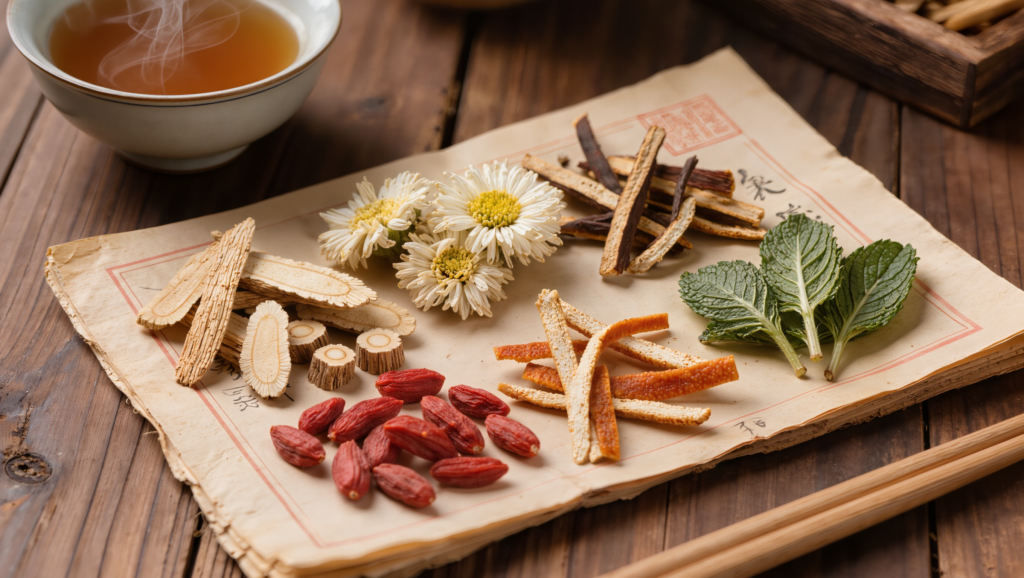
Different sources list slightly different herb counts (some say 10, some 11, some 14), but the core composition is consistent. A commonly cited version includes:
- Huangqin (Scutellaria baicalensis, Chinese skullcap): Clears heat, especially from the Lung and upper body; anti-inflammatory and antimicrobial in modern research.
- Zhizi (Gardenia jasminoides, gardenia fruit): Clears heat and drains dampness; supports liver and gallbladder function.
- Jiegeng (Platycodon grandiflorum, balloon flower root): Opens the Lung Qi, guides other herbs to the upper body, and helps transform phlegm.
- Maidong (Ophiopogon japonicus, dwarf lilyturf): Nourishes Yin, moistens dryness, and protects the Lung.
- Zhebeimu (Fritillaria thunbergii or F. verticillata): Clears heat and transforms phlegm, especially for stubborn, sticky mucus.
- Sangbaipi (Morus alba, mulberry root bark): Clears Lung heat and calms wheezing.
- Zhimu (Anemarrhena asphodeloides): Clears heat and nourishes Yin, especially for lung and stomach heat.
- Gualou (Trichosanthes kirilowii, snake gourd): Clears heat, transforms phlegm, and widens the chest to relieve tightness.
- Chenpi (Citrus reticulata, aged tangerine peel): Regulates Qi, dries dampness, and transforms phlegm.
- Fuling (Poria cocos): Strengthens the Spleen, drains dampness, and supports phlegm resolution.
- Gancao (Glycyrrhiza uralensis, licorice root): Harmonizes the formula, moistens the Lung, and protects the stomach.
Some versions may include additional herbs like Xingren (apricot kernel) to stop coughing and wheezing, or Jiegen variations, depending on the lineage and the patient’s specific symptoms.
How Does Qingjin Huatan Tang Work In TCM Theory?
In TCM, the formula is designed to address the root pattern, not just the symptom of “having phlegm.” Here is the logic:
- Clear Heat: Huangqin, Zhizi, Zhimu, and Sangbaipi target the heat that is “cooking” the phlegm and making it thick and yellow.
- Transform Phlegm: Zhebeimu, Gualou, and Chenpi work to break up and transform the sticky phlegm so it can be expelled.
- Regulate Qi: Jiegeng and Chenpi help move Qi in the chest, relieving the feeling of tightness and helping the phlegm move upward and out.
- Moisten and Protect: Maidong and Gancao prevent the heat-clearing herbs from being too drying and protect the Lung Yin.
This multi-target approach is typical of classical Chinese formulas, which are designed to treat the whole pattern rather than a single symptom.
What Does Modern Research Say About Qingjin Huatan Tang?
Modern studies have explored Qingjin Huatan Tang from several angles: clinical efficacy, anti-inflammatory mechanisms, and antiviral properties.
Clinical efficacy in respiratory conditions
Acute exacerbations of COPD (AECOPD)
A 2024 systematic review and meta-analysis of 16 randomized controlled trials (involving over 1,400 patients) found that adding Qingjin Huatan Decoction to standard Western medicine treatment for AECOPD:
- Significantly improved clinical efficacy (RR = 4.16).
- Improved pulmonary function (FEV₁, FVC, PEF).
- Reduced inflammatory markers (CRP, IL-6, TNF-α).
- Did not significantly increase adverse reactions compared to standard treatment alone.
A separate 2025 meta-analysis on stable COPD found similar results, with improved clinical efficacy (RR = 4.60) and no significant increase in adverse events.
Community-acquired pneumonia in the elderly
A 2020 meta-analysis of 13 studies (1,058 patients) found that modified Qingjin Huatan Decoction combined with Western medicine:
- Increased the clinical effective rate (RR = 1.16).
- Shortened fever time, cough time, time to rale disappearance, and hospital stay.
- Reduced inflammatory markers (CRP, WBC).
However, the authors noted the evidence quality was low and called for more high-quality, multicenter RCTs.
Bronchiectasis
A 2026 review of integrated TCM-Western medicine for bronchiectasis included studies where Qingjin Huatan Decoction was added to antibiotics and drainage. Results showed:
- Lower symptom scores.
- Reduced systemic inflammation (WBC, CRP, PCT).
- Improved pulmonary function.
- Lower sputum cytokines (TNF-α, IL-6, IL-8).
- Reduced protease activity (NE, Cathepsin G).
Mechanistic research: anti-inflammatory and antiviral effects
Beyond clinical outcomes, lab studies have explored how the formula works at a molecular level.
Anti-inflammatory effects
A 2022 network pharmacology study identified 22 active compounds from Qingjin Huatan Decoction that are absorbed into the bloodstream in rats. These compounds were found to:
- Inhibit LPS-induced acute lung injury.
- Modulate inflammatory pathways.
- Reduce cytokine production.
A 2024 study on AECOPD found the formula reduced inflammatory mediators and improved pulmonary function, supporting its anti-inflammatory role.
Antiviral effects
A 2023 study on influenza A (H1N1) pneumonia in mice found that Qingjin Huatan Decoction:
- Reduced lung virus titers.
- Improved survival rate and lung pathology.
- Reduced inflammatory cytokines (TNF-α, IL-1β, IL-6, IFN-γ).
- Acted partly through chemokine signaling pathways.
Key active compounds identified included baicalin (from Huangqin), geniposide (from Zhizi), and mangiferin.
Safety And Side Effects Of Qingjin Huatan Tang?
Like any herbal formula, Qingjin Huatan Tang is not without potential risks, especially when used incorrectly or in the wrong pattern.
Common adverse reactions
Reported side effects in clinical studies include:
- Palpitations.
- Dizziness or headache.
- Nausea, vomiting, or diarrhea.
- Abdominal pain.
- Dry mouth.
- Rash.
- Elevated blood glucose.
- Insomnia or drowsiness.
However, meta-analyses generally found no significant increase in adverse reactions compared to standard treatment alone.
The licorice issue: a key safety concern
One ingredient deserves special attention: Gancao (licorice root). Licorice contains glycyrrhizin, which can cause serious side effects when used in large amounts or long term:
- High blood pressure.
- Low potassium (hypokalemia).
- Fluid retention and edema.
- Irregular heartbeat or arrhythmias.
- Interactions with diuretics, digoxin, corticosteroids, and blood pressure medications.
For people with hypertension, heart disease, or kidney disease, licorice-containing formulas should be used with caution and under professional supervision.
Contraindications and cautions
Qingjin Huatan Tang is designed for heat patterns. It is generally not appropriate for:
- Cold-phlegm patterns (clear/white phlegm, cold intolerance).
- Yin deficiency without heat (dry cough without phlegm, night sweats).
- Spleen deficiency with dampness (poor appetite, loose stools, fatigue) without proper modification.
Pregnant women should be especially cautious due to the licorice content, and anyone on multiple medications should consult a healthcare provider or qualified TCM practitioner before use.
How Is Qingjin Huatan Tang Used In Practice?
In TCM clinical practice, Qingjin Huatan Tang is typically prescribed as:
- A decoction (boiled herbal tea), taken 1–2 times daily.
- Granules or concentrated powder, dissolved in hot water.
- Pills or capsules, for convenience.
The exact dosage and modifications depend on:
- The severity of symptoms.
- The patient’s constitution and other TCM patterns.
- Whether it is being combined with Western medicine.
In China, it is often used as an adjunct to antibiotics, bronchodilators, or other standard treatments, not as a replacement.[
What does this mean for you?
If you are dealing with a stubborn, phlegm-heavy cough with yellow mucus and heat symptoms, Qingjin Huatan Tang is a formula worth knowing about. But here are the key takeaways:
- It is pattern-specific. It works best for phlegm-heat, not all coughs or all phlegm.
- It is usually an adjunct, not a replacement. Most studies combine it with standard medical care.
- Evidence is promising but not definitive. Many studies are from China, often with methodological limitations, and more high-quality RCTs are needed.
- Safety matters. The licorice content requires caution in certain populations.
If you are considering trying it:
- Consult a qualified TCM practitioner or integrative medicine doctor.
- Get a proper TCM diagnosis to confirm the pattern.
- Disclose all medications and health conditions.
- Do not self-prescribe, especially if you have heart, kidney, or blood pressure issues.
Bottom line
Qingjin Huatan Tang is a classic example of how TCM approaches respiratory conditions: not by targeting “phlegm” in a generic way, but by addressing a specific pattern of heat and phlegm obstruction in the Lung. Its multi-herb formula is designed to clear heat, transform phlegm, regulate Qi, and protect the Lung Yin all at once.
Modern research supports its potential as an adjunct therapy for conditions like AECOPD, pneumonia, and bronchiectasis, with evidence of improved pulmonary function, reduced inflammation, and a generally favorable safety profile.
But like any powerful herbal formula, it is not a one-size-fits-all solution. The licorice content, the need for accurate pattern diagnosis, and the importance of professional guidance all mean this is a formula best used under the care of a qualified practitioner—not as a DIY remedy for every cough.
If you are dealing with stubborn, heat-type phlegm in the lungs, Qingjin Huatan Tang is a formula with a long history and growing modern evidence—but it is one piece of a larger puzzle, best used thoughtfully and safely.
Sources:
- https://pmc.ncbi.nlm.nih.gov/articles/PMC9304690/
- https://pmc.ncbi.nlm.nih.gov/articles/PMC9306795/
- https://pmc.ncbi.nlm.nih.gov/articles/PMC12801566/
- https://pmc.ncbi.nlm.nih.gov/articles/PMC11528017/