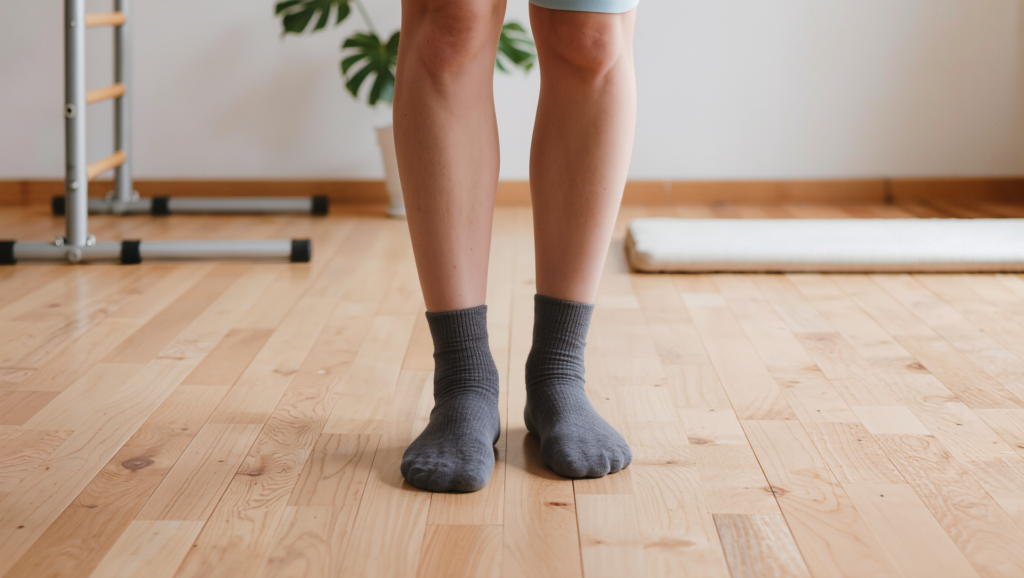












You have probably seen them on social media: little silicone or foam devices that spread your toes apart, promising better balance, stronger feet, and fewer falls. This is the toe splay trend, and it is gaining traction as a simple, low-cost way to support stability—especially in older adults at risk of falling.
But does restoring toe splay actually work? And how does it connect to fall prevention? In this post, we’ll explore the science behind toe splay, how it relates to balance, and what the evidence says about using toe spacers and foot exercises to reduce falls.
What Does Toe Splay Mean?
Toe splay refers to the natural ability of your toes to spread apart from each other, especially the big toe (hallux) moving away from the second toe. This is important for:
- Ground contact: More surface area in contact with the ground.
- Weight distribution: Better spread of pressure across the foot.
- Grip and propulsion: Toes help push off during walking and running.
- Balance: A wider base of support can improve stability.
In a healthy foot, the big toe should point forward, not inward toward the other toes. When the big toe drifts inward (as in hallux valgus or bunions), toe splay is reduced, which can affect balance and increase fall risk.
Why Toe Splay Matters For Balance
Your feet are your foundation. When they are strong, flexible, and properly aligned, they provide a stable base for the rest of your body. When they are weak, stiff, or misaligned, your balance suffers.
The role of the big toe
The big toe (hallux) plays a critical role in balance:
- Weight bearing: It bears a significant portion of your body weight during standing and walking.
- Propulsion: It helps push off during gait.
- Balance: It provides a key point of contact with the ground for stability.
When the big toe is weak, painful, or misaligned, it can compromise all of these functions.
The role of the lesser toes
The other four toes also contribute to balance:
- Grip: They help grip the ground, especially on uneven surfaces.
- Weight distribution: They help spread pressure across the foot.
- Sensory feedback: They provide important sensory information to the brain about ground contact and position.
When the lesser toes are weak or deformed (as in hammertoes or claw toes), it can also affect balance.
The Connection Between Toe Splay And Fall Risk
Research has shown that several foot-related factors are associated with increased fall risk in older adults:
- Foot pain: Increases fall risk by nearly 2 times (pooled OR = 1.99).
- Impaired sensory function: Increases fall risk by about 1.5 times (pooled OR = 1.52).
- Intrinsic foot muscle weakness: Increases fall risk by about 1.65 times (pooled OR = 1.65).
- Toe flexor weakness: Increases fall risk by about 2 times (pooled OR = 2.04 for lesser toes).
These findings suggest that maintaining strong, flexible, and properly aligned toes is important for preventing falls.
Hallux Valgus: When Toe Splay Goes Wrong
Hallux valgus (bunion) is a common foot deformity where the big toe drifts inward toward the second toe. This reduces toe splay and can have serious consequences for balance. [
How hallux valgus affects balance
Studies show that people with hallux valgus have:
- 20% more postural sway compared to healthy controls.
- Impaired walking mobility (measured by the Timed Up and Go test).
- Reduced functional balance (measured by the Berg Balance Scale).
As the severity of the deformity increases, balance worsens.
Why this happens
Hallux valgus causes:
- Loss of stiffness in the first ray (the big toe and its metatarsal bone).
- Compromised stabilizers of the first metatarsophalangeal joint, including the plantar aponeurosis and flexor hallucis longus.
- Reduced plantarflexion strength of the big toe.
All of these factors contribute to poorer balance and higher fall risk.
The Toe Spacer Trend: What Science Says
Toe spacers (also called toe separators or toe spreaders) are devices worn between the toes to encourage them to spread apart. They are often recommended as part of a foot rehab program.
Short-term effects: mixed results
A 2023 pilot study of 50 healthy, active subjects found that:
- Toe separators had no immediate effect on dynamic balance or ankle range of motion.
- There were no differences between the control and experimental conditions.
Another 2026 study of healthy adults found that:
- A six-week foot strengthening program improved hallux alignment, mobility, and ankle dorsiflexion.
- Adding a silicone toe spacer did not provide additional short-term benefits compared to exercise alone.
Long-term effects: promising but limited
Some studies suggest that toe spacers may help when used over a longer period:
- A study of people with gait imbalances found that spacers helped correct walking and improve stability.
- Research on stroke patients found similar benefits.
However, there is very little published research on the long-term effects of toe spacer use.
The bottom line on toe spacers
- Toe spacers alone are not a magic fix. They do not provide immediate improvements in balance for most people.
- They may help when combined with foot exercises. Some studies suggest that combining spacers with foot strengthening routines can boost foot strength and flexibility.
- More research is needed. The evidence is still limited, and results are mixed.
Foot Strengthening Exercises That Support Toe Splay
While toe spacers alone may not be enough, foot strengthening exercises have shown more consistent benefits for balance and fall prevention.
Intrinsic foot muscle exercises
These exercises target the small muscles inside the foot that support the arch and control toe movement:
- Short foot exercise: Pulling the ball of the foot toward the heel without curling the toes.
- Toe spreading: Actively spreading the toes apart.
- Toe curls: Curling the toes to pick up a towel or marble.
- Toe yoga: Moving the big toe up and down while keeping the other toes still.
Evidence for foot exercises
A systematic review of 9 studies (1,674 people) found that intrinsic foot muscle strengthening programs:
- May improve toe strength, balance, and functional mobility.
- May reduce the risk of falls.
- Do not appear to affect fear of falling.
Another review found that:
- Foot and ankle exercises improved balance under eyes-open conditions.
- Toe-strengthening exercise 3 times per week appeared important for improving balance.
Foot exercises and fall reduction
While foot exercises improve balance, the evidence for reducing actual fall incidence is still limited:
- A meta-analysis found that ankle-foot exercises improved balance but did not significantly reduce fall incidence in older adults.
- However, a multifaceted podiatry intervention (including toe flexor strengthening and footwear advice) reduced falls by 36% over 12 months in older adults with disabling foot pain. [
This suggests that foot exercises work best as part of a comprehensive fall prevention program.
The Role Of Footwear In Toe Splay And Balance
Footwear plays a big role in toe splay and balance:
- Narrow, pointed shoes squeeze the toes together, reducing splay.
- High heels shift weight forward, increasing pressure on the toes.
- Minimal footwear allows more natural toe splay and better sensory feedback.
Minimal footwear and balance
A 2025 study found that long-term minimal footwear use in older adults at risk of falling:
- Improved dynamic balance (Mini-BESTest scores).
- Reduced fall risk.
- Resulted in fewer falls and longer time to first fall compared to controls.
This suggests that allowing the foot to move more naturally can support balance.
Practical Tips: How To Restore Toe Splay And Improve Balance
If you want to use this science to improve your balance and reduce fall risk, here are some evidence-based strategies:
1. Practice toe spreading
- Sit or stand and actively spread your toes apart.
- Hold for 5–10 seconds, then relax.
- Repeat 10–15 times per foot.
2. Do toe curls
- Place a small towel on the floor.
- Use your toes to scrunch it up.
- Repeat 10–15 times per foot.
3. Try the short foot exercise
- Sit with your foot flat on the floor.
- Without curling your toes, pull the ball of your foot toward your heel.
- Hold for 5–10 seconds.
- Repeat 10–15 times per foot.
4. Use toe spacers (with caution)
- Wear them for short periods at first.
- Combine with foot exercises for best results.
- Stop if you feel pain or discomfort.
5. Choose better footwear
- Avoid narrow, pointed shoes.
- Choose shoes with a wide toe box.
- Consider minimal footwear for short periods if you are healthy and have good balance.
6. Combine with balance training
- Add balance exercises like single-leg stands or heel-to-toe walking.
- Consider a comprehensive fall prevention program.
Falls As A Major Health Issue
Falls are a major public health issue, especially for older adults:
- They can lead to serious injuries like hip fractures.
- They can reduce independence and quality of life.
- They can increase the risk of death.
Research shows that:
- Strength, balance, and aerobic training can reduce falls by up to 50% in community-dwelling older adults.
- Multi-component exercise programs reduce medically attended injurious falls and fall-related emergency department visits.
- Foot-focused interventions (including toe strengthening and footwear advice) can reduce falls by 36% in some populations. [
What We Still Don’t Know About Toe Splay And Balance
While the research on toe splay and balance is promising, there are important caveats:
- Most studies are small or short-term. Long-term effects on fall reduction are not yet clear.
- Toe spacers alone are not enough. They need to be combined with exercises and other interventions.
- Individual differences matter. What works for one person may not work for another.
More research is needed to fully understand how toe splay, foot strength, and balance interact, and to identify the best interventions for different populations.
Bottom line
The toe splay trend is more than just a social media fad—it is rooted in real science about foot function and balance. While toe spacers alone may not provide immediate benefits, restoring natural toe splay through exercises and better footwear can support stability and reduce fall risk.
Key takeaways:
- Toe splay is important for balance, especially the big toe.
- Toe spacers alone are not a magic fix, but may help when combined with exercises.
- Foot strengthening exercises are more consistently supported by evidence. [
- Footwear matters. Minimal footwear and wide toe boxes can support natural toe splay.
If you are concerned about balance or fall risk, consider adding foot strengthening exercises to your routine. And if you have significant foot pain or deformity, see a podiatrist or physical therapist for a personalized plan.
Your feet are your foundation—give them the attention they deserve, and they will help keep you steady on your feet for years to come.
SourcesL