











You have probably heard the advice to use smaller plates to eat less. But what if the color of your plate matters just as much—or even more—than its size? It turns out that the color contrast between your food and your plate can subtly influence how much you serve yourself, how full you feel, and ultimately how many calories you consume.
This is not just a quirky psychology experiment. It is rooted in a well-known visual illusion called the Delboeuf illusion, which affects how we perceive size and quantity based on surrounding context. When applied to food and plates, it can lead to overeating or undereating—often without you even realizing it.
In this post, we’ll dive into the science of plate color, portion perception, and appetite control, and show you how to use this knowledge to make smarter choices at every meal.
The Delboeuf Illusion: How Context Changes Perception
The Delboeuf illusion is a classic optical illusion where two identical circles appear different in size depending on the size of the surrounding circle. When a small circle is surrounded by a larger one, it looks smaller; when surrounded by a slightly larger one, it looks bigger.
This same principle applies to food on a plate:
- Food on a small plate looks larger than the same amount on a big plate.
- Food on a plate with a contrasting color looks larger than the same food on a plate of similar color.
In one study, participants overestimated the diameter of food portions by 5% and the visual area by 10% on plates with wider rims compared to thin rims. Adding color to the rim increased the perceived size by another 3%.
This means that the way your food is presented—plate size, rim width, and especially color—can trick your brain into thinking you have more or less food than you actually do.
How Plate Color Affects How Much You Serve Yourself
One of the most consistent findings in this research is that color contrast between food and plate influences serving size.
Low contrast = more food served
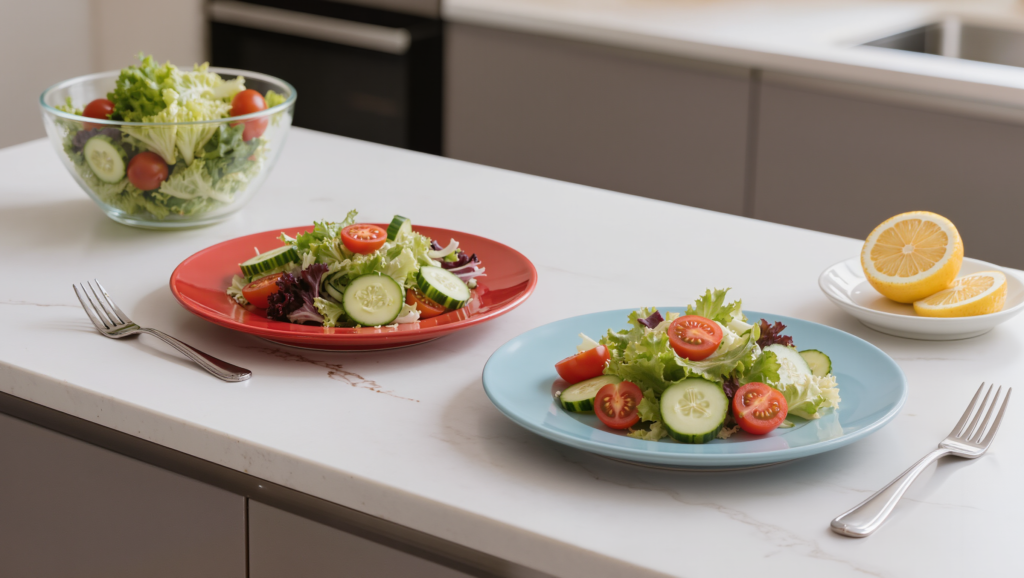
When the color of your food closely matches the color of your plate, you tend to serve yourself more. For example:
- White pasta with Alfredo sauce on a white plate.
- Red pasta with marinara sauce on a red plate.
In one study, participants in low-contrast conditions served themselves significantly more pasta than those in high-contrast conditions—182.7 grams vs. 140.6 grams.
This happens because the food blends into the plate, making it harder to judge how much you have taken. Your brain relies on visual boundaries to estimate portion size, and when those boundaries are fuzzy, you overshoot.
High contrast = less food served
When there is a strong color contrast between food and plate, you tend to serve yourself less. For example:
- Red pasta on a white plate.
- White pasta on a red plate.
In the same study, participants in high-contrast conditions served themselves less than the target amount, especially on smaller plates.
The clear visual boundary makes it easier to judge portion size, so you naturally stop before overdoing it.
Does Plate Color Affect How Full You Feel?
Interestingly, the research on plate color and satiety (feeling full) is more mixed than the research on serving size.
Some studies show an effect
A 2023 study of 408 adolescents found that:
- Food on a medium red plate led to lower perceived satiety than on medium or large white plates.
- Food on a small white plate led to lower perceived satiety than on large white plates (in girls only).
This suggests that larger, white plates may delay the feeling of fullness, potentially leading to more eating.
Other studies show no effect
A 2024 study on young people with mild intellectual disabilities found that:
- Plate color (white, red, or blue) did not significantly affect the amount of fried rice consumed.
- There were no differences in satiety or hunger ratings across conditions.
Another 2024 study found that plate color did not affect perceived portion size or energy value for desserts.
The takeaway
The effect of plate color on satiety may depend on:
- The type of food.
- The individual.
- The specific color combination.
- Whether you are serving yourself or being served a fixed portion.
More research is needed to fully understand when and how plate color influences feelings of fullness.
The Red Plate Effect: Does Red Really Curb Appetite?
Some studies suggest that red plates may reduce how much people eat, regardless of the food’s color.
In one series of experiments, participants were given popcorn, chocolate chips, or moisturizing cream on red, blue, or white plates. Results showed that:
- Red plates reduced consumption of both food and cream.
- The effect was not due to lower appeal—participants rated the food equally enjoyable regardless of plate color.
- The effect was not explained by simple color contrast.
This suggests that red may have a unique, possibly evolutionary or cultural, effect on consumption behavior.
However, not all studies agree. A 2018 study found that red and black plates actually led to more food intake compared to white plates when pasta with tomato sauce was served.
This inconsistency suggests that the effect of red may depend on:
- The type of food.
- The contrast with the plate.
- Individual differences.
Plate Size Still Matters (But not always)
While plate color is a newer area of research, the effect of plate size on portion perception is more established.
Bigger plates = bigger portions
Studies consistently show that:
- People choose larger portions when given bigger plates.
- A 28-cm plate led to more people choosing three scoops of rice compared to a 23-cm plate.
- Larger plates are associated with higher meal energy values.
This is because the Delboeuf illusion makes food look smaller on a big plate, so you compensate by taking more.
But the evidence is not unanimous
A 2017 systematic review found that:
- There is no consistent effect of plate size on food intake across all studies.
- Smaller plates did not always lead to less food consumed in buffet settings.
This suggests that while plate size can influence perception, it does not always translate directly into reduced intake.
Practical Tips: How To Use Plate Color And Size To Control Portions
If you want to use this science to your advantage, here are some evidence-based strategies:
1. Use high-contrast plates
- Choose plates that contrast strongly with your food.
- For example:
- White plate for red pasta or tomato-based dishes.
- Dark plate for light-colored foods like rice, pasta, or chicken.
- Blue or green plate for most foods.
This makes it easier to judge portion size and may help you serve yourself less.
2. Consider red plates for snacks or desserts
- If you struggle with overeating snacks or sweets, try serving them on red plates.
- The red color may subtly reduce consumption without making the food less enjoyable.
3. Use smaller plates for main meals
- While the evidence is mixed, smaller plates can still help with portion perception.
- Aim for 9–10 inch plates instead of 12-inch ones.
4. Avoid matching food and plate colors
- Be mindful of color combinations that blend together.
- For example, avoid white rice on a white plate or red pasta on a red plate.
5. Use plates with rims
- Plates with wider, colored rims can make food look larger.
- This may help you feel more satisfied with less food.
6. Be consistent
- Use the same plates regularly so your brain learns to associate them with appropriate portions.
- This can help train your perception over time.
Food Portion Perception And Weight Management
Portion control is a key factor in weight management, and environmental cues like plate size and color can play a surprisingly large role.
Research shows that:
- People consistently eat more when given larger portions.
- Visual cues like plate size and color influence how much we serve ourselves.
- Small changes in plate design can have meaningful effects on perceived food amounts and intake.
By understanding these cues, you can make smarter choices about how you present your food—without feeling deprived.
Limitations On Plate Color And Portion Aerception And What We Still Don’t Know
While the research on plate color and portion perception is promising, there are important caveats:
- Most studies are small and short-term. Long-term effects on weight management are not yet clear.
- Results are inconsistent. Not all studies find the same effects, and results can vary by food type, population, and setting.
- Individual differences matter. What works for one person may not work for another.
More research is needed to fully understand how plate color and size interact with other factors (like food type, hunger level, and eating environment) to influence intake.
Bottom line
Does your plate color make you eat more? The answer is: it can. The color contrast between your food and your plate influences how much you serve yourself, and possibly how full you feel.
Key takeaways:
- High contrast between food and plate leads to smaller portions.
- Low contrast leads to larger portions.
- Red plates may reduce consumption in some contexts.
- Plate size also matters, though the evidence is more mixed.
By choosing plates with high contrast to your food, using smaller plates for main meals, and being mindful of color combinations, you can harness the power of visual perception to support your appetite control goals.
It is a simple, low-cost strategy that requires no willpower—just a little awareness of how your brain perceives food.
Sources:
- https://pmc.ncbi.nlm.nih.gov/articles/PMC10362832/
- https://pmc.ncbi.nlm.nih.gov/articles/PMC11589548/