











When a cold or flu hits, many people reach for herbal remedies to ease symptoms and support recovery. Two of the most commonly used Traditional Chinese Medicine (TCM) formulas for upper respiratory infections (URIs) are Sangju Yin and Yin Qiao San. While both are used for “wind-heat” conditions, they are not interchangeable—they target different stages and symptom profiles.
Choosing the right formula can make a real difference in how quickly you feel better. In this post, we’ll break down the differences between Sangju Yin and Yin Qiao San, what each is best for, and how to decide which one might be right for you.
What are Sangju Yin And Yin Qiao San?
Both formulas are classic TCM prescriptions for wind-heat invasions, which in modern terms often correspond to early-stage colds, flu, or other viral URIs.
Sangju Yin
- Chinese name: 桑菊饮 (Sang Ju Yin)
- English name: Mulberry Leaf and Chrysanthemum Decoction
- Main focus: Cough and mild wind-heat symptoms.
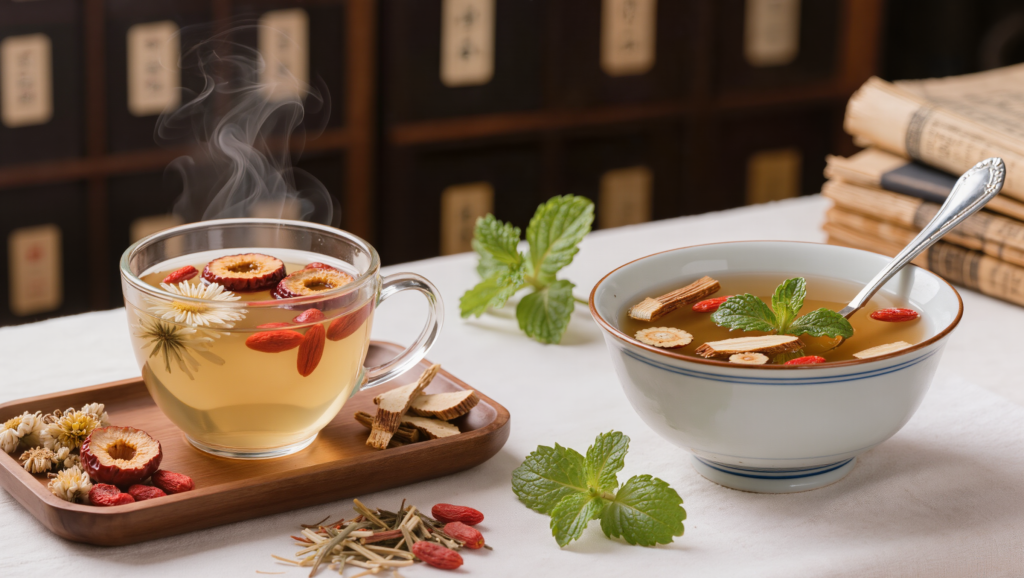
- Key herbs: Mulberry leaf (Sang Ye), chrysanthemum (Ju Hua), forsythia (Lian Qiao), mint (Bo He), platycodon (Jie Geng), bitter apricot kernel (Xing Ren), reed rhizome (Lu Gen), and licorice (Gan Cao).
Yin Qiao San
- Chinese name: 银翘散 (Yin Qiao San)
- English name: Lonicera and Forsythia Powder
- Main focus: More pronounced fever and sore throat.
- Key herbs: Honeysuckle (Jin Yin Hua), forsythia (Lian Qiao), mint (Bo He), burdock seed (Niu Bang Zi), platycodon (Jie Geng), fermented soybean (Dan Dou Chi), schizonepeta (Jing Jie), lophatherum (Dan Zhu Ye), and licorice (Gan Cao).
Key Differences: Symptom profile
The main difference between the two formulas is which symptoms dominate.
| Feature | Sangju Yin | Yin Qiao San |
|---|---|---|
| Primary symptom | Cough | Fever and sore throat |
| Fever | Mild | More pronounced |
| Sore throat | Mild or absent | Prominent |
| Cough | Dry or with scant phlegm, leading symptom | Less prominent |
| Thirst | Mild | More noticeable |
| Best for | Early, mild wind-heat with cough | More active wind-heat with fever and throat pain |
When to use Sangju Yin
Sangju Yin is best for early-stage wind-heat with cough as the main symptom.
Typical symptoms
- Mild fever with slight chills.
- Dry or slightly productive cough.
- Mild sore or itchy throat.
- Mild thirst.
- Red-tipped tongue with thin white or yellow coating.
When it is most useful
- Early common cold or flu.
- Acute bronchitis.
- Acute tonsillitis.
- Early-stage viral URIs with cough.
What it does
Sangju Yin works by:
- Dispersing wind-heat from the exterior.
- Restoring lung qi (helping the lungs function properly).
- Stopping cough and soothing the throat.
When to use Yin Qiao San
Yin Qiao San is best for more pronounced wind-heat with fever and sore throat.
Typical symptoms
- Higher fever.
- Marked sore throat.
- Headache.
- Thirst.
- Red tongue with yellow coating.
When it is most useful
- Flu with high fever.
- Sore throat-dominant colds.
- More active wind-heat presentations.
What it does
Yin Qiao San works by:
- Releasing the exterior (dispelling the pathogen).
- Clearing heat and toxins.
- Soothing the throat.
How to Choose Between Sangju Yin And Yin Qiao San
Here is a simple decision guide to help you choose between the two:
Choose Sangju Yin if:
- Cough is your main symptom.
- Fever is mild.
- Sore throat is mild or absent.
- You are in the very early stage of a cold.
Choose Yin Qiao San if:
- Fever is more pronounced.
- Sore throat is a major complaint.
- Cough is less prominent.
- You are further along in the illness.
What Modern Science Says About Sangju Yin And Yin Qiao San
The evidence for both formulas is still limited, but some studies are promising.
Yin Qiao San: more studied
- A 2020 systematic review of 4 RCTs found that Yin Qiao San (also called Eunkyosan in Korea) was superior to conventional medicine for total symptom resolution and remission of nasal symptoms.
- A 2023 randomized, placebo-controlled trial found that Yin Qiao San improved symptom and quality-of-life scores compared to placebo, though the study was prematurely terminated due to COVID-19.
- A 2026 review of 66 RCTs in children found that Yin Qiao San did not show statistically significant differences in some outcomes, but overall herbal medicines showed benefits.
Sangju Yin: less studied
- There is less direct clinical evidence for Sangju Yin specifically.
- However, one of its key ingredients, Phragmites communis (reed rhizome), has been studied in 42 RCTs for acute respiratory infections, showing improved cure rates and faster fever clearance.
- The formula is widely used in clinical practice, but more rigorous trials are needed.
Safety and Side Effects Of Sangju Yin And Yin Qiao San
Both formulas are generally considered safe when used appropriately, but there are some cautions.
Sangju Yin
- Not for wind-cold patterns (chills, clear runny nose, absence of thirst).
- Contains bitter apricot kernel (Xing Ren), which is toxic in large amounts.
- Not for severe heat-toxin (high fever, thick yellow phlegm).
Yin Qiao San
- Not for wind-cold patterns. [
- May cause mild digestive upset in some people.
- Not for severe or prolonged illness without medical supervision.
When to see a doctor
Herbal formulas can be helpful for mild, self-limiting URIs, but there are times when you should seek medical care:
- High fever that does not respond to treatment.
- Difficulty breathing or shortness of breath.
- Severe or worsening symptoms after a few days.
- Underlying health conditions that could complicate recovery.
Practical Tips: How To Use Sangju Yin And Yin Qiao San
If you decide to try one of these formulas, here are some tips:
1. Match the formula to your symptoms
- Cough-dominant: Sangju Yin.
- Fever and sore throat-dominant: Yin Qiao San.
2. Start early
- Both formulas work best in the early stages of a cold.
- The sooner you start, the better.
3. Follow dosage instructions
- Follow the recommended dose on the product label or as prescribed by a practitioner.
- Do not exceed the recommended dose.
4. Monitor your symptoms
- If symptoms worsen or do not improve after a few days, seek medical advice. [
5. Combine with rest and hydration
- Herbal formulas work best alongside rest and plenty of fluids.
Using TCM For Upper Respiratory Infections
URIs are among the most common reasons people seek medical care. While antibiotics are not effective for viral infections, many people turn to herbal remedies like Sangju Yin and Yin Qiao San to manage symptoms.
Why TCM is appealing
- Holistic approach: Treats the whole person, not just symptoms.
- Fewer side effects: Generally well-tolerated.
- Personalized: Formulas can be adjusted based on individual needs.
What still needs more research
- Large-scale, high-quality trials.
- Long-term safety data.
- Standardization of formulations.
Bottom line
Sangju Yin and Yin Qiao San are both valuable TCM formulas for upper respiratory infections, but they are not interchangeable. The key is to match the formula to your dominant symptoms.
Key takeaways:
- Sangju Yin is best for early, mild wind-heat with cough.
- Yin Qiao San is best for more pronounced fever and sore throat.
- Both are generally safe when used appropriately.
- Evidence is still limited, so more research is needed.
If you are unsure which formula is right for you, consult a qualified TCM practitioner or healthcare provider. With the right formula, you can support your body’s natural healing process and get back to feeling like yourself sooner.