











Waking up feeling like a zombie because your sleep schedule’s all over the place? You don’t need to leap out of bed for a dawn jog or invest in a $500 sunrise lamp. Hack your circadian rhythm right from under the covers using cold light therapy—a surprisingly effective combo of cool-coloured light exposure, timed breathing, and zero-movement mindset shifts that syncs your body clock without ever leaving the mattress.
This bed-bound approach draws from chronobiology basics: your suprachiasmatic nucleus (SCN, the brain’s master clock) loves bright, blue-enriched light in the morning to suppress melatonin and kickstart cortisol, alertness, and metabolism. Studies show even short bursts can phase-advance rhythms by 1–2.5 hours, helping shift workers, jet-lagged travelers, or chronic night owls realign fast. Pair it with “cold” light principles (think crisp, non-warm tones) and you amplify the effect while staying cozy.
Let’s break down how to do it safely, effectively, and without fancy gear.
Why Cold Light Therapy Works
Your circadian system isn’t just about “getting light”—it’s about timing, spectrum, and intensity. Natural dawn light is cool-toned (high blue, 450–480nm wavelength), which hits intrinsically photosensitive retinal ganglion cells (ipRGCs) to signal “wake up” to the SCN.
“Cold light” mimics this: cooler colour temperatures (5000–6500K) punch harder at suppressing melatonin than warm amber glows (under 3000K). Research confirms:
- Morning bright light (2500+ lux) advances rhythms more when blue-rich, producing phase shifts up to 2.4 hours over days.
- Even 30 minutes of targeted exposure rivals longer sessions if timed right (post-temperature nadir, around natural wake time).
- Bed-based delivery works because ipRGCs respond to indirect light through closed or half-open eyelids—less intense than full-on staring, but cumulative.
Cold therapy adds a twist: starting dim and ramping cool light mimics dawn’s gradual build, tricking your brain into smoother entrainment without shock. It’s ideal for insomnia, SAD, or delayed sleep phase disorder (DSPD), where rhythms lag 2+ hours behind society’s clock.
Bonus: no movement means you hack parasympathetic tone too—staying in bed lets you layer light with breathwork for deeper reset.
Cold Light Therapy Gear Up: What You Need (Mostly Phone or Lamp Basics)
No lab required. Start with household hacks:
Core tools
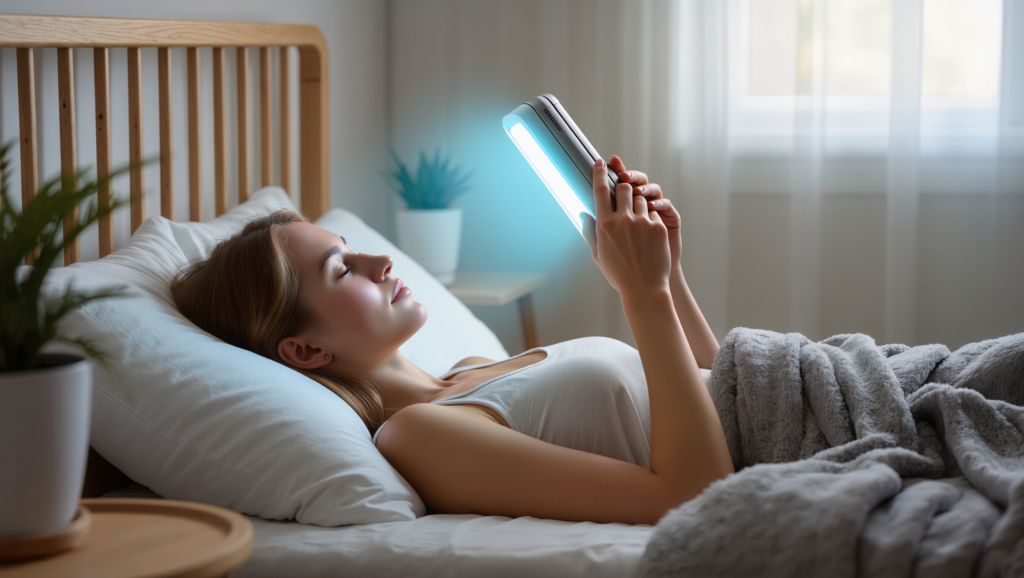
- Smartphone or tablet: Set to max brightness, cool-white mode (5000K+ via night shift off or apps like f.lux inverted). Hold 12–18 inches from face. Free apps like Blue light filter can toggle cold modes.
- Desk lamp or clip-on: 10W LED, 5000–6500K (daylight bulb, ~$5–10). Angle from headboard. Aim 1000–5000 lux at eyes (phone apps measure this).
- Sunrise alarm clock: Entry-level ones (~$20–50) ramp cool light over 30 minutes. Studies back gradual exposure for bigger shifts.
Nice-to-haves
- Blue-blocker glasses (amber, for evenings)—blocks ipRGC reset after dusk.
- Lux meter app (e.g., Lux Light Meter)—confirms intensity. Target 1000+ lux for effect.
Total startup: under $30 if you hack your phone.
The 5-Minute Bed Protocol: Morning Rhythm Reset
Do this within 30 minutes of natural wake (even if groggy). Light hits peak sensitivity then. Lie supine, eyes open (or softly focused)—no sunglasses.
Phase 1: Dim-to-Cold Ramp (0–5 min)
- Dim phone/lamp to 10–20% brightness, cool white (6500K).
- Gaze indirectly (ceiling reflection) for 2 minutes, breathing slow diaphragmatic (4-sec in, 6-sec out).
- Ramp to 80–100% over 3 minutes.
Why? Mimics dawn progression; intermittent patterns shift phases 60–90% as well as continuous.
Phase 2: Peak Exposure (5–20 min)
- Full brightness, eyes half-open if intense. Alternate 30-sec gaze/30-sec close.
- Visualise day’s energy—pair with affirmations (“I’m alert, synced”).
- Track: Notice melatonin fade (yawns stop, mind sharpens).
Expect 1–1.8 hour advance per week with consistency.
Phase 3: Anchor with Movement Mimic (20–25 min)
- Still in bed: Tense/release muscles (toes to head) while lit. Boosts cortisol response.
- Sip cold water—thermoreceptor trick enhances alertness.
Stop by 9 AM to avoid midday overstimulation.
Evening Wind-Down: Protect the Reset
Morning light alone shifts rhythms; evening hygiene locks it.
- Post-6 PM: Dim all lights to <100 lux (check app). Use amber bulbs or phone night mode.
- Blue-blockers 2 hours pre-bed—cuts ipRGC noise, advances phase.
- Zero screens 1 hour pre-sleep or use flux/red filter.
Studies: Evening light restriction + morning exposure doubles advances.
Customise for Your Circadian Rhythm Wreckers
Shift workers / jet lag
- Eastbound flights: Pre-arrival morning light x3 days (phone in hotel). Advances 2+ hours.
- Night owls (DSPD): 2500 lux 2 hours post-wake + dark goggles post-4 PM.
Insomnia / SAD
- 30–60 min daily; combine with 0.5mg melatonin afternoon (phase-advance booster). Shifts rhythms, lifts mood via serotonin.
- Track sleep diary: Expect deeper sleep in 3–7 days.
Geriatrics / ADHD
- Shorter 15-min sessions; stabilises irregular rhythms, boosts cognition.
Science Deep Dive: Phase Response Curves & Why Bed Works
Circadian pros use phase response curves (PRCs): light’s effect depends on timing.
- Morning (post-nadir ~5 AM): Advances clock (Type 1 PRC peak). 30 min intermittent = 75% of 2-hour continuous shift.
- ipRGCs integrate brief pulses—even closed eyes let 10–30% light through.
- Cold spectrum: Blue peaks at melatonin suppression; warmer light (firelight mimic) delays.
Animal data: Cold exposure indirectly aids via metabolism sync, but light’s direct SCN hit dominates. Human trials: Home light boxes advance DSPD effectively sans travel.
Risks low: Mild eye strain rare; avoid bipolar (mania trigger). Consult doc for eyes/mood disorders.
Troubleshooting: When It Feels Slow
| Issue | Fix | Evidence [cite] |
|---|---|---|
| No shift after week 1 | Double timing precision (use DLMO test kit) | Phase advances max at core temp nadir |
| Eye fatigue | Half-closed lids, 12″ distance | Intermittent = continuous efficacy |
| Winter blues persist | Add 0.5mg melatonin 6 PM | Combo yields 2.4h shifts |
| Inconsistent sleep | Strict dark post-8 PM | Light restriction amplifies |
Long-Term: Bed Hacks Into Circadian Rhythm Mastery
Consistency compounds: 3 weeks locks new rhythm. Pair with:
- Cold shower mimic: Face splash post-light.
- Meal timing: Breakfast 30 min post-session.
Outcome: Better sleep (80% report), mood lift, metabolism boost. It’s not magic— it’s chronobiology you control from bed. Why stumble to the window when you can hack dawn itself?
Sources
https://pmc.ncbi.nlm.nih.gov/articles/PMC4344919