











Most people think of gray water recycling as a clever way to save water, but in a healthy garden it can also become part of a beautiful “nutrient loop” – a cycle where water, organic matter, microbes, and plants all feed into each other instead of flowing straight to the sewer. When you divert lightly used household water into your landscape in the right way, you’re not just irrigating; you’re quietly feeding soil life, recycling nutrients, and closing loops that are usually linear and wasteful.
This isn’t a free‑for‑all, though. Done badly, gray water can add too much salt, alkalinity, or pathogens. Done well, it becomes one of the most elegant, backyard‑scale examples of circular ecology.
Let’s dig into what gray water actually is, how soil and plants “digest” it, and how to design simple systems that support nutrient loops instead of slowly poisoning your garden.
What Gray Water Actually Brings Into the Garden
“Gray water” (or greywater) is household wastewater from showers, baths, bathroom sinks, and laundry—sometimes also kitchen sinks in certain systems—excluding toilet water (that’s “blackwater” and off‑limits for simple garden reuse). It usually contains traces of:
- Skin cells, hair, sweat
- Soap residues and detergents
- Small amounts of food particles and grease (if kitchen gray water is included)
- Dirt, dust, and other organic bits
On paper, those look like “contaminants.” In a functioning soil ecosystem, many of them are nutrients and carbon sources waiting to be broken down.
Guides on garden gray water use point out that, assuming you avoid harsh products like bleach, chlorine, and high‑phosphate detergents, gray water contains:
- Organic matter (skin cells, oils) – food for soil microbes
- Small amounts of phosphorus (from many soaps) – a key plant nutrient
- Some nitrogen and other minerals – also taken up by soil biota and plants
When you pour this water down the drain, those nutrients become a pollution problem downstream. When you route it through soil and roots, they become part of a local nutrient loop instead.
How Soil Turns “Dirty” Gray Water Into Plant Food
The magic of gray water reuse isn’t in the plumbing; it’s in the soil.
As gray water moves through the soil profile:
- Physical filtration
- Particles, hair, and larger solids get trapped by soil aggregates, sand, and organic matter—like a living filter.
- This prevents clogging deeper layers and keeps most solids near the surface and active root zone.
- Biological processing
- Soil microbes (bacteria, fungi, protozoa) feed on the organic carbon in gray water—skin cells, oils, soap residues.
- Many of the “contaminants” are biodegradable; microbes use them as energy, breaking them into simpler compounds plants can actually absorb.
- As one practical guide explains, microbes and bacteria “feed off carbon and pathogens, leaving water, carbon dioxide, and non‑polluting insolubles” behind.
- Nutrient sorption and plant uptake
- Phosphorus and some nitrogen from soaps and organic matter bind to soil particles or get taken up by roots, effectively functioning as a mild fertilizer.
- Studies and field observations show greywater can “boost plant growth” and crop yields specifically because of these micro‑nutrient inputs.
- Groundwater recharge
- The remaining, filtered water either gets transpired back into the air via plants or slowly percolates down, helping recharge local groundwater—with much lower pollutant load than if it had gone straight to storm drains or sewers.
So when your shower water runs out to a mulch basin under a fruit tree instead of into a sewer, you’re doing more than saving water: you’re feeding soil organisms, cycling nutrients, and thickening the “living sponge” that makes your garden resilient.
Gray Water as a Nutrient Loop, Not Just Irrigation
In a typical household, the flow looks like this:
Clean water → house → used once → sewer or septic → distant treatment → discharged (often still nutrient‑loaded) into waterways.
You’ve imported nutrients (as soap, food, etc.) and then exported them as waste.
When you divert gray water to your garden, the loop looks more like:
Clean water → house → used once → soil and plants → microbes break down organics → nutrients stored in soil/biomass → harvested as food or mulch → back to soil.
You’ve closed a loop: those phosphorus, nitrogen, and carbon molecules stick around as part of your local ecosystem rather than contributing to algal blooms somewhere downstream.
Groups focused on gray water reuse explicitly frame it this way: using household wastewater in the landscape keeps water and nutrients on site, reduces load on sewer systems, and reconnects urban residents to natural water and nutrient cycles.
When you combine gray water with other regenerative practices—like composting, mulching, and planting deep‑rooted perennials—you start to build a genuine circular nutrient economy in your yard.
Practical Garden Benefits: Beyond Saving Water
People often start with gray water for drought‑proofing and water bills, then notice unexpected ecosystem perks.
Guides and case studies highlight that gray water systems:
- Provide a consistent daily water supply, even under municipal restrictions.
- “Boost plant growth” and crop yields thanks to organic matter and low‑level nutrients.
- Support soil microbial communities, improving structure, aeration, and water‑holding capacity.
- Help create cooler, greener microclimates—even in water‑scarce regions.
For example:
- One estimate notes that an average small household can generate over 100,000 liters of gray water per year, which is often more than enough to keep established trees and perennial beds lush during dry spells.youtube
- Gardeners report that gray water–fed trees and ornamental plantings show more vigorous growth, in part because they receive both water and dissolved nutrients regularly.
In other words, gray water is like a mild, slow‑release fertigation system—if you design it properly.
Where Nutrient Loops Can Go Wrong: Salts, pH, and Pathogens
Nutrient loops are only healthy if you’re cycling the right stuff. Gray water carries risks along with its benefits, and ignoring them can damage soil and plants over time.
Key issues:
- Salt and sodium build‑up
- Many detergents and cleaners contain sodium salts, which can accumulate in soil, displace calcium and magnesium, and degrade soil structure (turning it compacted or water‑repellent).
- Signs include stunted plants, leaf burn, and poor infiltration.
- Mitigation: choose low‑ or no‑salt products, rotate gray water zones, and occasionally flush soils with clean rain or tap water.
- Alkalinity and pH drift
- Soaps and detergents are often alkaline. Repeated application can raise soil pH, which stresses acid‑loving plants and can lock up micronutrients in some soils.
- Studies and experiments (e.g., RHS trials) note that some plants begin showing salt and pH stress after several weeks of continuous gray water use and benefit from a rinse with fresh water.
- Boron and other trace toxin accumulation
- Some “natural” cleaners, laundry boosters, and dish soaps contain boron/borates and other compounds that are toxic to plants at surprisingly low concentrations.
- Long‑term gray water use with these products can quietly poison sensitive species.
- Pathogens and hygiene
- Gray water can contain bacteria from our bodies, minor fecal contamination from showering, and foodborne microbes from kitchen sources.
- Gardening organizations and gray water experts therefore advise against using untreated gray water directly on edible leaves or root crops, especially those eaten raw.
- Safer uses include:
- Subsurface irrigation of fruit trees and vines
- Ornamental beds and lawns
- Systems where water doesn’t splash onto edible portions
- Anaerobic stink and mosquito problems
- If gray water pools on the surface or is stored too long, it can become anaerobic and smelly or attract mosquitoes.
- Best practice: use within 24 hours, distribute below mulch/soil, and avoid open storage unless you have a proper wetland or treatment system.
The takeaway: gray water can close nutrient loops only if you selectively filter what goes into the system (in your cleaning products) and how you apply it.
Designing Gray Water Systems That Support Nutrient Loops
You don’t need an expensive, high‑tech setup to link gray water with nutrient cycling. But smart design matters.
1. Start with the “inputs”: plant‑friendly products
Because every gram of detergent or cleaner ends up in your soil, product choice is your first line of nutrient management.
Look for:
- Biodegradable soaps
- Low/no phosphorus and nitrogen (unless you intentionally want more, but remember that overdoing P and N can cause imbalance).
- Low/no sodium and sodium‑based water softeners
- No chlorine bleach, disinfectants, or strong oxidizers
- Limited or no boron/borate compounds
Gray water organizations repeatedly stress “plant friendly” products—low in salts, boron, and chlorine—as essential for long‑term soil and plant health.
2. Use soil and mulch as your filter and reactor
Instead of spraying gray water onto leaves or compacted bare soil, aim for:
- Mulch basins around trees and shrubs: shallow depressions filled with wood chips that receive the gray water.
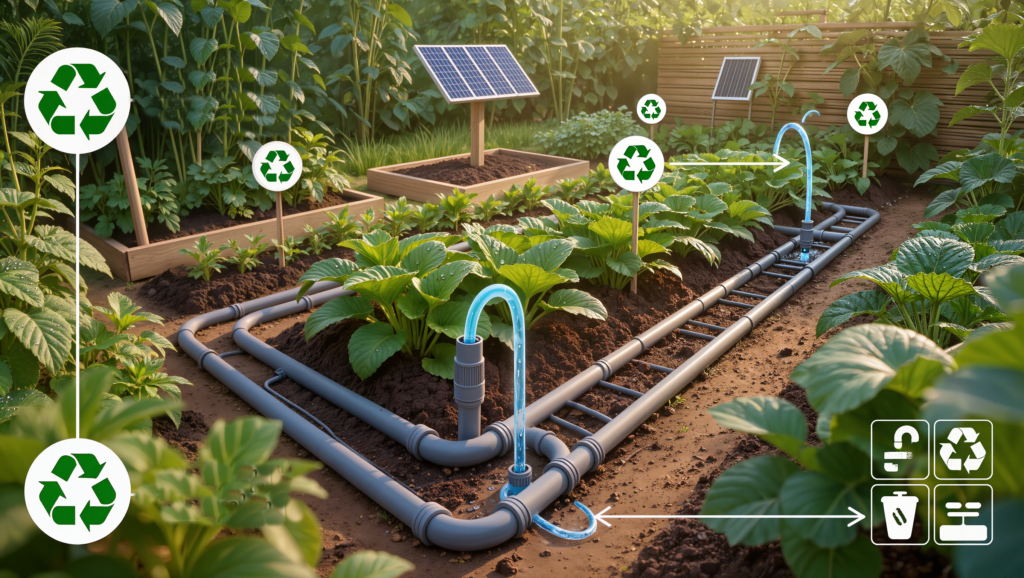
- Subsurface distribution via drip lines or perforated pipes under a mulch layer, so water infiltrates horizontally through active root zones.
- Constructed wetlands or gravel–reed beds if you have more gray water than your plants can immediately use; these act as biological filters and nutrient sinks, turning “waste” into wetland biomass.
Wood chips and organic mulches feed fungal networks, capture nutrients, and prevent odors—basically turning your gray water dispersal area into a mini composting and filtration zone.
3. Match plants to the resource
Some plants are more tolerant of variable pH, salts, and moisture than others. Resources on gray water gardening recommend:
- Lawns, ornamental shrubs, shade trees, and many fruit trees as prime gray water candidates.
- Avoiding:
- Very salt‑sensitive plants
- Acid lovers (blueberries, azaleas, camellias) without careful monitoring
- Most potted plants (limited soil volume and microbes make them prone to salt buildup)
For edibles:
- Use gray water only on the root zone of trees, vines, or perennials where water won’t splash onto harvested parts.
- Keep it off leafy greens, root crops, and herbs eaten raw, unless the water has been properly treated.
4. Think of gray water as part of a bigger loop
Gray water becomes far more powerful when combined with other regenerative practices:
- Compost returns kitchen scraps and yard waste nutrients to the soil.
- Mulch protects soil, feeds microbes, and buffers any pH/salt impacts.
- Cover crops add nitrogen and organic matter, deepening the nutrient sponge.
- Rainwater harvesting complements gray water, flushing salts and reducing reliance on treated water.
In a well‑designed system, nutrients from your home (food, soap minerals, organic matter) and from the landscape (leaf fall, roots, prunings) cycle through soil organisms, plants, and back again instead of leaving as “waste.”
Regulations and Safety: Don’t Skip This Part
Although this is a backyard topic, gray water reuse is regulated in many regions for good reasons.
Common themes in guidelines and expert advice:
- Check local codes before installing anything permanent. Some places allow simple “laundry‑to‑landscape” systems without permits; others require engineered systems.
- Don’t cross‑connect gray water pipes with potable water lines.
- Use gravity and diversion valves where possible; keep pumps and storage minimal unless designed by a pro.
- Design systems to drain fully after use to avoid stagnant water.
- Avoid using gray water from loads contaminated with diapers, industrial chemicals, or heavy grease.
Regulation isn’t there to kill creativity—it’s there to keep nutrients cycling on site instead of turning into neighborhood‑scale health issues.
The Big Picture: Gray Water as a Household‑Scale Ecosystem Lever
When you zoom out, gray water recycling is about more than saving a few bucks on your water bill:
- It turns a linear system circular, keeping both water and nutrients in the same ecosystem that produced them.
- It feeds the soil food web, which in turn feeds your plants, which feed you or pollinators or wildlife.
- It lowers the nutrient load going into wastewater systems and downstream rivers, where those same nutrients become pollution instead of fertility.
In a world of brittle, centralized infrastructure and stressed water resources, using gray water wisely is one of the simplest ways to make your home landscape more resilient, productive, and ecologically honest.
Your shower water doesn’t have to be “waste.” With a bit of design and some care about what goes down your drains, it can be the start of a nutrient loop that keeps your garden greener, your soil richer, and your local water cycle just a little bit saner.