











In our previous article about water softeners we dug deep into the benefits of water softeners for your home and hair. If you’re tired of hauling bags of salt and babying your old-school water softener—but you still want smooth skin, clean dishes, and sparkling appliances in a hard water zone—this deep dive is for you! Modern homeowners have more choices than ever for treating hard water without traditional ion-exchange softeners. Here’s what science, engineers, and experts offer as genuine alternatives for getting soft-water benefits, minus the maintenance headaches (and sodium overload).
Understanding the Water Softener Problem
Traditional water softeners use ion exchange to actually swap calcium and magnesium ions (the “hard” minerals) for sodium, literally removing hardness from the water. The result: soap lathers, scale vanishes, and your pipes (not to mention your hair) last longer. But that comes with trade-offs:
- Maintenance: Frequent salt refills.
- Environmental impact: Salty discharge water can harm soil, streams, and septic systems.
- Health/taste: Added sodium is an issue for some, especially with drinking or cooking water.
- Legal restrictions: Softeners are banned in many drought-prone or environmentally conscious communities.
Luckily, not all new technologies rely on salt—or even actively “soften” water by removing minerals and heavy metals!
The Science of Modern Hard Water Alternatives
1. Salt-Free Water Conditioners (Template Assisted Crystallization – TAC)
TAC devices are the stars of the salt-free world. Instead of removing minerals, they convert them into harmless microscopic crystals that pass right through your plumbing without sticking and building scale. The science? Water flows through a tank of special “template” media. Here, calcium and magnesium ions collect, then are coaxed to rapidly form tiny crystals. These crystals don’t adhere to pipes or appliances—the main culprit behind limescale.
- Performance: Independent studies and lab tests show TAC can reduce scale buildup by up to 99% in pipes, water heaters, and fixtures. No brine or sodium means it’’s environment friendly and low-maintenance.
- What doesn’t change: Your water chemistry (hardness is technically still there, but won’t deposit as scale).
- Best for: Homes with mild-to-moderate scaling issues who want minimal upkeep.
2. Electronic/Magnetic/Electromagnetic Descalers
- How they work: These systems clip around your main water line and use electric or magnetic fields to change mineral ion behavior, making it harder for limescale to form on pipes and appliances.
- Reality check: The science here is mixed—some lab/field reports show moderate effectiveness, while others show negligible benefits. These devices don’t remove minerals and results can depend on flow rate, hardness, and even water chemistry.
- Upside: Simple installation, no major plumbing, and almost zero ongoing costs. They’re low-risk if you want to experiment (but lower your expectations).
3. Polyphosphate Dosing Systems
- How they work: These units release small amounts of food-safe polyphosphates into the water. Polyphosphates “bind” with calcium/magnesium, preventing them from precipitating as scale.
- Downside: Phosphate buildup long-term isn’t great for the environment, and these systems need to be regularly refilled. Not the best for those on low-phosphate diets or using lots of water for irrigation.
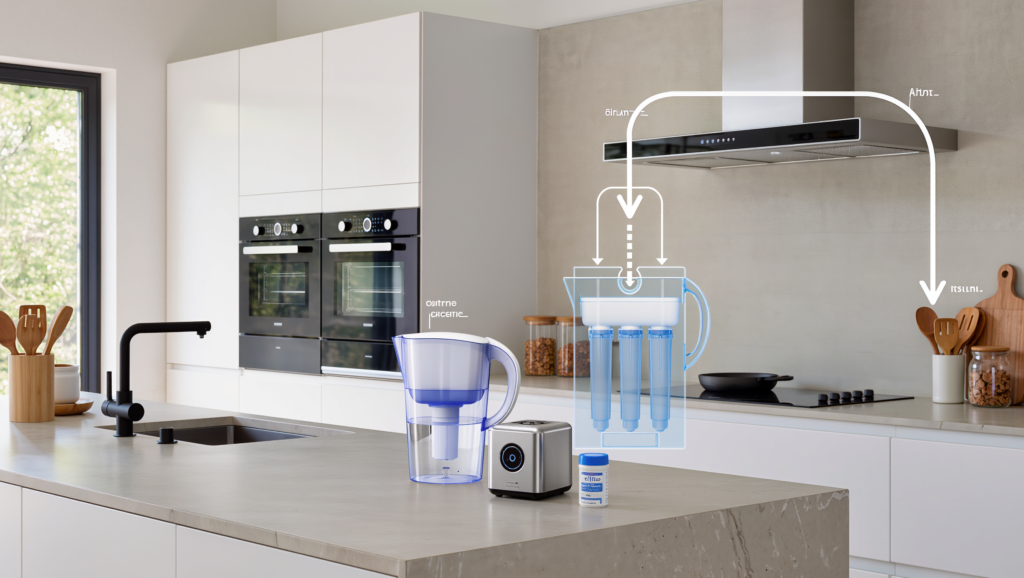
4. Point-of-Use (POU) Filters & Appliances
Instead of treating your whole home, POU devices target only where you need soft water most (e.g., showerheads, washing machines, or drinking water taps). These include:
- Showerhead filters: Can reduce some hardness/carbonates, plus chlorine and other contaminants.
- In-line dishwasher or washing machine filters: Limit scale in your “problem” appliances.
- Laundry boosters: Powdered additives (like washing soda) soften water for cleaning.
5. Water Filtration: Reverse Osmosis (RO) & Deionization
- How they work: RO and DI systems filter out almost everything—including hardness minerals—using high-pressure membranes or ion-exchange resins.
- Where they shine: Under-sink RO is great for drinking/cooking water, particularly for those watching sodium or with mineral taste sensitivities. Whole-home RO is expensive and wasteful for all but the hardest water regions.
6. Boiling (Batch Softening)
- Boiling precipitates some temporary hardness, making it a classic (if laborious) trick for small batches—think filling your iron or watering plants. Not practical for your whole house, but handy in a pinch.
TAC vs. Traditional Softeners: What’s the Real Difference?
| Feature | Traditional Softener | TAC Salt-Free Conditioner |
|---|---|---|
| Removes hard minerals | Yes (swaps Ca/Mg for Na) | No (alters Ca/Mg structure) |
| Salt used? | Yes | No |
| Wastes water? | Yes (regeneration cycles) | No |
| Adds sodium? | Yes | No |
| Maintenance | High (salt, cleaning) | Low (media lasts years) |
| Banned areas | Sometimes | Rarely |
| Scale protection | Complete | Up to 99% if installed/used correctly |
Electronic/Magnetic Descaler vs. Salt-Free Conditioner
| Electronic/Magnetic Descaler | Salt-Free Conditioner (TAC) | |
|---|---|---|
| Scale reduction | Inconsistently effective | Consistently (proven in labs) |
| Removes hardness | No | No |
| Eco-impact | None | None |
| Maint. | None | Very low |
| Upfront cost | Low | Moderate |
Installation and Cost Breakdown
- Salt-free conditioners: $700–$2,000, depending on home size and brand. Media may last up to a decade.
- Electronic descalers: $100–$500, DIY install for most homes.
- POU/Appliance filters: $50–$200 each, with cartridges replaced every few months.
- RO systems: $200–$1000 for under-sink, $5,000+ for whole-home.
Which Alternative Is Right for You?
- If you just want to avoid limescale (in pipes, water heater, etc.): Salt-free TAC systems are a proven, reliable, and eco-friendly choice.
- Focused appliance protection or drinking water: Consider RO or point-of-use filters.
- Looking for a quick, low-commitment fix: Try an electronic/magnetic descaler or laundry booster, understanding limitations.
- Minimal environmental impact and low maintenance: Go for media-based conditioners or appliance-specific solutions.
A Few Extra Tips
- Always test your water before and after installing any system—to understand your “before” and “after” in real numbers.
- If using well water or very high mineral loads, consider a blended approach—like combining sediment filtration with conditioning.
- Regular maintenance (changing filters/media) is crucial for keeping any system running its best, salt or not.
Final Thoughts (and Quick Takeaways)
Water softening is no longer just about salt and heavy lifting. The next-gen alternatives—mostly TAC and SCM (scale control media) systems—offer genuine benefits: less maintenance, less waste, lower utility costs, and a friendlier approach to both your plumbing and the planet.
Key points at a glance:
- Template Assisted Crystallization is the science-backed champ of scale prevention, not just a “softening” substitute.
- Electronic and magnetic descalers may work… or may not—go in with real expectations.
- For best results, target your needs (whole home vs. point use), your water chemistry, and your comfort with maintenance or costs.
Don’t let hard water get you down or tie you to salt-based systems—today’s options work smarter, not harder, and a little science goes a long way in protecting your home!
Did you find this article helpful? Support us by following us on our social media for more content on natural health and wellness:: Youtube, Instagram, Facebook, Pinterest, Twitter (X)