











If you only ever learn to recognise one wild mushroom, make it this one. The death cap (Amanita phalloides) and its close relatives in the Amanita genus are responsible for around 90–95% of all mushroom‑related deaths worldwide, and a single cap can be enough to kill a healthy adult. The most chilling part? To an untrained eye, these mushrooms can look like perfectly harmless buttons or field mushrooms hiding in lawns, parks, and woodland edges.
This is not the time for “close enough.” In this guide we’ll walk through, in detail, how to recognise deadly Amanita species—especially the death cap and the “destroying angel” group—where they grow, how they’re most often confused, and why you should never rely on home rules or photos alone when deciding if a mushroom is safe to eat.
Important: This is for awareness and safety, not DIY foraging clearance. If you aren’t 100% sure, do not eat it. When in doubt, throw it out.
Why Amanita Mushrooms Are So Dangerous
The death cap (Amanita phalloides) is often called the most poisonous mushroom in the world.
The toxin: amatoxins
Death caps and their white cousins (“destroying angels”) contain amatoxins, a family of bicyclic octapeptides (like α‑amanitin) that:
- Irreversibly bind RNA polymerase II – the enzyme your cells use to transcribe DNA into mRNA.
- Shut down protein synthesis, especially in fast‑metabolising tissues like the liver and kidneys.
- Cause progressive hepatorenal failure (liver and kidney failure).
Some Reviews note that α‑amanitin is the most deadly amatoxin for humans, and A. phalloides alone is responsible for about 90% of global mushroom‑poisoning fatalities. A single cap can be lethal for an adult.
The delayed, deceptive symptoms
Amatoxin poisoning is particularly deceptive because you often feel fine for hours after eating:
- 6–12 (up to 36) hours post‑ingestion: First symptoms appear – abdominal pain, vomiting, and watery diarrhea.
- 24–48 hours: GI symptoms may subside, and the person may feel “better,” while liver damage quietly progresses.
- ~72 hours onward: GI symptoms return along with jaundice, bleeding, confusion, and signs of liver failure. Without aggressive treatment or transplant, death often occurs 7–10 days after symptom onset.explore.
This “honeymoon period” causes some people to underestimate the danger and delay hospital care—sometimes fatally.
The Classic Death Cap ID Features Of Amanita Mushroom You Must Learn
Even experts use multiple features together to ID a death cap. Never bet your life on just one characteristic.
According to botanic gardens, poison centers, and mycology guides, Amanita phalloides is typically recognised by:
1. Cap (pileus)
- Colour: Yellowish to greenish, sometimes pale brown or almost whitish. Often olive‑green in the center, fading to yellow‑green toward the margin.
- Surface: Smooth, sometimes slightly sticky when wet. Older specimens may look washed‑out or brownish.
- Shape: Initially domed/convex, becoming flatter with age; 5–15 cm across typically.
Beware: Young death caps in the “button” stage can look like store‑bought button mushrooms.
2. Gills (lamellae)
- Always white – not pink, brown, or cream as in many edible species.
- Free from the stem (do not attach strongly to it).
- Spore print: White – this is a crucial distinguishing feature from many edible field mushrooms, which have pink to chocolate‑brown prints.
3. Stem (stipe)
- Colour: White central stem, sometimes with a slight greenish or yellowish tint.
- Ring (annulus): A white, skirt‑like ring near the top of the stem formed from the partial veil.
- Texture: Often smooth; sometimes with faint striations above the ring.
4. Volva (cup at the base)
This is the single most important Amanita giveaway:
- At the base of the stem there is a sac‑like cup (volva) – the remnant of a universal veil the mushroom emerged from.
- Often buried slightly in soil or leaf litter – you may need to gently dig around the base to see it.
Many fatal mistakes happen because people pluck mushrooms without the base, miss the volva, and assume they’re safe.
5. Habitat
- Often found under oak trees (and sometimes other hardwoods) in parks, gardens, and woodlands.
- Forms mycorrhizal relationships – usually appears near specific trees, not randomly in lawns like some saprophytic mushrooms.
Botanic gardens report A. phalloides increasingly appearing in urban parks and gardens under planted oaks and other host trees.
The Destroying Angels: The Other Deadly All‑White Cousins Of Amanita Mushroom
Alongside the death cap, several all‑white Amanita species (often called “destroying angels”) are just as lethal and sometimes even harder to identify.
Key traits:
- All‑white mushroom – white cap, white gills, white stem.
- Rounded bulb or volva at the base of the stem, often enclosed in a sac.
- White ring (annulus) on the stem.
- White spore print.
These can be mistaken for:
- Young puffballs (when still round and unexpanded).
- Young button mushrooms or meadow mushrooms.
That’s why mycologists hammer the rule: never eat any all‑white, gilled mushroom unless you are absolutely expert and have verified all features including the base and spore print.
Common Lookalikes Of Amanita Mushroom and Deadly Mistakes
Many fatal poisonings happen because edible species are confused with deadly Amanitas. A few notorious mix‑ups:
- Edible Agaricus (button/champignon) vs death cap
- Agaricus usually has pink → chocolate‑brown gills and brown spore print.
- Death cap has white gills and white spore print, plus volva.
- Puffballs vs destroying angels
- True puffballs are solid white inside (no developing cap or gills).
- Young Amanitas in an egg stage will show a tiny cap and gills if cut vertically.
- False death caps (Amanita citrina) vs death caps
- These are generally less toxic and smell like raw potatoes.
- However, novice foragers should still treat any Amanita with extreme caution; the smell test is not safe enough.
Mycology resources emphasise that you should never assume something isn’t an Amanita just because you can’t see a volva—it may have disintegrated, broken off, or be too deep. Use the combination of features: cap colour, white gills, ring, habitat, and base structure.
Symptoms of Amanita (Amatoxin) Poisoning: What Happens After “One Bite”
If you suspect someone has eaten a possible death cap or destroying angel, do not wait for symptoms—get emergency help immediately. But here’s the typical course for awareness:
- Latency (6–12, up to 36 hours)
- No symptoms; toxins quietly damage liver and kidneys.
- Gastrointestinal phase (~6–24 hours)
- Sudden onset of severe abdominal pain, vomiting, and profuse, watery diarrhea.
- Can lead to dehydration, low blood pressure, electrolyte imbalances.
- Apparent improvement (24–48 hours)
- GI symptoms may improve; patient feels better.
- Liver damage continues silently; liver enzymes and bilirubin rise.
- Hepatic and renal failure (3–7 days)
- Jaundice (yellow eyes/skin), dark urine.
- Confusion, bleeding, hypoglycaemia, coagulopathy.
- Possible multi‑organ failure and death.
Fatality rates have been reported from about 11% up to 50% depending on treatment speed and context, especially in children or if diagnosis is delayed.
Treatment Of Amanita Mushroom Poisoning: Why Early Action Is Everything
There is no single guaranteed antidote for amatoxin poisoning. Treatment is mainly supportive and time‑critical:
- Immediate hospital care – preferably with toxicology/hepatology support.
- Decontamination: If very early (within 2–4 hours), activated charcoal to bind remaining toxins.
- Supportive therapy:
- IV fluids to correct dehydration and electrolyte imbalances.
- Close monitoring of blood glucose, liver/renal function, and coagulation.
Some treatments used (with varying evidence):
- High‑dose penicillin – historically used to compete with amatoxin for uptake.
- Silymarin / silibinin (from milk thistle) – may help protect liver cells by inhibiting toxin uptake; often used in Europe.
- N‑acetylcysteine (NAC) – used in some protocols to support glutathione and liver detox.
- In severe cases, liver transplantation is sometimes the only life‑saving option.
A classic review notes supportive therapy as crucial, with penicillin and silymarin considered among the best‑supported adjuncts, though none is a magic bullet.
Bottom line: do not attempt home remedies. If there is any chance an Amanita was eaten, call emergency services or a poison center right away.
How to Protect Yourself (and Others) From Deadly Amanitas
1. Learn the “Amanita danger pattern”
If a mushroom has all of these
- White or pale gills
- White spore print
- A ring (skirt) on the stem
- A bulb or sac‑like cup (volva) at the base
…assume it’s a dangerous Amanita unless you are an expert. Never eat it.
2. Always dig up the base when identifying
Don’t cut mushrooms at the soil line when identifying. Carefully dig or pull to reveal the full base and check for a volva or bulb.
3. Never rely on folk tests or “rules”
These are dangerous myths:
- “If animals eat it, it’s safe.”
- “Silver spoons turn black in poisonous mushrooms.”
- “All white mushrooms are safe” (actually often the opposite).
Science and statistics say otherwise—amatoxins don’t care about folklore.
4. Treat urban mushrooms with the same caution
Death caps are now common in urban parks and gardens, especially under planted oaks and chestnuts. Do not assume city mushrooms are safer.
5. Forage only with local experts
If you’re interested in foraging:
- Join local mycology clubs or guided forays.
- Use regional field guides and cross‑reference multiple sources.
- When in doubt, ask an expert in person or simply leave it.
Other Dangerous Amanitas (So You Don’t Fixate Only on Death Caps)
While A. phalloides and destroying angels are the primary killers, other Amanita species can cause serious poisoning:
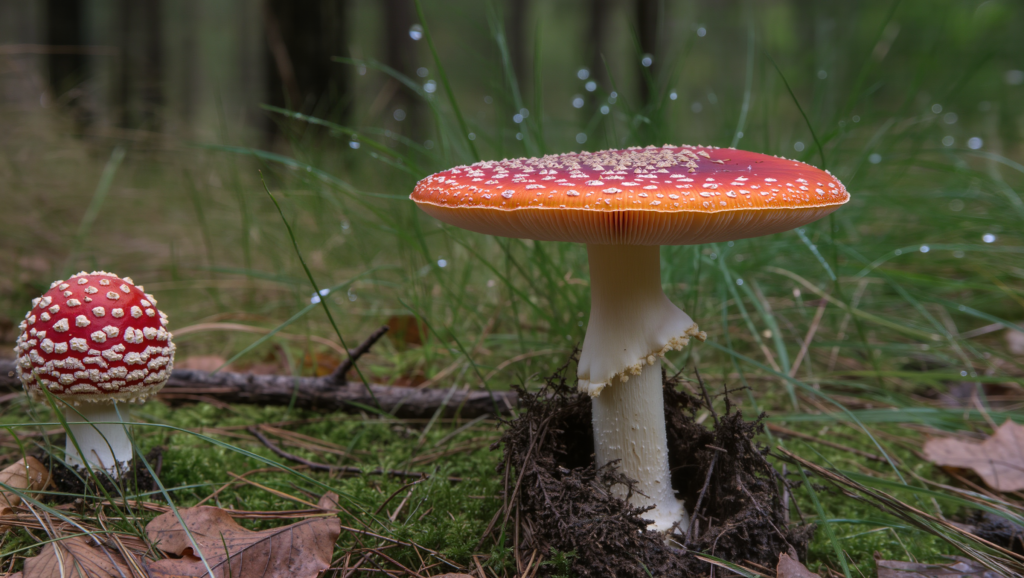
- Amanita muscaria (fly agaric – red with white spots): Typically causes neurotoxic delirium, hallucinations, and autonomic instability rather than liver failure, but can still be dangerous.
- Amanita pantherina and others: Similar neurotoxic syndromes.
The key point: many Amanitas are risky, not just the death cap. If you see the combination of Amanita‑style volva + ring + white gills, treat it as suspect.
The Takeaway: One Bite Really Can Be Your Last
- Death caps and destroying angels contain amatoxins that shut down protein synthesis, leading to liver and kidney failure and a high risk of death.
- Identification relies on a constellation of features: cap colour, white gills, ring, volva at base, white spore print, and typical habitats (often under oaks).
- Symptoms are delayed and deceptive, with a temporary “recovery” before organ failure.
- There is no guaranteed antidote; early hospital care is critical, with supportive treatment and possible use of silymarin, penicillin, and NAC, or transplant in severe cases.
For non‑experts, the safest foraging rule is simple: never eat wild mushrooms unless they’ve been positively identified by a true expert—and be especially wary of any mushroom with white gills, a ring, and a bulb or cup at the base. Awareness of what these deadly Amanitas look like isn’t about turning you into a forager; it’s about making sure curiosity on a woodland walk never turns into a medical emergency.
Sources
- https://www.ncbi.nlm.nih.gov/books/NBK431052/
- https://pubmed.ncbi.nlm.nih.gov/3092435/
- https://pmc.ncbi.nlm.nih.gov/articles/PMC7977045/