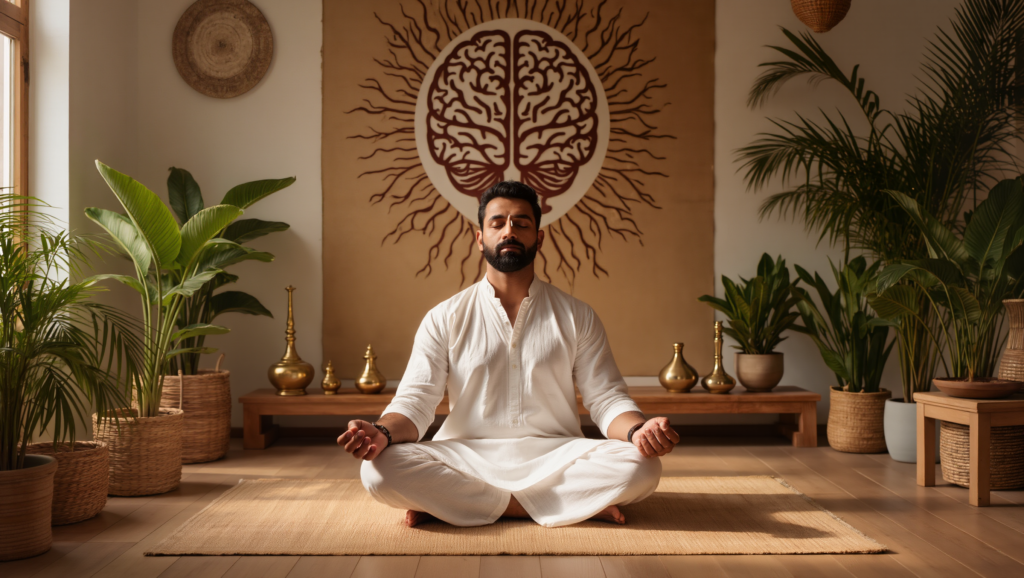












Most people think of pranayama as a “relaxing yoga add‑on”—nice if you have time, but nowhere near as serious as meditation, therapy, or brain training. Yet one of the oldest pranayama practices, nadi shodhana (alternate nostril breathing), was literally designed as an ancient nervous‑system technology: a way to balance the body’s solar and lunar energies, calm the stress system, and sync the left and right sides of your brain through one simple breathing pattern.
Modern physiology can’t fully test “prana” or “nadis,” but it does recognize something fascinating: your body naturally shifts nostril dominance every few hours, a phenomenon called the nasal cycle, and this is linked to shifts in autonomic tone (sympathetic vs parasympathetic). Yogic texts noticed this centuries ago and built a technique—alternate nostril breathing—to consciously influence that cycle, leading to calmer nerves, clearer focus, and a more integrated feeling between analytical and creative modes of mind.
Let’s unpack how this works, what “left and right brain balance” really means (and what’s myth), and how to actually practice this one deceptively simple technique safely and effectively.
The Yogic Map: Ida – Pingala and Your “Two Brains”
In the yogic and Ayurvedic model, your breath doesn’t just move air; it carries prana, or life force, through subtle channels called nadis.
Two main nadis matter here:
- Ida nadi
- Runs along the left side of the spine.
- Associated with the left nostril, lunar (“chandra”) energy.
- Qualities: cooling, introspective, intuitive, receptive—linked to right‑brain‑type functions (creativity, big‑picture seeing).
- Physiologically connected with the parasympathetic nervous system (rest, digest, restore).
- Pingala nadi
- Runs along the right side of the spine.
- Associated with the right nostril, solar (“surya”) energy.
- Qualities: warming, active, analytical, focused—linked to left‑brain‑type functions (logic, language, order).
- Physiologically connected with the sympathetic nervous system (fight, flight, get‑things‑done).
Traditional teachers describe it this way:
- Right‑nostril breathing → stimulates pingala, the “masculine,” outward, left‑brain‑style energy, and the sympathetic system.
- Left‑nostril breathing → stimulates ida, the “feminine,” inward, right‑brain‑style energy, and the parasympathetic system.
When these two are balanced, the central channel (sushumna nadi) is said to open, leading to steadier attention, more even mood, and deeper meditative states.
The Science Bit: Nasal Cycle, Autonomic Balance, and the Left–Right Brain Myth
Nasal cycling: yogis noticed it first
Modern science confirms a key yogic observation: you don’t breathe equally through both nostrils all the time. Around 1895, physician Richard Kayser described the nasal cycle, in which airflow alternates between nostrils every 2–2.5 hours.
Contemporary reviews note that:
- At any given moment, one nostril is more dominant (more airflow).
- This dominance is linked to shifts in autonomic balance—more sympathetic tone on one side, more parasympathetic on the other.
- When the right nostril is dominant, people tend to show higher heart rate, blood pressure, body temperature, cortisol and locomotor activity—a more activated state.
- Left‑nostril dominance correlates with a more restful state—lower heart rate, cortisol, and metabolic arousal.
In short: the yogic ida/pingala model maps reasonably well onto measurable shifts in breathing, nervous system tone, and metabolic state.
Left vs right brain: what’s real, what’s not
You’ve probably heard the pop‑psych line: “left brain = logical, right brain = creative.” The reality is more nuanced:
- Both hemispheres work together for almost everything.
- There are functional asymmetries (language centers more left‑dominant in most people; certain spatial and holistic processing more right‑dominant), but it’s not a strict personality split.
Some yoga and wellness sources lean heavily into the left/right brain storytelling, and at least one anatomy‑savvy yoga writer calls this the “left–right brain myth” when overstated. Still, alternate nostril breathing is frequently described (even by conservative Ayurvedic sources) as a practice that “balances the right and left hemispheres of the brain” and “harmonizes the masculine and feminine energies.”
A more science‑accurate translation would be:
Nadi shodhana appears to balance sympathetic and parasympathetic activity, promote inter‑hemispheric coordination, and create a subjectively balanced state between analytic and intuitive modes of mind.
You’re not flipping a “logic off, creativity on” switch, but you are nudging your nervous system toward integration instead of dominance.
Nadi Shodhana: The One Simple Technique
The pranayama at the heart of this is nadi shodhana, often translated as “channel purification” or “alternate nostril breathing.”
Ayurvedic and yogic sources agree on its core benefits:
- Balances right and left energy channels (ida and pingala).
- Calms the nervous system while keeping the mind alert.
- Reduces anxiety and emotional reactivity; very centering for vata dosha.
- Helps integrate hemispheric function, supporting both focus and creativity.
Classic hand position (Vishnu mudra)
Most teachers use the right hand to alternately close each nostril:
- Fold the index and middle fingers toward the palm (or rest them between the eyebrows).
- Use the thumb to gently close the right nostril.
- Use the ring finger (and little finger) to gently close the left nostril.
Left hand can rest on your thigh.
Step‑by‑step basic nadi shodhana
Here’s a simple, safe version you can practice daily:
- Sit comfortably
- On a cushion or chair, spine tall but not rigid, shoulders soft.
- Close your eyes and take a few easy breaths in and out through both nostrils.
- Set a gentle rhythm
- Begin to equalize the breath: inhale for a count of 4, exhale for a count of 4–6.
- If 4 feels long, use 2–3; comfort is more important than big numbers.
- Close the right nostril, inhale left
- Gently press your right thumb to close the right nostril.
- Inhale slowly through the left nostril, feeling the breath stream up the left side.
- Switch & exhale right
- At the top of the inhale, pause briefly (no strain).
- Close the left nostril with your ring finger, release the thumb, and exhale through the right nostril.
- Inhale right, exhale left
- Keeping the left nostril closed, inhale through the right nostril.
- Pause softly, then close the right nostril with your thumb, release the left, and exhale through the left nostril.
- That’s one full round
- Left in → right out → right in → left out.
- Continue for 5–10 rounds, or 1–5 minutes to start. You can gradually extend to 10–15 minutes as you become comfortable.
Important guidelines:
- Breath should remain smooth, quiet, and unforced. No gasping or dragging.
- If you feel light‑headed, shorten the counts or take a break.
- Avoid long breath holds (retention) until you’ve learned under a qualified teacher and have no cardiovascular, blood pressure, or anxiety conditions.
What Nadi Shodhana Does to Your Nervous System
Traditional and modern sources converge on a few core effects:
1. Balances sympathetic and parasympathetic tone
Yoga writers summarising the research on nasal cycling and autonomic tone
- Right‑nostril emphasis → sympathetic activation (more alert, stimulated state, increased heart rate, blood pressure, cortisol).
- Left‑nostril emphasis → parasympathetic dominance (restful, lower heart rate and cortisol, calming).
By alternating nostrils in a steady, equal rhythm,
- Prevents either branch from dominating.
- Encourages a “just right” state: alert but calm, focused but not wired.
- Explains why many teachers prescribe it as a pre‑meditation practice or a go‑to tool for anxiety and over‑stimulation.
Ayurvedic practitioners explicitly list benefits such as reduced emotional reactivity, quick access to deep physical and mental stillness, and balanced vata, pitta, and kapha.
2. Increases oxygenation and clears subtle “channels”
One Ayurveda‑focused guide notes that nadi shodhana
- Increases oxygenation by promoting fuller, deeper, more even breaths.
- Cleanses the “channels” of the subtle energy body—nadis corresponding to nerve ganglia along the spine—by removing energetic blockages.
From a physiological lens:
- Slow, rhythmical breathing with mild lengthening of exhalation has well‑documented effects on heart‑rate variability (HRV) and vagal tone—markers of a flexible, resilient nervous system.
- More efficient ventilation and reduced over‑breathing can improve CO₂ tolerance, oxygen delivery, and reduce symptoms like dizziness or panic in sensitive people.
3. “Balances” left and right brain—what that really feels like
While the strict left‑brain/right‑brain stereotype is oversimplified, practitioners and teachers consistently report that nadi shodhana leads to experiences like:
- Less mental chatter and more coherent, focused thought.
- Easier access to both logical reasoning and intuitive insight—you don’t feel stuck in one mode.
- A sense of inner symmetry—less lopsidedness between “overthinking” and “over‑feeling.”
Some teachers describe it as opening simultaneous access to the “linear/logical mind” and the “analog/creative mind,” making you more integrated and present in how you show up.
Variations: When You Want Calm vs Clarity vs Energy
Once you’re comfortable with basic nadi shodhana, yoga and Ayurveda offer single‑nostril variations that tilt the balance intentionally:
- Chandra Bhedana (moon/pure left‑nostril breathing)
- Inhale left, exhale right, or simply breathe mostly through the left nostril.
- Calms the nervous system, reduces body heat, lowers blood pressure, steadies the mind, and promotes sleep.
- Great for anxiety, insomnia, and when you feel overheated or overstimulated.
- Surya Bhedana (sun/right‑nostril breathing)
- Inhale right, exhale left, or emphasize right nostril.
- Warming and stimulating; used to relieve low energy, lethargy, or mild depression, and can aid digestion.
Alternate nostril breathing (nadi shodhana) sits in the middle, balancing both channels rather than favoring one.
How to Use This Pranayama in Modern Day
You don’t need a 90‑minute yoga class to feel the effects. A few practical ways to weave nadi shodhana into daily life:
1. Pre‑work focus reset
- 3–5 minutes of alternate nostril breathing before deep work:
- Balances alertness and calm, reducing “stress‑productivity” and giving you clearer, steadier focus.
2. Anxiety “circuit breaker”
- When you feel triggered or overwhelmed, 1–3 minutes can:
- Down‑shift sympathetic overdrive.
- Reduce emotional reactivity.
- Give you a small pause between stimulus and response.
3. Evening downshift
- Combine Chandra Bhedana (left‑nostril emphasis) or gentle nadi shodhana with dim lights and no screens for 5–10 minutes:
- Helps transition brain and body into a more parasympathetic, sleep‑ready state.
4. Balancing doshas in Ayurveda
Ayurvedic clinicians often recommend nadi shodhana to:
- Balance vata (overthinking, anxiety, scattered energy).
- Soften excess pitta (irritability, intensity).
- Clear kapha stagnation by gently stimulating prana while still calming the mind.
They commonly call it one of the most “profound and helpful” breathing practices because its risk is low, accessibility is high, and impact spans both body and mind.
Safety Notes When Practicing Pranayama and When to Get Guidance
For most people, basic nadi shodhana (equal in/out, no long holds) is safe. Still:
- Avoid or modify if you have:
- Uncontrolled high blood pressure.
- Serious respiratory or cardiovascular disease.
- Recent facial/nasal surgery or severe congestion.
- Skip advanced variations with long breath retentions or complex ratios unless guided by an experienced teacher and cleared medically.
If you ever feel:
- Dizziness, chest tightness, or panic—stop, breathe normally through both nostrils, or open the mouth, and let the system settle.
- Strong emotional release—allow it gently, and consider pairing the practice with grounding techniques (feet on floor, gentle movement) or working with a therapist if trauma is present.
Bringing It All Together
In Ayurvedic and yogic terms, pranayama like nadi shodhana is not just about “relaxing.” It’s an ancient technology for tuning your nervous system:
- Right nostril ↔ pingala ↔ sympathetic ↔ analytical/active energy.
- Left nostril ↔ ida ↔ parasympathetic ↔ intuitive/creative energy.
- Alternate them in a steady, conscious way, and you balance the two, creating a state where the mind feels both calm and bright, and the “two brains” of your body—solar and lunar, doing and being—can finally work together.
You don’t need a lab to feel it. Take five quiet minutes, one hand, and one simple breathing pattern, and you’ll experience why yogis have been using this as their go‑to “brain balancing” tool for centuries.