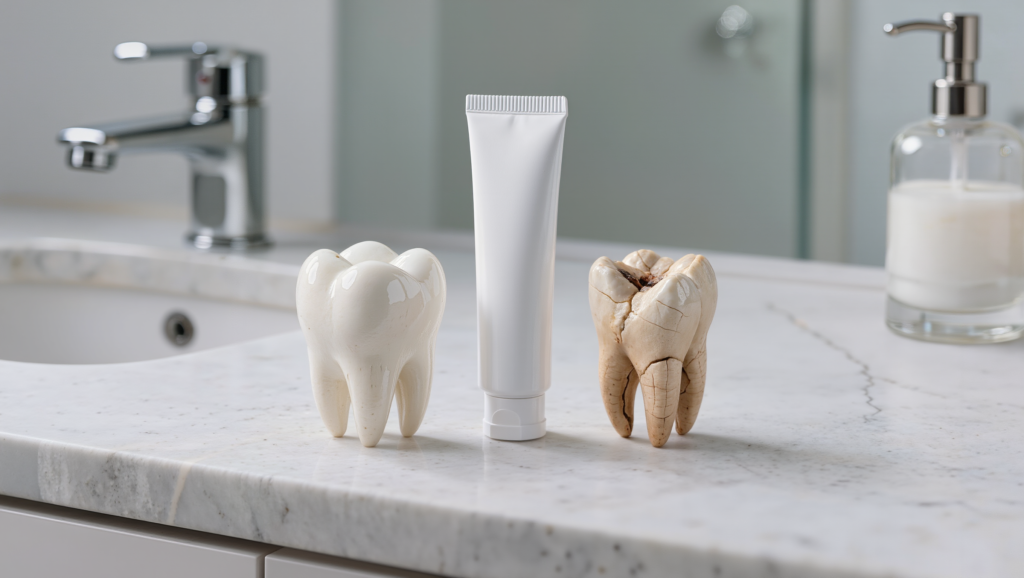












If you have switched to a fluoride-free toothpaste, you are not alone. Many people are drawn to “natural” oral care products out of concerns about fluoride toxicity, desire for cleaner ingredient lists, or preference for alternative remineralizing agents. But here is the uncomfortable question: could your fluoride-free toothpaste be quietly weakening your enamel over time?
The answer depends on what is in your toothpaste, how you use it, and your individual risk for cavities. Some fluoride-free formulations show real promise for remineralization, especially those containing hydroxyapatite. But the evidence base for long-term cavity prevention still favors fluoride, particularly for children and high-risk groups.
Understanding the science behind enamel remineralization can help you decide whether your current toothpaste is protecting your teeth—or leaving them more vulnerable.
How Enamel Gets Weakened In The First Place
To understand remineralization, you first need to know how enamel breaks down. Tooth enamel is the hardest substance in your body, but it is constantly under attack from:
- Acid produced by oral bacteria after they metabolize sugars.
- Acidic foods and drinks (sodas, citrus, sports drinks, wine).
- Dry mouth, which reduces saliva’s natural buffering and remineralizing capacity.
- Aggressive brushing or abrasive toothpaste.
When acid contacts enamel, it dissolves some of the mineral crystals—a process called demineralization. Over time, repeated acid attacks can create microscopic weak spots, white spot lesions, and eventually cavities.
Saliva helps counteract this by:
- Neutralizing acid.
- Supplying calcium and phosphate ions.
- Providing proteins that support remineralization.
But saliva alone is not always enough, especially with frequent snacking, sugary drinks, or poor oral hygiene. That is where toothpaste comes in.
What Does Enamel Remineralization Mean?
Remineralization is the process of redepositing minerals—mainly calcium and phosphate—back into weakened enamel. This can:
- Repair early, non-cavitated lesions (white spots).
- Harden the enamel surface.
- Make teeth more resistant to future acid attacks.
- Reduce sensitivity by sealing exposed dentinal tubules.
Effective remineralizing agents must:
- Provide bioavailable calcium and phosphate.
- Bind to enamel surfaces.
- Promote crystal growth or repair.
- Withstand acidic challenges.
Fluoride has been the gold standard for decades because it not only supports remineralization but also forms a more acid-resistant mineral called fluorapatite.
How Fluoride Strengthens Enamel
Fluoride works in several ways:
- Enhances remineralization. Fluoride attracts calcium and phosphate ions back into demineralized enamel, accelerating repair.
- Forms fluorapatite. Fluoride integrates into the enamel crystal structure, creating fluorapatite, which is less soluble in acid than normal hydroxyapatite.
- Inhibits bacteria. Fluoride can interfere with acid-producing bacteria, reducing the overall acid load in the mouth.
- Promotes surface hardening. Fluoride-treated enamel is more resistant to future demineralization.
Large-scale reviews, including Cochrane analyses, show high-certainty evidence that fluoride toothpaste (1,000–1,250 ppm) reduces cavities compared with non-fluoride toothpaste, especially in children.
This is why dentists have recommended fluoride toothpaste for decades as the cornerstone of cavity prevention.
The Rise Of Fluoride-free Toothpaste Alternatives
Concerns about fluoride—real or perceived—have driven demand for fluoride-free toothpastes. Common reasons people choose them include:
- Worries about fluoride toxicity or fluorosis.
- Preference for “natural” or “clean” ingredients.
- Sensitivity to fluoride-containing products.
- Desire for alternatives for young children who might swallow toothpaste.
Common fluoride-free active ingredients include:
- Nano-hydroxyapatite (n-HAP): Synthetic version of the main mineral in enamel.
- CPP-ACP (casein phosphopeptide–amorphous calcium phosphate): Delivers calcium and phosphate.
- Calcium sodium phosphosilicate (NovaMin): Bioactive glass that releases calcium and phosphate.
- Theobromine: Compound from cocoa with proposed remineralizing effects.
- Herbal or enzymatic formulations: Aimed at reducing bacteria or supporting gum health.
But do they actually remineralize enamel as effectively as fluoride?
Hydroxyapatite: The Strongest Fluoride-Free Contender
Hydroxyapatite (HAP) is the primary mineral component of tooth enamel and bone. Nano-hydroxyapatite toothpastes contain tiny particles that can:
- Bind to enamel surfaces.
- Fill microscopic defects and white spot lesions.
- Provide calcium and phosphate for remineralization.
- Reduce sensitivity by occluding dentinal tubules.
Several studies suggest HAP can perform comparably to fluoride in certain contexts:
- An in situ study found that 10% hydroxyapatite achieved comparable efficacy to 500 ppm fluoride in remineralizing initial caries and preventing lesion development.
- A 2025 systematic review and meta-analysis found no significant difference between HAP and fluoride toothpastes for caries progression, with a risk ratio of 0.98.
- Multiple clinical trials report that HAP toothpaste is non-inferior to fluoride for early lesion remineralization and sensitivity reduction.
However, important caveats remain:
- Many studies are short-term (weeks to months) rather than years.
- Sample sizes are often small.
- Most evidence is in adults, with limited data in children.
- Non-inferiority does not necessarily mean equivalence; margins can be wide.
A 2026 evidence mapping review concluded that while hydroxyapatite-based products have the most consistent evidence among fluoride-free alternatives, no fluoride-free category currently has evidence comparable to fluoride for long-term caries prevention in children.
Other Fluoride-free Remineralizing Agents
CPP-ACP
CPP-ACP (found in products like MI Paste) delivers calcium and phosphate in a stabilized form. Studies show it can:
- Remineralize early enamel lesions.
- Reduce white spot lesions, especially after orthodontic treatment.
- Improve surface microhardness in lab studies.
However, clinical caries-prevention data are more limited compared to fluoride, and results can vary by formulation and usage.
Calcium Sodium phosphosilicate (NovaMin)
NovaMin is a bioactive glass that releases calcium and phosphate when it contacts saliva. Research suggests it can:
- Remineralize early lesions.
- Reduce dentin sensitivity.
- Improve enamel microhardness in some studies.
Again, long-term caries prevention data are less robust than for fluoride.
Theobromine
Theobromine, a compound from cocoa, has been proposed as a remineralizing agent. One study found theobromine-containing toothpaste showed the least surface microhardness recovery compared to other agents, suggesting weaker remineralization in that particular trial.[
Evidence for theobromine is still preliminary compared to fluoride or HAP.
Is Fluoride-free Toothpaste Weakening Your Enamel?
The honest answer: it depends.
When fluoride-free toothpaste may be okay
Fluoride-free toothpaste is less likely to weaken your enamel if:
- It contains a proven remineralizing agent like nano-hydroxyapatite at effective concentrations (e.g., 10% HAP).
- You have low cavity risk: good oral hygiene, limited sugar intake, healthy saliva flow, no history of frequent cavities.
- You use it consistently and correctly: twice daily brushing, proper technique, limited snacking.
- You are an adult with stable oral health and no active decay.
In these cases, a well-formulated fluoride-free toothpaste may maintain or even improve enamel health, particularly for sensitivity and early lesion repair.
When fluoride-free toothpaste could be a problem
Fluoride-free toothpaste is more likely to contribute to enamel weakening if:
- It contains no proven remineralizing agent (just abrasives, detergents, and flavorings).
- You have high cavity risk: history of frequent cavities, orthodontic appliances, dry mouth, high sugar diet, poor hygiene.
- You are a child or teenager, whose enamel is still developing and who is at higher risk for cavities.
- You have existing white spot lesions, early decay, or erosion that needs active remineralization.
- You rely solely on toothpaste without addressing diet, hygiene, and saliva factors.
In these scenarios, skipping fluoride could mean missing out on a well-established, high-certainty tool for cavity prevention.
What Scientific Research Actually Says About Enamel Remineralization
Summarizing the current research:
- Fluoride toothpaste: High-certainty evidence from multiple systematic reviews and long-term trials shows it reduces cavities compared with non-fluoride toothpaste, especially in children.
- Hydroxyapatite toothpaste: Growing evidence suggests it can be non-inferior to fluoride for early lesion remineralization and sensitivity, but long-term, large-scale caries prevention data—especially in kids—are still limited.
- Other fluoride-free agents (CPP-ACP, NovaMin, theobromine): Show promise in lab and short-term clinical studies for remineralization and sensitivity, but evidence for long-term cavity prevention is weaker than for fluoride.
- Plain fluoride-free toothpaste without active remineralizing agents: Cleans teeth but offers little to no anticavity or remineralization benefit beyond mechanical plaque removal.
A 2026 review concluded that fluoride-free formulations demonstrate measurable biological effects, but evidence is dominated by surrogate outcomes and short-term designs. No fluoride-free category currently matches fluoride’s evidence base for long-term caries prevention in children.
Practical Recommendations When Choosing Flouride Free Toothpaste
If you want to stay fluoride-free
- Choose a toothpaste with nano-hydroxyapatite (ideally around 10%) or another proven remineralizing agent.
- Avoid “natural” toothpastes that list only abrasives, oils, and herbs with no active remineralizing ingredient.
- Maintain excellent oral hygiene: brush twice daily, floss, limit sugary snacks and drinks.
- Consider additional measures: xylitol gum, saliva support, regular dental checkups, sealants if indicated.
- Be extra cautious if you or your children have high cavity risk.
If you are open to fluoride
- Use a fluoride toothpaste with 1,000–1,500 ppm fluoride for adults, as recommended by dental associations.
- For children, use age-appropriate amounts (a smear for under 3, pea-sized for 3–6) to balance benefits and fluorosis risk.
- Consider fluoride varnish or rinses if you are at high risk for cavities.
- You can still choose toothpastes with additional ingredients (e.g., HAP, CPP-ACP) alongside fluoride for sensitivity or extra remineralization.
For parents
- Discuss fluoride use with your pediatric dentist, especially if your child has a history of cavities, enamel defects, or high sugar intake.
- If you prefer fluoride-free for young children, ensure the product contains a proven remineralizing agent and that diet and hygiene are tightly controlled.
- Monitor for early signs of decay: white spots, sensitivity, visible holes.
Bottom line
Fluoride-free toothpaste is not automatically bad, but not all fluoride-free products are equal. Some, especially those with nano-hydroxyapatite, show real potential for remineralizing enamel and reducing sensitivity.
However, fluoride remains the gold standard for long-term cavity prevention, with decades of high-quality evidence supporting its safety and effectiveness, particularly in children and high-risk groups.
If you choose fluoride-free, do so intentionally: pick a product with proven active ingredients, maintain excellent oral hygiene, and be honest about your cavity risk. If your goal is maximum enamel protection and cavity prevention—especially for kids—fluoride toothpaste still has the strongest evidence behind it.
Your enamel does not care about marketing claims. It cares about minerals, acid balance, and consistent care. Choose accordingly.
Sources:
- https://pmc.ncbi.nlm.nih.gov/articles/PMC13050991/
- https://pmc.ncbi.nlm.nih.gov/articles/PMC6901576/
- https://pubmed.ncbi.nlm.nih.gov/37526766/
- https://pmc.ncbi.nlm.nih.gov/articles/PMC10452078/