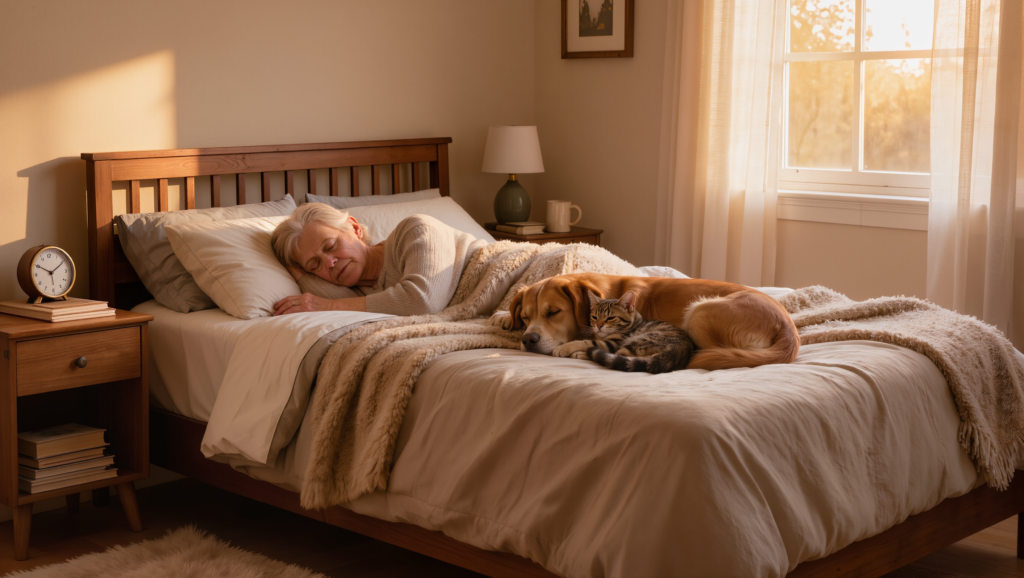












If you are an older adult with a dog or cat, you have probably noticed something: your sleep schedule does not entirely belong to you anymore. That 6 a.m. nudge from a wet nose, the 3 a.m. zoomies from a cat who thinks midnight is playtime, or the comforting weight of a purring companion on your chest—these moments shape when you go to bed, when you wake up, and how well you sleep overall.
For decades, research on pets and health has focused on companionship, stress reduction, and physical activity. But a growing body of evidence shows that pet ownership also influences something fundamental: your circadian rhythms—the internal 24-hour clock that governs sleep, wakefulness, hormone release, and many other physiological processes. In older adults, whose circadian systems are already more fragile, pets can act as both anchors and disruptors of sleep-wake timing.
So, does your dog or cat control your sleep and wake time? The answer is more nuanced than “yes” or “no.” It depends on the type of pet, your routines, where your pet sleeps, and how you manage the interplay between your biological clock and your companion’s natural rhythms.
Circadian Rhythms And Aging: Why Timing Matters More After 60
Circadian rhythms are driven by a master clock in the brain (the suprachiasmatic nucleus) that synchronizes bodily functions to the light-dark cycle. In younger adults, this system is relatively robust. With age, however, several changes occur:
- Reduced amplitude of circadian signals (weaker “day vs. night” contrast).
- Earlier timing of melatonin release and core body temperature minimum (leading to earlier bedtimes and wake times).
- More fragmented sleep, with increased nighttime awakenings and daytime napping.
- Greater sensitivity to light exposure timing, medications, and lifestyle disruptions.
These changes make older adults more vulnerable to circadian misalignment—when internal rhythms drift out of sync with external time cues. Misalignment is linked to insomnia, daytime sleepiness, mood disturbances, cognitive decline, and metabolic problems.
In this context, anything that consistently shifts sleep-wake timing—work schedules, caregiving duties, or yes, pets—can have outsized effects on an older adult’s circadian health.
How Pets Influence Sleep-Wake Timing
Pets, especially dogs and cats, have their own circadian patterns. They are not simply on “human time.” Understanding these patterns helps explain how they shape your sleep.
Dogs: early risers with regular routines
Dogs are generally diurnal (active during the day) but with strong morning and evening peaks. Many dogs:
- Wake their owners early for bathroom breaks, walks, or breakfast.
- Encourage regular outdoor exposure to morning light, a powerful circadian cue.
- Benefit from consistent feeding, walking, and bedtime routines that can stabilize their owners’ schedules as well.
Research shows that dog owners tend to have earlier bedtimes and wake times than non-dog owners or cat-only owners. One study of adult women found that dog owners (with or without cats) had significantly earlier bedtimes and wake times compared to cat-only owners, likely due to dogs’ needs to go outside in the morning and their more regular daily routines.
In older adults, this can be a double-edged sword:
- Potential benefit: Regular morning walks and light exposure can strengthen circadian rhythms, improve sleep quality, and reduce insomnia risk. A 2026 study of older adults found that dog ownership was associated with a reduced risk of insomnia (adjusted OR = 0.63), and frequent dog walking was beneficial for sleep health.
- Potential cost: Early morning awakenings driven by the dog can truncate sleep, especially if the owner is already prone to early waking or has difficulty falling back asleep.
Cats: crepuscular creatures of dusk and dawn
Cats are naturally crepuscular—most active at dawn and dusk. In a domestic setting, this often translates to:
- Evening “zoomies” and play bursts.
- Nighttime wandering, vocalizing, or demands for attention.
- Early morning activity that can wake light-sleeping owners.
For older adults, cat-related sleep disruptions can be significant:
- Cats who sleep in the bed are reported to be as disruptive as human partners in some surveys, associated with more awakenings and weaker feelings of sleep comfort.
- Cat-only owners tend to have later bedtimes and wake times than dog owners, but also report more sleep disturbances in some studies.
That said, not all cat owners experience poor sleep. Some find the presence of a calm, sleeping cat soothing, and the impact likely depends on the individual cat’s temperament, age, and where it sleeps.
Other pets: rabbits, birds, and beyond
While dogs and cats dominate the research, other pets can also affect sleep:
- Rabbit ownership has been associated with an increased risk of poor sleep quality in older adults in one study (OR = 1.94), possibly due to nighttime activity, noise, or care demands.
- Birds, small mammals, and reptiles may influence sleep through noise, lighting, or care routines, though data are limited.
The key takeaway: different pets impose different temporal demands, and these demands interact with an older adult’s already shifting circadian system.
What Scientific Studies Says About Pet Ownership, Sleep Quality And Circadian Markers
Several recent studies shed light on how pet ownership relates to sleep and circadian rhythms in adults, including older populations.
Reduced insomnia risk with dog ownership
A 2026 study focusing on older adults found that pet ownership was significantly associated with a reduced risk of insomnia (adjusted OR = 0.75). The protective effect was strongest for:
- Dog owners (OR = 0.63).
- Owners of healthy pets (OR = 0.41).
Proposed mechanisms include:
- Increased physical activity (dog owners averaged ~45 minutes of daily walking), which helps regulate circadian rhythms and improve sleep efficiency.
- Enhanced psychosocial support and routine, which can stabilize sleep-wake timing.
- Morning light exposure from dog walking, a potent circadian zeitgeber (time cue).
However, the same study noted that:
- Ownership duration of less than one year was associated with higher insomnia risk, possibly reflecting adjustment stress.
- Daily interaction exceeding two hours was linked to poorer sleep (OR = 2.25), suggesting that excessive engagement—especially late at night—may disrupt sleep.
Dog and cat owners sleep better than non-owners
A 2026 cross-sectional study examining dog and/or cat ownership and sleep found that:
- Non-pet owners reported worse sleep than pet owners.
- Those who owned both a dog and a cat reported the best sleep of all groups.
- The relationship was mediated by anxiety symptoms, perceived stress, light exposure, and sleep-wake timing.
This suggests that pets may improve sleep indirectly by reducing stress and anxiety, encouraging regular light exposure, and reinforcing consistent sleep-wake schedules.
Actigraphy data: dog owners show robust rhythms
A brief report using actigraphy (objective movement-based sleep tracking) in dog owners found:
- Comparable circadian rhythm strength (relative amplitude) and consistency (interdaily stability) to previously reported post-industrial samples.
- Less intra-daily variability (fragmentation) than some reference groups, indicating relatively stable rest-activity patterns.
While this study was not limited to older adults, it supports the idea that dog ownership is associated with regular, well-structured sleep-wake patterns.
Cats can be as disruptive as human bed partners
Survey-based research indicates that:
- Owners who sleep with their pets sometimes take longer to fall asleep, experience more disturbances, and wake up feeling less refreshed.
- Cats in the bed were reported to be equally as disruptive as human partners in some measures, associated with weaker feelings of comfort.
For older adults, who often have lighter, more fragmented sleep, these disruptions can be particularly impactful.
Mechanisms Of How Pets Alter Circadian Rhythms
Pets influence circadian rhythms through several pathways:
1. Enforcing regular sleep-wake schedules
Dogs, in particular, thrive on routine. They need:
- Morning walks and bathroom breaks.
- Regular feeding times.
- Consistent evening wind-down and bedtime.
Owners often align their schedules with these needs, creating a structured daily pattern that can stabilize circadian timing. In older adults, who may otherwise have fewer external time cues (e.g., after retirement), this structure can be especially valuable.
2. Modulating light exposure
Morning light is one of the strongest signals to advance and strengthen circadian rhythms. Dog walking often entails:
- Early morning outdoor exposure.
- Consistent timing of light intake.
- Physical activity that further reinforces circadian alignment.
For older adults, who may spend more time indoors and receive less bright light, this can help counteract age-related circadian weakening.
3. Influencing stress and arousal
Pets can both reduce and increase arousal:
- Calming presence, tactile contact, and companionship lower perceived stress and anxiety, which can facilitate sleep onset and maintenance.
- Nighttime activity, vocalization, or bed-sharing can increase awakenings and sympathetic activation, fragmenting sleep.
The net effect depends on the pet’s behavior, where it sleeps, and the owner’s sensitivity to disturbances.
4. Shaping physical activity patterns
Regular physical activity is a known circadian enhancer. Dog owners typically engage in more daily movement, which:
- Improves sleep efficiency and depth.
- Strengthens the amplitude of rest-activity rhythms.
- Helps maintain a clearer distinction between day (active) and night (rest).
In older adults, who may be less active due to health or mobility issues, this can be a critical factor in preserving circadian health.
The Older Adult Context: Unique Vulnerabilities And Opportunities
Older adults face specific challenges that make pet-related influences on circadian rhythms especially important:
Increased sensitivity to sleep disruption
With age comes:
- More frequent nighttime awakenings.
- Lighter sleep stages.
- Greater difficulty returning to sleep after waking.
A cat’s nighttime prowling or a dog’s early morning demand can therefore have a larger impact on perceived sleep quality than in younger adults.
Greater reliance on external time cues
Retirement, reduced social obligations, and sensory changes (e.g., cataracts limiting light exposure) can weaken internal circadian signals. In this context, pets can serve as powerful external zeitgebers:
- Dogs impose regular morning and evening anchors.
- Feeding and care routines create predictable daily structure.
- Companionship reduces social isolation, which itself can destabilize rhythms.
Health conditions and medications
Chronic pain, nocturia (nighttime urination), respiratory issues, and medications (e.g., diuretics, sedatives) already challenge sleep in older adults. Pets can either exacerbate or mitigate these issues:
- A dog that encourages gentle evening walks may improve circulation and reduce restlessness.
- A cat that jumps on the chest may worsen breathing difficulties or pain.
- The emotional support of a pet may reduce anxiety-related insomnia.
Practical Strategies To Aligning Your Circadian Rhythms With That Of Your Pet
If you are an older adult with a dog or cat, you do not have to surrender your sleep entirely to your pet’s whims. Thoughtful management can help you harness the benefits while minimizing disruptions.
For dog owners
- Embrace the morning routine. Use your dog’s need for a morning walk as an opportunity for bright light exposure and gentle exercise, both of which strengthen circadian rhythms.
- Set a consistent bedtime. Dogs thrive on predictability. A regular evening routine (last potty break, calm down time, settled sleeping area) can help both you and your dog wind down at a consistent time.
- Manage early awakenings. If your dog wakes you too early:
- Gradually shift feeding and walking times later by 10–15 minutes every few days.
- Use blackout curtains to reduce early morning light cues in the bedroom.
- Consider an automatic feeder for breakfast to decouple feeding from your immediate presence.
- Consider sleeping arrangements. If your dog’s movement or snoring disrupts your sleep, try a comfortable crate or bed in the same room but not on your bed.
For cat owners
- Shift activity to daytime. Engage your cat in play and feeding during the day and early evening to reduce nighttime zoomies. Avoid heavy play within two hours of your bedtime.
- Create a cat-friendly sleep space. Provide a cozy bed or perch in the bedroom (or another room) to encourage your cat to sleep independently if bed-sharing disrupts your rest.
- Use timed feeders. Automatic feeders can provide early morning meals without requiring you to wake up, reducing the reinforcement of early waking behavior.
- Address nighttime vocalization. If your cat is unusually active or vocal at night, especially if older, consult a vet to rule out pain, hyperthyroidism, or cognitive dysfunction.
For all pet owners
- Keep a consistent schedule. Like humans, animals have circadian rhythms. Going to bed and waking up around the same time each day helps both you and your pet stay on a similar sleep-wake cycle.
- Monitor interaction time. Excessive daily interaction (>2 hours in one study) was associated with poorer sleep in older adults. Ensure that pet care and play do not encroach excessively on your wind-down time.
- Track your sleep and your pet’s behavior. A simple sleep diary noting your bed/wake times, awakenings, and pet-related disruptions (plus your pet’s activity patterns) can reveal patterns and guide adjustments.
- Prioritize your own sleep needs. If you are consistently sleep-deprived due to pet-related disruptions, consider behavioral changes (sleeping arrangements, routines) or, in extreme cases, discussing options with a vet or counselor. Your health matters too.
Pets As Circadian Rythm Co-regulators
Rather than thinking of pets as controllers of your sleep, it may be more accurate to view them as co-regulators of your circadian system. In older adulthood, when internal clocks are more fragile and external time cues may be fewer, the rhythms of a dog or cat can provide structure, motivation, and companionship that help anchor your own sleep-wake cycle.
At the same time, pets are not perfectly aligned with human schedules. Their crepuscular or diurnal tendencies, age-related sleep changes, and individual personalities can introduce friction into your sleep environment. The goal is not to eliminate all pet-related influences, but to shape them in ways that support, rather than undermine, your circadian health.
Bottom line
Yes, your dog or cat does influence your sleep and wake time—sometimes subtly, sometimes dramatically. Dog ownership tends to push older adults toward earlier, more regular schedules and is associated with lower insomnia risk, likely through enforced routines, morning light exposure, and increased physical activity. Cat ownership can be more mixed, with potential benefits for stress and companionship but also risks for nighttime disruption, especially if cats sleep in the bed.
For older adults, whose circadian systems are more vulnerable to misalignment, these pet-driven shifts matter. Pets can act as powerful external time cues that either stabilize or destabilize sleep-wake rhythms, depending on how the relationship is managed.
By understanding your pet’s natural rhythms and intentionally shaping routines, sleeping arrangements, and interaction patterns, you can harness the circadian benefits of pet ownership while protecting your own sleep. In doing so, you and your companion can share not just a home, but a healthier, more synchronized daily rhythm.
Sources:
- https://pmc.ncbi.nlm.nih.gov/articles/PMC12908031/
- https://pmc.ncbi.nlm.nih.gov/articles/PMC8748904/
- https://pmc.ncbi.nlm.nih.gov/articles/PMC7215279/