











Most gardeners focus on pH, compost, and watering. But there is a quiet, often overlooked measurement that can tell you a lot about whether your plants can actually use the nutrients in your soil: soil electrical conductivity, or EC.
EC does not measure specific nutrients directly. Instead, it measures how well your soil water conducts electricity, which depends on the amount of dissolved salts and ions in the soil solution. In nonsaline soils, that makes EC a surprisingly useful proxy for nutrient availability, especially for water-soluble nutrients like nitrate nitrogen.
The catch is that EC is a double-edged sword. Too low, and your plants may be starving. Too high, and you risk salt stress, nutrient imbalances, and even root burn. Understanding this balance is one of the most practical “hacks” you can add to your garden toolkit.
What Soil Electrical Conductivity Helps To Measure
Electrical conductivity is a measure of how easily an electrical current passes through a material. In soil, that material is the soil solution—the water-filled pores around soil particles that contain dissolved ions.
Those ions include:
- Nutrient cations such as potassium (K⁺), calcium (Ca²⁺), magnesium (Mg²⁺), and ammonium (NH₄⁺).
- Nutrient anions such as nitrate (NO₃⁻), phosphate (H₂PO₄⁻/HPO₄²⁻), and sulfate (SO₄²⁻).
- Non-nutrient salts such as sodium (Na⁺) and chloride (Cl⁻).
When more ions are dissolved in the soil water, the soil conducts electricity more easily, and the EC reading goes up. When the soil is dry or low in dissolved salts, EC drops.
That means EC is essentially a measure of ionic strength in the root zone. It tells you how “salty” or “nutrient-rich” the soil solution is, not which specific nutrients are present.
Why Soil Electrical Conductivity Matters For Nutrient Uptake
Plants take up nutrients as ions through their roots. The concentration of those ions in the soil solution relative to the concentration inside root cells influences osmotic gradients and water uptake.
When EC is too low:
- There are fewer dissolved ions available.
- Nutrient concentrations in the soil solution may be insufficient.
- Plants can show deficiency symptoms and slowed growth.
When EC is too high:
- The soil solution becomes very concentrated.
- Water moves out of roots more easily than into them (osmotic stress).
- Plants struggle to take up water and nutrients even if they are present.
- Specific ions can become toxic or compete with others for uptake.
Extremely low EC indicates a lack of available nutrients, which can limit growth and reduce vigor. Conversely, high EC environments can lead to competitive interactions among ions; for example, excessive potassium might suppress magnesium uptake, and high ammonium can reduce calcium availability by altering rhizosphere pH.
So EC does not just tell you “how much.” It also hints at how easily plants can access what is there.
Using Soil Electrical Conductivity As An indirect Indicator Of Nutrient Availability
Soil EC as an excellent indicator of nutrient availability and loss, soil texture, and available water capacity. Although EC does not provide a direct measurement of specific ions or salt compounds, it has been correlated to concentrations of nitrates, potassium, sodium, chloride, sulfate, and ammonia.
In nonsaline soils, determining EC can be an easy, economical way to estimate the amount of nitrogen available for plant use. Nonsaline soils that have a higher EC value generally have more available nutrients than those that have a lower EC value.
One practical rule of thumb for nonsaline soils with a pH below about 7.2, where nitrate is the dominant dissolved salt, is that soil nitrate nitrogen (in ppm) is approximately 140 multiplied by the EC reading from a 1:1 soil-to-water mixture.
That does not replace a full soil test, but it does give you a quick snapshot of whether your soil solution is nutrient-poor, adequate, or potentially excessive.
How Soil Electrical Conductivity Affects Different Nutrients
EC influences nutrient availability in several ways:
1. Total ionic concentration
Higher EC means more ions in solution. That can increase the chemical activity of nutrients, making them more available—up to a point. Beyond that point, osmotic stress and ion competition start to dominate.
2. Ion competition
High EC environments can lead to competitive interactions among cations and anions. For example:
- Excessive potassium can suppress magnesium uptake.
- High ammonium can reduce calcium availability by altering rhizosphere pH.
- High sodium can interfere with potassium and calcium uptake.
This is why “more fertilizer” does not always mean “more nutrition.” At high EC, adding more of one nutrient can actually reduce the plant’s ability to take up others.
3. Osmotic stress
Osmotic stress is a central mechanism by which high EC reduces nutrient uptake. When the soil solution is very concentrated, water tends to move out of root cells rather than into them. That makes it harder for roots to absorb both water and dissolved nutrients, even if those nutrients are present in the soil.
Plants may show wilting, leaf burn, stunted growth, or marginal necrosis—not because there is no water, but because the water is “too salty” for easy uptake.
4. Salinity and toxicity
Very high EC often indicates salinity, which can be caused by:
- Over-fertilization.
- Poor drainage.
- Irrigation with saline water.
- Accumulation of sodium and chloride.
Sodium and chloride ions can accumulate inside plant cells, damaging membranes, disrupting photosynthesis, and interfering with the uptake of beneficial nutrients like potassium, zinc, and manganese.
That is why EC is used not only as a fertility indicator but also as a salinity warning system.
The Typical Soil Electrical Conductivity Ranges For Gardens
EC is reported in different units, such as dS/m (decisiemens per meter), mS/cm (millisiemens per centimeter), or µS/cm (microsiemens per centimeter). Roughly:
- 1 dS/m = 1 mS/cm = 1000 µS/cm.
For many garden plants, an EC range around 0.2 to 0.8 dS/m (200–800 µS/cm) is considered ideal. This range ensures there are enough nutrients without the risk of salt stress.
Other general guidelines include:
- Seedlings and cuttings: ~200–800 µS/cm (low is safer).
- Most vegetables and mature ornamentals: ~800–2000 µS/cm.
- Very sensitive plants (some houseplants): aim lower in the seedling range.
Carrots, for example, have a minimum need around 1.0 mS/cm, with 2.8 mS/cm described as a happy medium and a maximum around 8 mS/cm.
These are not universal rules. Optimal EC depends on crop type, growth stage, soil texture, organic matter, climate, and irrigation practices. But they give you a starting point for interpreting your readings.
Factors That Influence Soil Electrical Conductivity
EC is not a fixed property. It changes with:
Soil moisture
On moist soil, at a given temperature, EC is relative to the amount of nutrients in the soil: an increase in nutrients produces an increase in soil EC. In dry soil, EC greatly drops even if minerals are present, because ions need water to move.
That means a dry soil can look “low nutrient” on an EC meter even if it is fertile. Always consider moisture when interpreting readings.
Soil texture and organic matter
Clay and organic matter have high cation exchange capacity (CEC), meaning they can hold more positively charged nutrients. A high clay content and organic matter generally lead to a higher CEC, which can hold more nutrients and influence EC.
Sensor EC values have been found to be highly correlated with organic matter and potassium contents in soil and can be used as an indicator for plant-available nutrients when organic matter and water content are considered.
Temperature
EC increases with temperature because ions move more easily in warmer water. Many meters automatically compensate for temperature, but it is still worth knowing that readings taken in cold soil may appear lower than the same soil when warm.
Fertilizer and amendment history
Recent fertilizer applications, compost additions, manure, or irrigation water quality can all shift EC. High EC has been associated with high levels of nitrate and other selected soil nutrients such as phosphorus, potassium, calcium, magnesium, manganese, zinc, and copper in some management units.
How To Properly Use Electrical Conductivity In Your Garden
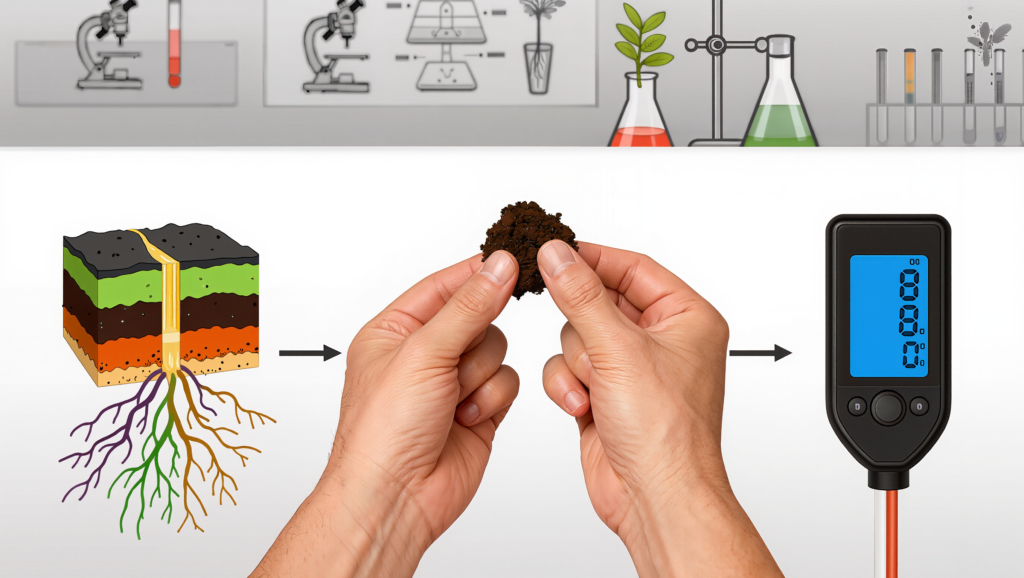
You do not need a laboratory to benefit from EC. Handheld EC meters and soil probes are widely available and relatively inexpensive.
1. Establish a baseline
Test EC in different parts of your garden:
- Raised beds.
- In-ground rows.
- Container mixes.
- Areas with poor growth.
- Areas with vigorous growth.
Note the values along with moisture level, recent fertilizer applications, and plant performance.
2. Compare over time
Measure EC:
- Before fertilizing.
- After fertilizing.
- During dry spells.
- After heavy rain or irrigation.
This helps you see how your practices shift the soil solution. If EC jumps dramatically after fertilizing, you may be over-applying. If it stays very low despite feeding, your fertilizer may be leaching or not dissolving well.
3. Pair EC with pH and observation
pH tells you whether nutrients are chemically available; EC tells you roughly how many soluble nutrients are present.
Use both together:
- Low pH + low EC: likely nutrient-poor and chemically limited.
- Neutral pH + low EC: may just need more fertilizer.
- Neutral pH + very high EC: risk of salt stress and imbalance.
- High pH + high EC: possible salinity and nutrient lockout issues.
Always combine meter readings with plant symptoms: leaf color, growth rate, tip burn, wilting, and overall vigor.
4. Adjust management based on EC
If EC is consistently low:
- Increase organic matter.
- Use balanced, moderate-rate fertilizers.
- Improve irrigation to keep nutrients in solution.
- Consider cover crops to build soil biology and nutrient cycling.
If EC is consistently high:
- Reduce fertilizer rates or frequency.
- Leach excess salts with extra irrigation if drainage is good.
- Improve drainage in heavy soils.
- Choose salt-tolerant crops for high-EC zones.
- Avoid adding more soluble salts until EC drops.
Common Mistakes When Using Electrical Conductivity in Gardens
Treating Electrical Conductivity as a complete soil test
EC gives a quick picture of salt and nutrient levels near roots, but it cannot tell you what nutrients are available. You still need periodic full soil tests for pH, macro- and micronutrients, organic matter, and texture.
Ignoring moisture
Measuring EC in bone-dry soil will give artificially low readings. Measuring in saturated soil will give artificially high readings. Try to test at consistent moisture levels, or at least note moisture when you record EC.
Over-fertilizing because “higher is better”
Higher EC in nonsaline soil generally means more water-soluble nutrients, but very high EC levels can cause plant burn or kill the plant. More is not always better once you pass the optimal range for your crop.
Using EC alone in saline soils
In saline or sodic soils, high EC may reflect harmful salts rather than useful nutrients. In those cases, EC is more a warning sign than a fertility indicator.
Why Electrical Conductivity is the overlooked hack
Most gardeners never measure EC. They guess fertilizer rates, watch for deficiency symptoms, and hope for the best. But EC gives you a rapid, inexpensive indication of ionic strength in the root environment, influencing water uptake, nutrient availability, and plant health.
It helps you:
- Detect under-fertilization before plants show severe deficiency.
- Catch over-fertilization before salt damage appears.
- Fine-tune irrigation and feeding schedules.
- Compare different beds, mixes, or compost batches.
- Make more informed decisions between fertilizer applications.
That is the real value: EC turns nutrient management from guesswork into something you can monitor and adjust.
Bottom line
Soil electrical conductivity is a simple measurement with powerful implications. It does not tell you exactly which nutrients are present, but it does tell you how “rich” or “salty” your soil solution is, which strongly affects whether plants can take up those nutrients.
Low EC often means low available nutrients and slowed growth. High EC can mean abundant nutrients—or dangerous salinity and osmotic stress. The goal is to keep EC in a crop-appropriate range where roots can access water and ions without being burned or starved.
Add EC to your garden routine alongside pH and periodic soil tests. Use it to guide fertilizer rates, irrigation, and amendments. That small, overlooked number can make a big difference in how efficiently your garden turns soil into healthy, productive plants.