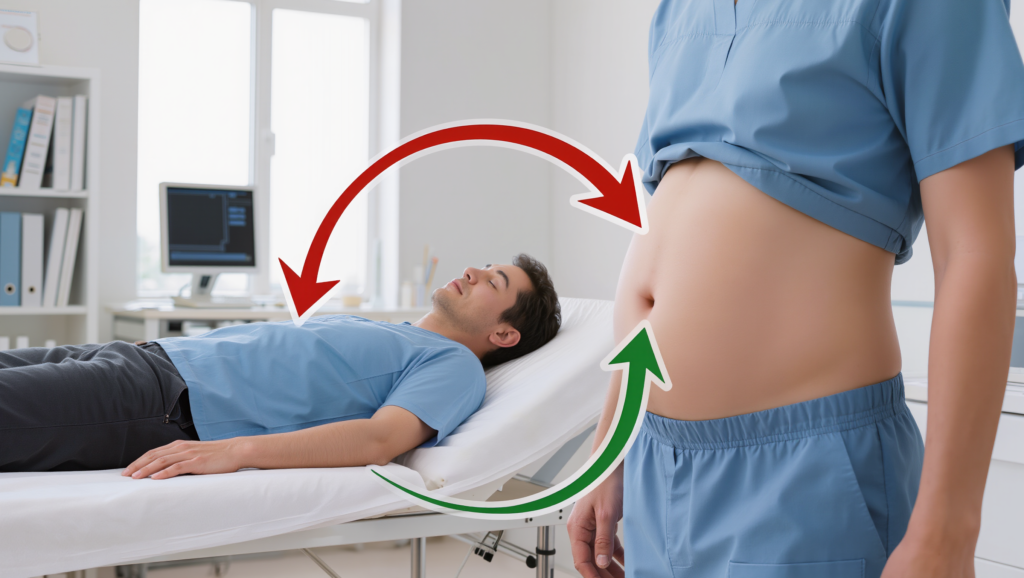












You have probably heard the advice: “Don’t lie down right after eating.” Maybe your parents said it, your doctor mentioned it, or you saw it in a health article. It sounds like old-school wisdom, the kind of rule that might be more tradition than science. But when it comes to digestion, posture actually matters more than you might think.
Lying down soon after a meal can slow gastric emptying, increase the risk of acid reflux, and make you feel more bloated or uncomfortable. Staying upright, on the other hand, helps your stomach empty more efficiently and uses gravity to keep stomach contents where they belong.
So, should you lie down after eating? For most people, especially those prone to heartburn or indigestion, the answer is a clear “no” for at least 2–3 hours after meals. Here is what the science says about posture, gastric emptying, and why staying vertical after eating really does aid digestion.
What Happens To Your Stomach After You Eat?
To understand why posture matters, it helps to know what your stomach is doing after a meal.
When you eat:
- Food enters the stomach, where it is mixed with gastric acid and enzymes.
- The stomach gradually empties its contents into the small intestine in a controlled way.
- The rate of emptying depends on meal composition (liquids vs. solids, fat, protein, fiber), volume, and various hormonal and neural signals.
Gastric emptying is not just about comfort; it affects:
- How quickly nutrients are absorbed.
- How full you feel (satiety).
- How likely you are to experience reflux, bloating, or nausea.
Anything that slows gastric emptying or increases pressure in the stomach can raise the risk of acid moving backward into the esophagus, causing heartburn and other reflux symptoms.
How Posture Affects Gastric Emptying
You might assume that your stomach works the same way whether you are sitting, standing, or lying down. After all, digestion is mostly automatic. But multiple studies show that body position can measurably change how fast your stomach empties.
Lying down slows gastric emptying
In a classic study researchers measured gastric emptying in healthy volunteers after they ate a solid meal (a sandwich) and a liquid meal (soup) in different postures: seated vs. lying supine (flat on the back).
Key findings:
- The half-emptying time of the sandwich was 32% longer when subjects were supine compared to seated.
- The emptying rate after the lag phase was 39% slower in the supine position.
- For the soup, the half-emptying time was 50% longer when subjects lay down immediately after eating compared to other conditions.
In other words, lying down after a meal significantly delayed how quickly the stomach emptied, for both solid and liquid components.
A later study using a continuous real-time 13C breath test (BreathID system) confirmed this for liquid meals. Healthy volunteers consumed a 200 kcal liquid meal and were tested in sitting vs. lying positions. Results showed:
- T 1/2 (half-emptying time) and T lag (lag phase) were significantly delayed in the lying position.
- The gastric emptying coefficient was decreased when lying down.
Another study found that orocecal transit time (a proxy for overall gut transit) was significantly slower in the supine position than in sitting (260 ± 21 min vs. 238 ± 20 min). Gastric emptying in the lying position was significantly slower compared to sitting, whether measured over 90 or 120 minutes.
Taken together, the evidence is consistent: lying down after eating slows gastric emptying, especially for liquids and mixed meals.
Does meal size matter more than posture?
One study compared small vs. large meals in sitting vs. left lateral (lying on the left side) positions. It concluded that meal volume had a major effect on gastric emptying, while posture had only a minor impact on intragastric meal distribution and no significant effect on overall emptying rate in that specific setup.
However, this study focused on left lateral decubitus (lying on the left side) and specific meal types, and other research shows clearer posture effects, especially for supine (flat on the back) positions.
The consensus from multiple lines of evidence is that while meal size and composition are dominant factors, posture still plays a meaningful role, particularly when lying flat soon after eating.
Right side vs. left side: does it matter?
Some older studies explored whether lying on the right vs. left side changes gastric emptying. One experiment with saline test meals found:
- More rapid initial emptying when subjects lay on the right side compared to left side or sitting.
- However, for larger, more physiologic meals that strongly activate duodenal receptors, posture differences were less pronounced.
In practical terms, while side-lying may have subtle effects, the bigger issue for most people is lying flat (supine) soon after a meal, which consistently slows emptying and increases reflux risk.
Why Staying Vertical Aids Digestion
Staying upright after eating—whether sitting or standing—supports digestion in several ways:
1. Faster gastric emptying
As shown above, sitting or standing allows the stomach to empty more quickly than lying down. Faster emptying means:
- Less time with a full, distended stomach.
- Reduced intragastric pressure.
- Lower likelihood of stomach contents pushing against the lower esophageal sphincter (LES) and causing reflux.
2. Gravity helps keep acid down
Your LES is a muscular valve between the stomach and esophagus. When it relaxes or is under pressure, acid can flow backward. Being upright uses gravity to:
- Keep gastric contents lower in the stomach.
- Reduce the chance of acid reaching the esophagus, especially if the LES briefly relaxes.
Gastroenterologists emphasize that eating and then lying down immediately is a common way to trigger heartburn, because stomach acid can regurgitate back up if you are not using gravity to help it stay down.
3. Better coordination of digestive motility
During sleep and when lying down:
- Stomach activity decreases.
- Intestinal contractions slow.
- Esophageal contractions reduce, and the LES may temporarily relax more often.
Staying upright after eating gives your body time to begin digesting before these sleep-related changes occur, which may reduce heartburn, regurgitation, and other acid reflux symptoms.
4. Reduced reflux and GERD symptoms
Multiple studies link lying down soon after eating with increased risk of gastroesophageal reflux disease (GERD):
- A large logistic regression analysis identified lying down soon after eating as an independent risk factor for GERD, with an odds ratio of 1.544. Other risk factors included fast eating, eating beyond fullness, high BMI, and smoking.
- In Asian populations, consuming high-spice foods followed by lying down after eating increases GERD risk, partly because lying down reduces LES pressure and promotes reflux of gastric contents.
- Approximately 26% of GERD patients have delayed gastric emptying, which prolongs retention of acidic food in the stomach, increases reflux risk, and contributes to symptoms. Delayed emptying raises stomach pressure, relaxing the LES and allowing acid into the esophagus.
Clinical guidelines for GERD consistently recommend:
- Avoiding lying down immediately after eating.
- Waiting at least 2–3 hours after meals before going to bed.
- Elevating the head of the bed by 6–8 inches for nighttime reflux.
What About Standing Vs. Sitting After Meals?
If lying down is bad, is standing better than sitting?
A gastroenterologist interviewed for a 2026 article noted:
- “Studies have shown that your stomach tends to empty faster when standing versus sitting to eat.”
- However, the difference is modest, and sitting upright during and after eating provides essentially the same benefit for most people, including those with reflux or gastroparesis.
The key is being upright, not necessarily standing. Sitting in a relaxed but vertical position (not slouched) is sufficient to aid digestion and reduce reflux risk.
Are There Instances When Lying Down After Eating Might Be Okay (Or Even Helpful)
For most people, especially those with reflux, the advice is clear: stay upright after meals. But there are a few exceptions where lying down may be considered:
Postprandial hypotension
Some people, particularly older adults or those with autonomic dysfunction, experience a drop in blood pressure after eating (postprandial hypotension), leading to dizziness or lightheadedness. In these cases, medical advice may include:
- Lying down for about an hour after eating to improve blood flow to the brain and reduce symptoms.
This is a specific medical situation and should be guided by a healthcare provider. For the average person without this condition, lying down after meals is more likely to cause digestive issues than help.
Severe fatigue or illness
If you are extremely fatigued, ill, or recovering from surgery, you may need to rest sooner after eating. In such cases:
- Try to elevate your upper body with pillows or a recliner rather than lying flat.
- Avoid large, heavy meals before rest.
- Discuss with your doctor if reflux or indigestion becomes a problem.
Practical Recommendations: How Long Should You Stay Upright After Eating?
Based on current evidence and clinical guidelines:
- For general digestion: Aim to stay upright (sitting or standing) for at least 1–2 hours after meals.
- If you have GERD or frequent heartburn: Avoid lying down for 2–3 hours after eating. This is a standard recommendation in GERD management guidelines.
- Before bedtime: Finish your last meal or large snack at least 3 hours before lying down to sleep. This reduces nighttime reflux and allows more complete gastric emptying before sleep.
- If you must rest sooner: Use a recliner or prop yourself up with pillows so your upper body is elevated, rather than lying flat.
Additional tips to support digestion after meals:
- Eat slowly and chew thoroughly; fast eating is an independent risk factor for GERD.
- Avoid overeating; “eating beyond fullness” increases reflux risk.
- Limit very hot foods, high-fat meals, and known trigger foods if you are prone to reflux.
- Maintain a healthy weight; high BMI is a significant risk factor for GERD.
The bottom line
Should you lie down after eating? For most people, especially those concerned about digestion, heartburn, or reflux, the answer is no. Research shows that lying down soon after a meal:
- Slows gastric emptying by 30–50% for both solid and liquid components.
- Increases intragastric pressure and the likelihood of acid reflux.[
- Is an independent risk factor for GERD, with an odds ratio around 1.5.
Staying vertical after meals—sitting or standing in an upright posture—helps your stomach empty more efficiently, uses gravity to keep acid down, and reduces the risk of indigestion and reflux.
A practical rule of thumb:
- Stay upright for at least 1–2 hours after eating.
- If you have GERD or frequent heartburn, aim for 2–3 hours.
- Avoid large meals within 3 hours of bedtime.
There are exceptions (such as postprandial hypotension), but for the vast majority of people, the old advice holds up: don’t lie down right after eating.
Sources:
- https://pmc.ncbi.nlm.nih.gov/articles/PMC11347905/
- https://pmc.ncbi.nlm.nih.gov/articles/PMC10458865/
- https://pubmed.ncbi.nlm.nih.gov/19102419/
- https://pmc.ncbi.nlm.nih.gov/articles/PMC12984807/