











If you have ever experienced a gout attack, you know it is not just “joint pain.” It is a sudden, fiery inflammation—often in the big toe—that can make even a bedsheet feel unbearable. Conventional medicine offers fast relief with anti-inflammatory drugs and urate-lowering medications, but many people are also looking for a more holistic approach that addresses the underlying causes of uric acid build-up.
This is where Ayurveda comes in. In Ayurvedic medicine, gout is closely linked to a condition called Vatarakta, which involves an imbalance of the Vata and Rakta doshas. Rather than just masking symptoms, Ayurveda aims to correct the root imbalances—through diet, lifestyle, herbs, and detoxification practices—that contribute to excess uric acid and chronic inflammation.
But how much of this is backed by science, and how much is tradition? In this post, we’ll explore the Ayurvedic view of gout, what modern research says about uric acid and inflammation, and how the two approaches can complement each other.
What Is Gout?
Gout is a form of inflammatory arthritis caused by the deposition of monosodium urate (MSU) crystals in joints and surrounding tissues. These crystals form when uric acid levels in the blood become too high—a condition called hyperuricemia.
Key facts:
- Hyperuricemia is defined as serum urate above 6.8–7 mg/dL (about 420 µmol/L).
- MSU crystals precipitate when urate concentration exceeds its solubility limit.
- Crystal deposition alone may not cause symptoms, but it sets the stage for acute flares.
Gout is the most common inflammatory arthritis in adults, and its prevalence is rising worldwide.
Why Uric Acid Builds Up In The Body
Uric acid is the end product of purine metabolism. Purines come from two sources:
- Endogenous production: Your body makes purines as part of normal cell turnover.
- Exogenous intake: You get purines from food, especially animal organs, seafood, and certain meats.
Hyperuricemia results from:
- Increased uric acid production (e.g., high purine intake, high fructose intake).
- Decreased uric acid excretion (mostly by the kidneys, but also the intestines).
In most people, decreased excretion is the primary driver of high uric acid, not just diet.
The Inflammatory Cascade: Why Gout Hurts So Much
The pain of gout is not caused directly by uric acid itself, but by the immune response to MSU crystals.
Here is how it works:
- MSU crystals form in the joint when urate levels are high.
- Macrophages and other immune cells recognize the crystals as a “danger signal.”
- This activates the NLRP3 inflammasome, a key player in innate immunity.
- The inflammasome activates caspase-1, which converts pro-IL-1β into active IL-1β.
- IL-1β triggers a cascade of inflammatory cytokines and chemokines.
- Neutrophils flood into the joint, causing swelling, redness, and intense pain.
This is why gout flares are so sudden and severe—they are an exaggerated innate immune response.
The Ayurvedic View: Vatarakta And Dosha Imbalance
In Ayurveda, gout is understood as Vatarakta, a condition involving the vitiation (imbalance) of two doshas:
- Vata: Associated with movement, circulation, and the nervous system.
- Rakta: Associated with blood and its qualities.
According to Ayurvedic theory:
- Vitiated Vata is obstructed by vitiated Rakta, leading to severe joint pain and swelling.
- The condition is influenced by diet, lifestyle, and digestive fire (Agni).
This framework is conceptually similar to the modern understanding of gout as a metabolic and inflammatory disorder.
How Ayurveda Addresses The Root Causes Of Gout And Uric Acid Build Up
Ayurveda does not just treat the symptoms of gout—it aims to correct the underlying imbalances that lead to uric acid build-up and inflammation.
1. Diet and digestion
Ayurveda emphasizes the importance of Agni (digestive fire) in maintaining health. Poor digestion is thought to lead to the accumulation of toxins (Ama) that contribute to disease.
Dietary recommendations for gout in Ayurveda include:
- Avoiding high-purine foods: Organ meats, seafood, red meat.
- Reducing alcohol and sugary drinks: Both can raise uric acid.
- Eating easily digestible foods: Cooked vegetables, whole grains, legumes in moderation.
- Staying hydrated: To support kidney function and uric acid excretion.
These recommendations align with modern dietary advice for gout.
2. Herbal remedies
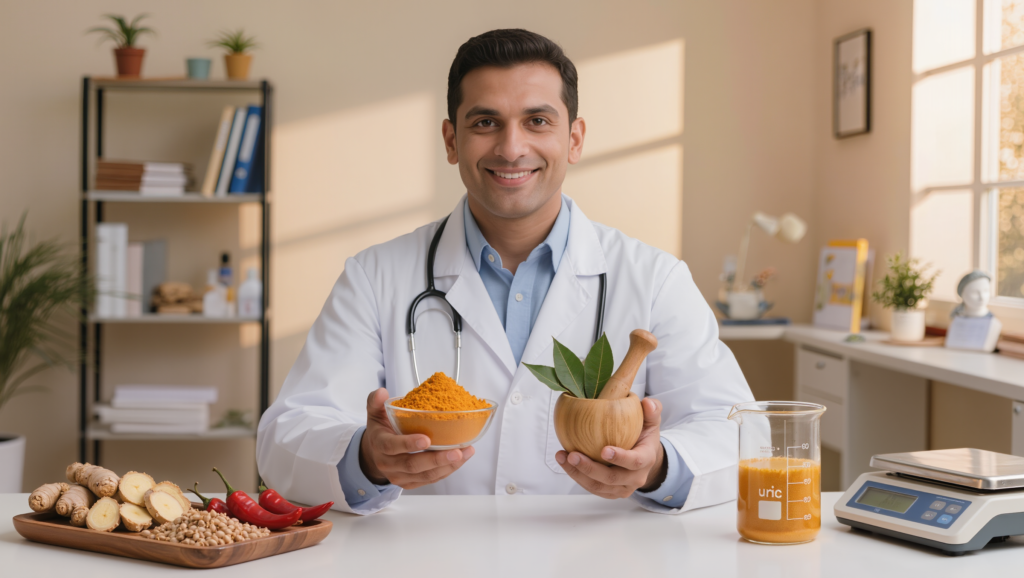
Ayurveda uses a variety of herbs to address gout, often in combination. Some of the most studied include:
- Guduchi (Tinospora cordifolia): Known for its anti-inflammatory and immunomodulatory properties.
- Shunthi (Zingiber officinale, ginger): Anti-inflammatory and digestive support.
- Musta (Cyperus rotundus): Digestive and anti-inflammatory.
- Kaishor Guggul: A classical Ayurvedic formulation used for joint and skin disorders.
- Vasadi Kwatha: A decoction used in Vatarakta management.
A 2024 case study found that a combination of Vasadi Kwatha, Kaishor Guggul, and Guduchi-Shunthi-Musta reduced serum uric acid from 9 mg/dL to 5.3 mg/dL over three months.
3. Detoxification (Panchakarma)
Ayurveda includes detoxification practices called Panchakarma to remove accumulated toxins:
- Virechana (therapeutic purgation): To cleanse the digestive tract.
- Raktamokshana (bloodletting): Traditionally used for blood-related disorders, though controversial in modern practice.
- Basti (medicated enemas): To balance Vata and support elimination.
These practices are based on traditional theory, and their efficacy for gout specifically is not well-established in modern clinical trials.
4. Lifestyle and routine (Dinacharya)
Ayurveda emphasizes daily routines that support balance:
- Regular sleep and wake times.
- Moderate exercise: To support circulation and metabolism.
- Stress management: Through meditation, yoga, or pranayama.
- Avoiding overexertion and irregular eating.
These lifestyle factors can indirectly support uric acid management by improving overall metabolic health.
What Science Research Says About Ayurvedic Treaments For Gout
The evidence for Ayurvedic treatments for gout is still limited, but some studies are promising.
Clinical studies: small but positive
A 2024 randomized clinical trial of 60 patients with Vatarakta found that:
- Nimbadi Churna and Kokilakshadi Kashay both significantly reduced symptoms and serum uric acid levels over 28 days.
- There was no significant difference between the two treatments.
- Both were well-tolerated with minimal complications.
However, the study was open-label (not blinded), and the sample size was small.
Case studies: individual results
A 2024 case study of a 45-year-old woman with Vatarakta found that:
- A combination of Vasadi Kwatha, Kaishor Guggul, and Guduchi-Shunthi-Musta reduced serum uric acid from 9 to 5.3 mg/dL over three months.
- Symptoms of joint pain and swelling improved.
While encouraging, case studies do not prove efficacy in the general population.
The evidence gap
- Most Ayurvedic studies are small, unblinded, or single-center.
- There are few high-quality randomized controlled trials.
- More rigorous research is needed to confirm efficacy and safety.
How Ayurveda And Modern Medicine Can Work Together To Treat Gout And Uric Acid Build Up
Ayurveda and conventional medicine are not mutually exclusive. In fact, they can complement each other well.
Conventional medicine: fast relief and urate lowering
Modern treatments include:
- NSAIDs, colchicine, or corticosteroids: For acute flares.
- Allopurinol or febuxostat: To lower uric acid long-term.
- IL-1 inhibitors: For severe or refractory cases.
For people with frequent flares (two or more per year), tophaceous gout, or joint damage, long-term urate-lowering therapy is strongly recommended to keep serum urate below 6 mg/dL.
Ayurveda: addressing root causes and lifestyle
Ayurveda can complement conventional treatment by:
- Supporting digestion and metabolism.
- Providing anti-inflammatory herbs.
- Encouraging healthy lifestyle habits.
- Reducing reliance on medications over time (under medical supervision).
Important caution
- Do not stop prescribed medications without consulting your doctor.
- Some herbs can interact with medications.
- Ayurvedic treatments should be used alongside, not instead of, conventional care for serious conditions.
Practical Tips And Integrative Approach To Treating Gout
If you want to take an integrative approach to managing gout, here are some evidence-based steps:
1. Follow a low-purine, anti-inflammatory diet
- Limit organ meats, seafood, and red meat.
- Avoid sugary drinks and excessive alcohol.
- Eat plenty of vegetables, whole grains, and low-fat dairy.
- Stay hydrated.
2. Consider Ayurvedic herbs (with guidance)
- Talk to a qualified Ayurvedic practitioner or integrative medicine doctor.
- Consider herbs like Guduchi, ginger, and Musta.
- Be cautious with bloodletting or other intensive detox practices.
3. Maintain a healthy lifestyle
- Exercise regularly but avoid overexertion during flares.
- Manage stress through meditation or yoga.
- Get adequate sleep.
- Maintain a healthy weight.
4. Monitor uric acid levels
- Get regular blood tests to track uric acid.
- Work with your doctor to adjust treatment as needed.
5. Use conventional medicine when needed
- Do not hesitate to use NSAIDs or colchicine for acute flares.
- Consider urate-lowering therapy if you have frequent flares or tophi.
Understanding Gout As a Metabolic Disease
Gout is increasingly understood as a metabolic disorder linked to:
- Obesity and insulin resistance.
- Hypertension and cardiovascular disease.
- Chronic kidney disease.
- Dietary patterns high in purines, fructose, and alcohol.
This is why a holistic approach—like Ayurveda—that addresses diet, lifestyle, and digestion can be valuable.
Bottom line
Gout is more than just a painful joint condition—it is a sign of underlying metabolic imbalance and chronic inflammation. While conventional medicine offers effective treatments for acute flares and urate lowering, Ayurveda offers a complementary approach that addresses the root causes through diet, herbs, and lifestyle.
Key takeaways:
- Gout is caused by MSU crystal deposition due to hyperuricemia.
- Inflammation is driven by the NLRP3 inflammasome and IL-
- Ayurveda views gout as Vatarakta, involving Vata and Rakta imbalance.
- Ayurvedic herbs and lifestyle changes may help reduce uric acid and inflammation.
- Evidence is still limited, so Ayurveda should complement, not replace, conventional care.
If you are dealing with gout, consider working with both a rheumatologist and an Ayurvedic practitioner to create a personalized plan that addresses both symptoms and root causes.
Whether you choose conventional medicine, Ayurveda, or a combination of both, the goal is the same: to reduce uric acid, calm inflammation, and prevent future flares—so you can get back to living your life without pain.
Sources:
- https://pmc.ncbi.nlm.nih.gov/articles/PMC12479186/
- https://pmc.ncbi.nlm.nih.gov/articles/PMC8219997/