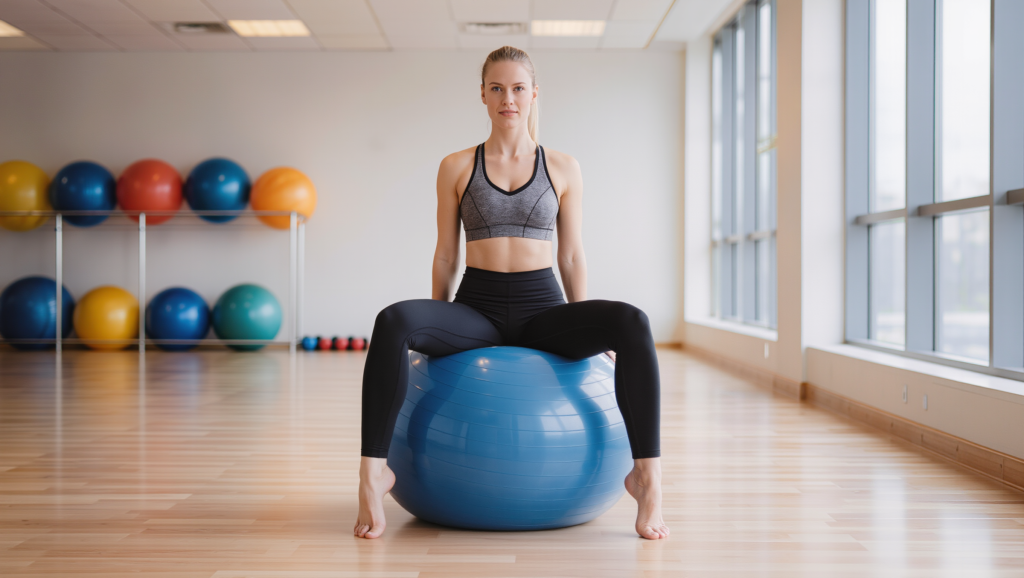












If you spend hours at a desk, you have probably felt that familiar stiffness in your lower back, hips, and shoulders. The idea of swapping your office chair for a stability ball sounds appealing: less slouching, more core engagement, and maybe even a subtle workout while you work.
But does a stability ball really activate your core more than a regular chair? The answer is more nuanced than the marketing suggests. Some studies show small increases in certain trunk muscles, while others find no meaningful difference in overall core activation. And prolonged ball sitting can actually increase discomfort and fatigue.
In this post, we’ll break down the science of dynamic sitting, how stability balls affect core muscles, and how to use them safely if you decide to try one.
How A stability Ball Affects Core muscles
A stability ball is an unstable surface, which means your body has to constantly make small adjustments to stay balanced. This can engage:
- Abdominal muscles (rectus abdominis, obliques).
- Lower back muscles (erector spinae).
- Pelvic floor muscles.
- Hip and glute muscles.
The Core Hypothesis: Instability Equals Activation
The fundamental premise of the stability ball chair is based on a concept called “active sitting.” The idea is that because the ball is an unstable surface, your deep core muscles—specifically the transverse abdominis, obliques, and erector spinae—must constantly fire in micro-adjustments to keep you upright and prevent you from toppling over . In theory, this constant low-level contraction is akin to a gentle, all-day workout that strengthens the stabilizers of the spine while you type.
For a long time, this was accepted as gospel in physical therapy circles. However, as is often the case, the laboratory tells a more complicated story than the locker room. When researchers put participants through hour-long sitting sessions comparing a stability ball to a standard office chair, they found something that might burst your bubble: the actual increase in trunk muscle activation was surprisingly modest . In fact, the most significant finding wasn’t about muscle gain at all; it was about discomfort. Participants consistently reported feeling significantly more uncomfortable sitting on the ball for prolonged periods compared to the chair, even though the muscular differences were small .
So, does the ball “activate” the core? Yes, technically. But is it the transformative strengthening tool it’s cracked up to be? That depends entirely on how you use it and what you expect.
The “Muscle Activation” Paradox: Quality Over Quantity
If we look at the electromyography (EMG) data—the electrical signals that tell us how hard a muscle is working—the picture gets fascinating. A 2025 study found that when participants sat on a stability ball, their overall muscle activity across the abdomen, back, and legs increased by about 55% compared to a standard office chair with a backrest . That sounds impressive on paper. However, the researchers noted that a large chunk of this increase came from the rectus femoris—a muscle in your thigh—not necessarily your deep core .
Why the thigh? Because when you sit on a ball, you have to plant your feet firmly and often adjust your leg position to keep the ball from rolling away. You aren’t necessarily doing more “crunches”; you’re just doing more “stabilizing” with your lower body.
Furthermore, some reviews highlight a critical caveat: while short-term use of a ball might engage stabilizing muscles, prolonged use leads to fatigue. And when your core muscles fatigue, your posture actually degrades, and your risk of injury goes up . This is the cruel irony of the ball chair: it works your muscles just enough to tire them out, but perhaps not enough to produce meaningful hypertrophy or strength gains, all while leaving you vulnerable to a sudden roll or slump .
Why You Don’t Need to Bounce On A Stability Ball To Activate Core Muscles
If the goal is truly to “upgrade your core” while sitting, the science suggests that the type of movement matters more than the surface. The traditional stability ball forces you to balance, which is good, but it can be clunky for actual work. Enter the modern evolution: the dynamic office chair.
A 2015 study compared the muscle activation of participants performing pelvic rotation exercises on a stability ball versus on a dynamic office chair (a chair designed with a tilting mechanism that encourages movement). The results were remarkably similar. The researchers found that trunk muscle activity on the dynamic chair was comparable to the stability ball across almost all exercises, with the only major difference being slightly higher activity in the right external oblique on the ball . The conclusion was eye-opening: dynamic office chairs can promote movement and core activation while providing the safety and adjustability of a traditional chair .
This is a crucial distinction for anyone working a 9-to-5. You don’t need to sacrifice lumbar support to get your core engaged. If you suffer from lower back pain, the rigid instability of a ball might actually aggravate your spine by forcing your erector spinae to overwork . A dynamic chair allows you to fidget, shift, and engage your core without the constant fear of falling or the rapid onset of muscle fatigue that comes with a sphere .
The Arm (and Leg) Movement Factor: When the Ball Actually Shines
There is one area where the stability ball genuinely outperforms a standard chair, but it’s highly specific: lower limb movement. A 2011 study looked at how the trunk responds to rapid limb movements while seated on a ball versus a chair. When participants performed arm movements, there was basically no difference in trunk muscle response between the ball and the chair. However, when they performed hip flexion (lifting the leg), the stability ball induced earlier and higher amplitude muscle activation in the rectus abdominis and external obliques .
What does this mean in English? If you are sitting on a ball and you lift your leg to put on a sock, or if you are doing “marching” exercises while taking a phone call, your core does fire more effectively to protect your spine. But simply sitting there typing? Your body is smart enough to find a comfortable equilibrium, and the core activation drops off .
This suggests that the ball is less of a “chair” and more of a “movement trainer” that you happen to sit on. If you are static, you might as well be on a chair. If you are moving your legs, the ball becomes a legitimate stability challenge.
The Safety and Fatigue Reality Check Of Using A Stability Ball As Chair
We need to talk about the elephant in the room—or rather, the ball under the desk. Some researchers are blunt about the risks: exercise balls are not designed to ANSI standards for seating, and others explicitly bans unstable seating like ball chairs in certain environments due to fall and injury risks . While you might not be piloting a fighter jet, you are navigating a workspace with coffee cups and sharp desk corners.
More importantly, the research points to accommodation. A 2013 study investigated whether giving people a 9-day “accommodation period” to get used to sitting on a ball would reduce the discomfort they felt. The idea was that maybe you just need to toughen up. The results suggested that while some adaptation occurs, the fundamental issue remains: prolonged sitting on a ball is simply not as comfortable as a supportive chair, and the muscle activation benefits don’t suddenly skyrocket after you get used to it .
For those with existing back issues, this is critical. If you have an acute disc issue or facet joint irritation, the constant micro-corrections required to stay upright on a ball can aggravate the very tissues you are trying to soothe . Some physiotherapist note that a ball chair is not a treatment for back pain and should be used as an occasional active-sitting option rather than a full-time replacement .
How To Work On Core Muscles While Using Stability Ball As a Chair Without Falling
So, you still want to get some core benefit while sitting? Here is the evidence-based protocol for using a stability ball without falling into the trap of ineffective or dangerous sitting.
1. Treat It Like a Snack, Not a Meal
The consensus from both ergonomics research and physical therapy is that the ball should be used in short bursts. Start with 15 to 30 minutes, once or twice a day . Use it during a phone call or when you are brainstorming, not when you are deep in focus work that requires you to lean forward and type for hours.
2. Nail the Geometry (Or Don’t Bother)
The most common mistake is using a ball that is the wrong size. Your hips and knees should form roughly a 90-degree angle, with your thighs parallel to the floor . If the ball is too soft (under-inflated), you get more surface area and stability, but less challenge. If it is over-inflated, it becomes a rigid, tippy hazard . Merrithew, a manufacturer of stability balls, provides a sizing chart indicating that most people between 5’4″ and 5’11” need a 65cm ball, but the final adjustment is inflation: you want your hips slightly higher than your knees when seated .
3. Move Deliberately
Since the research shows that arm movements don’t trigger much extra core activity, but leg movements do , use the ball for “active breaks.” Do some seated marches, gentle pelvic tilts, or leg extensions while you are on the ball. This is where the “dynamic” part of dynamic sitting actually pays off. Just don’t expect to get a six-pack from static balancing.
4. Don’t Abandon Your Chair
The modern ergonomic chair is a feat of engineering designed to keep your spine neutral and your discs hydrated. The stability ball cannot replicate lumbar support or height adjustability. The best approach is a hybrid workstation. Use your supportive chair for the majority of the day, and swap to the ball for a 20-minute core-activation session in the afternoon when you feel stiff.
The Verdict: A Tool, Not a Miracle
The stability ball does activate your core—that part of the marketing is technically true. The 2025 data confirms that there is a measurable increase in muscle activity and even a slight bump in energy expenditure (about a 13% net increase in oxygen consumption) when sitting on a ball versus a chair . But the effect is small, and the risk of fatigue and discomfort is real .
Upgrading your seat isn’t about finding a magic piece of furniture that does the work for you. It’s about introducing variety into a sedentary day. The stability ball is a fantastic tool for breaking up static posture and forcing your deep stabilizers to wake up for a few minutes. But it is a terrible replacement for a well-fitted chair over an 8-hour shift.
If you want to upgrade your core, use the ball as a trigger for movement, not as a substitute for a spine-friendly workstation. Sit on it for 20 minutes, do some pelvic tilts, engage your abs, and then roll it back under the desk and return to your chair before your lower back starts complaining. Your core will get the memo, and your productivity (and safety) will thank you.