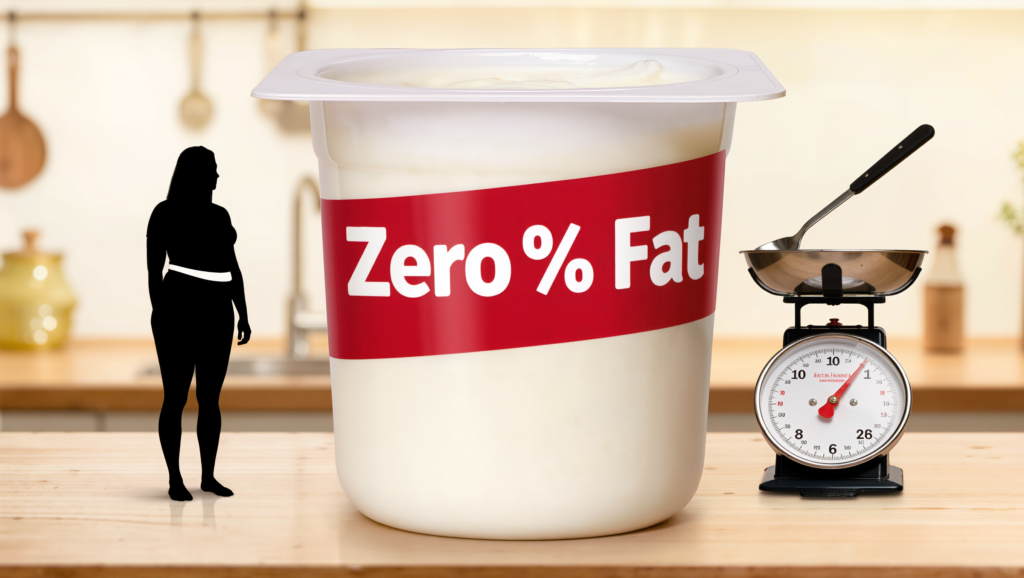












“Zero percent fat” sounds like a free pass. The label suggests you can eat or drink as much as you want without consequences, but that is not what fat-free actually means. A product can contain little or no fat and still provide plenty of calories from sugar, starch, carbohydrates, or large serving sizes.
In some cases, a fat-free product may even encourage overeating because the health claim creates a “health halo.” People may assume it is lighter than it really is, serve themselves more, or eat it more frequently. People substantially eat more when foods were described as low-fat, and it’s important to state that research shows tthat many low-fat and no-fat foods contain added sugar, starch, or salt and may have as many calories as regular versions.
The real lesson is simple: weight gain is not caused by one nutrient label. It happens when total energy intake regularly exceeds the amount your body uses. A food can be fat-free and still contribute to that calorie surplus.
What “Fat-Free” Truly Means
The first thing to understand is that “zero percent fat” is usually a marketing phrase, not a promise that the entire product contains literally zero fat or zero calories.
In the United States, a product labeled “fat-free” can contain less than 0.5 grams of fat per serving. The serving itself may be small, and manufacturers are allowed to define servings in ways that do not always match how much people actually eat.
That creates two common misunderstandings:
- Fat-free does not mean calorie-free.
- Less than 0.5 grams per serving does not mean zero fat in the entire package.
For example, if a snack contains 0.4 grams of fat per serving and the package contains four servings, eating the whole package provides more fat than the front label may make you expect. The same serving-size issue applies to calories, sugar, and carbohydrates.
The FDA’s nutrition-label guidance makes this point directly: “fat-free” and “no added sugars” do not mean calorie-free, and modified products may contain as many calories as their regular counterparts.
Why Calories Do Not Come Only From Fat
Fat is calorie-dense, providing about 9 calories per gram. Carbohydrate and protein provide about 4 calories per gram, while alcohol provides about 7 calories per gram.
That means removing fat can reduce calories—but only if the manufacturer does not replace the missing fat with enough sugar, starch, or other calorie-containing ingredients to make up the difference.
A low-fat cookie, yogurt, dressing, frozen dessert, or muffin may still contain:
- Added sugar.
- Corn syrup or glucose syrup.
- Refined flour.
- Maltodextrin.
- Rice starch.
- Fruit concentrates.
- Sweetened coatings.
- Larger portions.
The math is not complicated. If the fat is removed but carbohydrates are added back for taste and texture, the calorie difference may be small. Low-fat and no-fat foods may have just as many calories—or more—than the regular version.
This is why “fat-free” tells you only one thing about the product. It does not tell you whether the food is low in sugar, low in calories, filling, minimally processed, or helpful for weight management.
Why Manufacturers Add Sugar To Fat-Free Products
Fat provides much more than calories. It gives food creaminess, richness, aroma, mouthfeel, and staying power. When manufacturers remove it from foods such as yogurt, salad dressing, ice cream, and baked goods, the product can become thin, bland, watery, or less satisfying.
To compensate, manufacturers may add:
- Sugar for sweetness.
- Starch for thickness.
- Salt to improve flavor.
- Gums and stabilizers for texture.
- Artificial or non-nutritive sweeteners.
- Flavorings to mimic the original product.
This does not mean every fat-free product is unhealthy. Some are genuinely lower in calories and can be useful in a balanced diet. The point is that you cannot assume the replacement ingredients are nutritionally neutral.
A fat-free flavored yogurt, for example, may contain less fat than a plain whole-milk yogurt but considerably more added sugar. A fat-free salad dressing may contain little fat but be sweetened and highly processed. A fat-free frozen dessert may have a similar calorie count to a regular product because the lost fat has been replaced with sugar and starch.
The Serving-Size Trap Of Fat-free Products
Serving size is one of the most important details on a food label, and it is also one of the easiest to overlook.
A package may appear to contain one snack, but the nutrition panel may define it as two, three, or even more servings. If the front says “zero percent fat” and the back lists 90 calories per serving, you may assume the entire package contains 90 calories. If it actually contains three servings, the total is 270 calories.
The same problem applies to:
- Fat-free crackers.
- Mini cakes.
- Snack bars.
- Flavored yogurt.
- Coffee creamers.
- Fat-free sauces.
- Low-fat cereal clusters.
Before deciding that a food is “light,” multiply the calories, sugar, and carbohydrates by the amount you actually plan to eat. The Nutrition Facts panel is based on the listed serving, not your personal serving.
The Health-Halo Effect Of Fat-free Products
A food label can change how people behave. Research summarized by the BBC found that participants ate as much as 28% more low-fat sugar-coated chocolates than normal versions and underestimated how many calories they had consumed
That is the health-halo effect: one positive-sounding feature makes the entire product appear healthier than it is. The claim “fat-free” can cause people to:
- Take a larger portion.
- Eat directly from the package.
- Add more toppings or sauces.
- Consume the food more often.
- Feel less need to compensate elsewhere.
The problem is not that people are foolish. It is that food marketing is designed to focus attention on one attractive characteristic while the rest of the nutrition profile fades into the background.
A fat-free candy is still candy. A fat-free cookie is still a cookie. Removing one nutrient does not erase the sugar, flour, calories, or the overall eating pattern.
Can Fat-free Foods Make You Fat?
Strictly speaking, fat-free foods do not create body fat through some special mechanism. Body fat increases when the body receives more usable energy than it expends over time. That excess energy can come from fat, carbohydrates, protein, or alcohol.
However, fat-free foods can contribute to weight gain when they encourage higher total calorie intake
There are several possible routes:
- Replacement calories: Fat is removed, but sugar and starch are added, leaving the calorie count similar.
- Larger portions: The health label makes the product seem safe to eat in greater quantities.
- Lower satiety: Some low-fat products may be less satisfying, encouraging additional eating.
- More frequent consumption: People may classify the food as a guilt-free snack.
- Highly processed combinations: The product may remain low in fat but high in refined carbohydrates and added sugar.
Whether a diet is low-fat or high-fat, consuming more calories than the body needs can contribute to weight gain.
That is the central principle. Total calories and overall diet quality matter more than whether a package advertises itself as fat-free.
Why Dietary Fat Can Help With Satiety
Fat is not automatically the enemy. It slows gastric emptying and contributes to the sensory experience of food, which can make meals more satisfying. A meal containing some healthy fat may keep you full longer than a highly refined, fat-free snack.
Healthy sources include:
- Avocado.
- Nuts and seeds.
- Olive oil.
- Fatty fish.
- Natural peanut or almond butter.
- Plain yogurt.
- Eggs.
- Olives.
This does not mean you should add unlimited oil or eat large amounts of high-fat food. Fat is calorie-dense, so portions still matter. The better approach is to choose a moderate amount of nutritious fat within meals that also contain protein, fiber, and minimally processed carbohydrates.
A bowl of plain yogurt with berries, seeds, and oats may be more satisfying than a sweetened fat-free yogurt followed by another snack an hour later. The healthier choice depends on the full meal, not just the fat percentage.
The Difference Between Naturally Low-fat And Processed Fat-free
There is a major difference between a food that is naturally low in fat and a product that has been reformulated to remove fat.
Naturally low-fat foods include many fruits, vegetables, legumes, potatoes, and whole grains. They provide water, fiber, vitamins, minerals, and plant compounds without needing a fat-replacement strategy.
Processed fat-free foods may have started as products that normally contain fat, such as:
- Cookies.
- Ice cream.
- Cheese products.
- Creamy dressings.
- Flavored dairy desserts.
- Snack cakes.
The phrase “fat-free” does not tell you which category you are dealing with. The ingredient list and Nutrition Facts panel do.
This is why a fat-free apple is not nutritionally equivalent to a fat-free cookie. Both may carry little fat, but one is a whole food and the other may be a refined, sweetened product.
How To Read A Zero-fat Label
Ignore the front of the package for a moment and turn it around. Check these five details:
Calories per actual portion
Look at calories per serving, then calculate how many calories you will consume based on the amount you actually eat.
Added sugar
Check whether sugar, syrup, glucose, fructose, dextrose, honey, or concentrated fruit ingredients appear near the beginning of the ingredient list.
Protein and fiber
Protein and fiber can help make food more filling. A fat-free food with little protein and fiber may not satisfy you for long.
Ingredient quality
The shorter ingredient list is not automatically better, but a product dominated by refined starches, sugar, and flavoring deserves a closer look.
The regular version
Compare the fat-free product with the standard version. Sometimes the calorie difference is surprisingly small, while the fat-free product contains more sugar. It is recommended to compare labels rather than trusting the marketing claim.
What You Should Buy Instead Of Fat-free Products
You do not need to avoid all fat-free foods. Nonfat Greek yogurt, skim milk, beans, fruit, vegetables, and many whole grains can be useful foods. The problem is treating “zero fat” as a complete health assessment.
A practical shopping strategy is:
- Choose whole or minimally processed foods most of the time.
- Pick unsweetened versions of yogurt and plant-based beverages.
- Choose plain foods and add your own fruit or spices.
- Use healthy fats in measured portions.
- Compare calories and sugar between low-fat and regular versions.
- Avoid eating directly from large packages.
- Look for fiber and protein, not just low fat.
The best choice may be the version that you find satisfying enough to eat in a reasonable portion.
The Role Of Fat In A Weight-loss Diet
A weight-loss diet can be low-fat, moderate-fat, or relatively high-fat. The most important factors are whether it creates a sustainable calorie deficit, provides adequate nutrition, and is satisfying enough to maintain.
Weight loss ultimately comes down to calorie intake, whether the diet is low-fat or high-fat. This does not make calories the only thing that matters, but it does keep the discussion grounded.
Food quality, protein, fiber, sleep, stress, physical activity, and appetite all influence how easy it is to maintain that calorie balance. A diet built entirely around fat-free processed products may look disciplined but still fail if it leaves you hungry and leads to overeating later.
Bottom line
“Zero percent fat” does not mean zero calories. Fat-free foods can still contain sugar, starch, refined carbohydrates, and enough calories to contribute to weight gain—especially when the label encourages larger portions or more frequent eating.
The answer is not to fear fat or automatically choose full-fat products. It is to look at the entire nutrition label, compare the regular and modified versions, and choose foods that provide real satisfaction along with useful nutrients.
A fat-free apple, plain yogurt, or vegetable is one thing. A fat-free cookie, sweetened dessert, or oversized snack is another. The label may say “zero percent fat,” but your body responds to the whole package.
Sources: