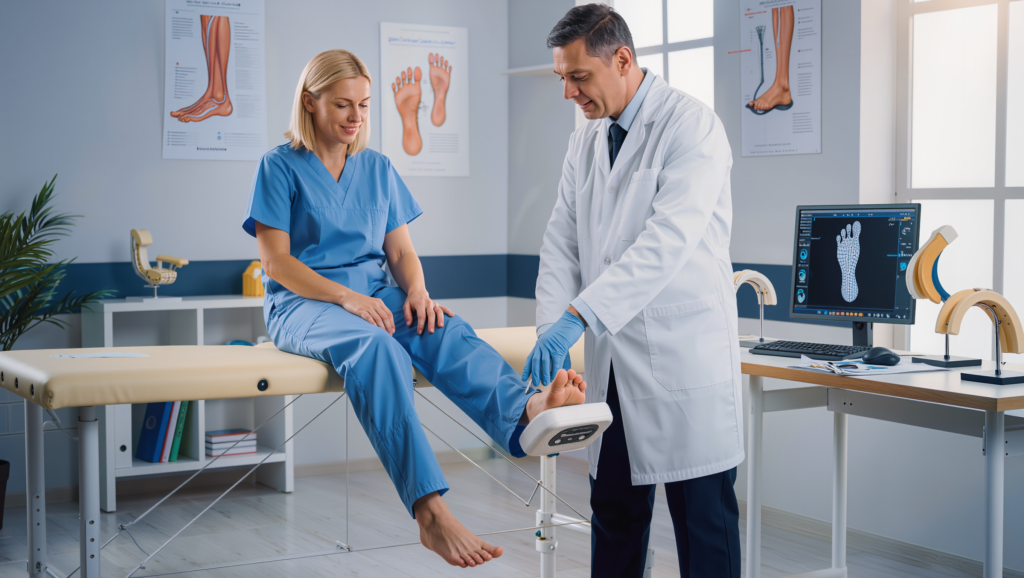












If you have ever been told your knee pain might be coming from your feet, it probably sounded a little strange. After all, your knees are up here, and your feet are way down there. But podiatrists, physical therapists, and orthopedic specialists have long known that the alignment of your feet—especially the height and strength of your arches—can have a surprising impact on how your knees feel and function.
Weak or collapsed arches (often called flat feet or pes planus) can change the way your entire lower body moves. This can shift stress onto your knees, alter joint mechanics, and contribute to pain, stiffness, and even cartilage damage over time.
But it is not a simple one-way street. Not everyone with flat feet gets knee pain, and not all knee pain comes from foot alignment. Let’s unpack the biomechanics, the evidence, and what you can do about it.
How Your Foot Arches Affect Your Knees: The Biomechanics
Your foot is not just a platform for standing. It is a complex shock absorber and lever that influences how forces travel up through your ankles, knees, hips, and spine. When your arches are weak or collapsed, this chain of movement gets disrupted.
The pronation connection
Flat feet often lead to overpronation—when your foot rolls inward too much as you walk or run. This causes:
- Internal rotation of the tibia (shin bone). As your foot pronates, your lower leg rotates inward.
- Altered knee alignment. This internal rotation can change the angle at which your femur (thigh bone) meets your tibia, affecting how forces are distributed across the knee joint.
The result: increased stress on the inner (medial) part of the knee, which is where many people develop osteoarthritis and pain.
Increased medial knee loading
Research shows that people with flat feet and knee osteoarthritis (OA) experience:
- Higher medial tibiofemoral contact forces during walking. This means more pressure on the inner knee compartment.
- Greater knee adduction angular impulse. This is a measure of how much the knee is pulled inward during gait, a known risk factor for medial knee OA progression.
- More cartilage damage over time in the medial compartment.
One study found that people with knee OA and flat feet had significantly higher pain scores and altered knee mechanics compared to those with normal arches.
The kinetic chain effect
Your body works as a connected system. When your feet pronate excessively, it can create a domino effect:
- Ankle: Altered joint mechanics.
- Knee: Increased internal rotation and stress.
- Hip: Compensatory changes in movement patterns.
- Pelvis and lower back: Further compensations that can contribute to pain elsewhere.
This is why podiatrists often look at the whole lower body, not just the feet, when evaluating knee pain.
What Science And Research Says About Flat Feet And Knee Pain
The evidence linking flat feet to knee pain is growing, though it is not always straightforward.
Cross-sectional studies
Several studies have found associations between flat feet and knee pain:
- A 2018 study of 95 patients with knee OA found that those with bilateral flat feet had significantly higher knee pain scores (11.3 vs. 6.58) and worse physical function. The odds of worse knee pain were 5.48 times higher in those with bilateral flat feet, even after adjusting for age, sex, BMI, and OA severity.
- A 2022 study found that flatfoot severity was significantly associated with knee OA symptoms, including pain, stiffness, and functional impairment. More severe flatfoot correlated with greater knee degeneration and malalignment.
- A 2024 study found that increased arch stiffness was associated with more severe knee pain in early osteoarthritis (OA), while a more flexible arch was linked to more intense pain in early OA.
Biomechanical studies
Studies measuring joint forces and movement patterns confirm the link:
- A 2022 study found that people with knee OA and flat feet had excessive medial tibiofemoral contact forces during walking, increasing load on the inner knee.
- A 2024 study found that knee OA patients with flat feet had altered knee kinetics, including lower knee flexion moments but higher pain scores.
- A 2016 study found that foot and ankle symptoms significantly increased the odds of developing knee symptoms (OR 1.55) and symptomatic radiographic knee OA (OR 3.28).
The caveat: causation is not proven
Most of these studies are cross-sectional, meaning they show associations but cannot prove that flat feet cause knee pain. Some researchers suggest that increased pronation may sometimes be a compensatory mechanism to reduce knee load and pain, rather than a cause.
Still, the overall pattern is clear: there is a meaningful relationship between foot alignment and knee health, especially in people with existing knee OA.
Who Is Most At Risk Of Knee Pain From Flat Foot?
Not everyone with flat feet will develop knee pain. Several factors can increase your risk:
Severity of flatfoot
- Bilateral flat feet (both feet) are more strongly associated with knee pain than unilateral (one foot).
- More severe flatfoot (greater arch collapse) correlates with worse knee symptoms.
Existing knee osteoarthritis
- People with knee OA and flat feet tend to have more pain and worse function than those with OA and normal arches.
Activity level
- High-impact activities (running, jumping) can amplify the stress on knees in people with flat feet.
- Prolonged standing or walking on hard surfaces can also contribute.
Body weight
- Higher BMI increases the load on both feet and knees, compounding the effects of poor alignment.
How To Resolve Knee Pain Caused By Flat Foot ?
If you have flat feet and knee pain, there are several evidence-based strategies that may help.
1. Orthotic insoles
Anti-pronation or arch-support insoles can:
- Reduce excessive pronation.
- Improve ankle-hip coordination.
- Potentially reduce knee stress over time.
A 2026 study found that long-term use of anti-pronation insoles produced phase-specific changes in distal inter-joint coordination in people with flat feet, particularly at the ankle-hip joint.
2. Short foot exercises
These exercises strengthen the intrinsic muscles of the foot, helping to support the arch:
- Short foot exercise: Sit or stand and try to “shorten” your foot by pulling the ball of your foot toward your heel without curling your toes.
- Toe spreading: Spread your toes apart and hold.
- Arch lifts: While standing, try to lift your arch without lifting your toes or heel.
A 2026 review found that short foot exercises can improve arch height and reduce pronation, potentially reducing knee stress.
3. Footwear modifications
- Choose shoes with good arch support and cushioning.
- Avoid flat, unsupportive shoes (like flip-flops) for prolonged walking.
- Consider stability or motion-control shoes if you overpronate.
4. Strengthening and stretching
- Calf stretches: Tight calves can worsen pronation.
- Hip strengthening: Strong hip muscles can help control knee alignment.
- Quadriceps and hamstring strengthening: Support overall knee stability.
5. Weight management
- Losing excess weight reduces load on both feet and knees.
- Even modest weight loss can make a difference in knee pain. [
6. Professional evaluation
- See a podiatrist or orthopedic specialist for a gait analysis.
- Consider custom orthotics if over-the-counter options do not help.
- Physical therapy can address muscle imbalances and movement patterns.
When To See A Professional
If you have flat feet and are experiencing knee pain, especially if it is:
- Persistent or worsening.
- Accompanied by swelling, stiffness, or instability.
- Affecting your daily activities.
- Associated with other symptoms (like hip or back pain).
…it is worth getting evaluated. A podiatrist can assess your foot alignment, gait, and overall lower body mechanics to determine if your feet are contributing to your knee pain.
The bottom line
Can weak arches really cause knee pain? The answer is: yes, they can contribute to it, especially in people with existing knee osteoarthritis or those who overpronate significantly.
The biomechanical link is clear:
- Flat feet can lead to overpronation.
- Overpronation causes internal tibial rotation.
- This alters knee alignment and increases medial knee loading.
- Over time, this can contribute to pain, cartilage damage, and osteoarthritis.
However, it is not a simple cause-and-effect relationship. Not everyone with flat feet gets knee pain, and not all knee pain comes from foot alignment. But if you have flat feet and knee pain, addressing your foot mechanics—through orthotics, exercises, or footwear changes—may be a valuable part of your treatment plan.
The next time you visit a podiatrist, do not be surprised if they ask about your knees. Your feet and knees are more connected than you might think.
Sources:
- https://pmc.ncbi.nlm.nih.gov/articles/PMC9280043/
- https://pmc.ncbi.nlm.nih.gov/articles/PMC11883265/