











That soft glow from your child’s nightlight, your bathroom hallway lamp, or your phone’s standby LED might feel comforting. But if it is the wrong color, it could be quietly sabotaging your sleep. Light at night does not just help you see; it sends powerful signals to your brain about whether it is day or night. And not all colors are created equal when it comes to sleep.
The key player in this story is your pineal gland, a tiny structure deep in your brain that produces melatonin, the hormone that helps regulate sleep. Exposure to certain colors of light—especially blue—can suppress melatonin and shift your circadian rhythm, making it harder to fall asleep and stay asleep.
So, is your nightlight helping or harming? And what light color is actually best for sleep? The answer lies in understanding how different wavelengths of light interact with your brain’s internal clock.
The Pineal Gland And Melatonin: Your Internal Night Switch
The pineal gland is a small, pinecone-shaped gland located near the center of your brain. Its main job in the context of sleep is to produce melatonin, a hormone that signals “biological night” to your body
Here is how it works:
- As evening approaches and light levels drop, specialized light-sensitive cells in your retina detect the change.
- These cells send signals to your brain’s master clock, the suprachiasmatic nucleus (SCN) in the hypothalamus.
- The SCN tells the pineal gland to start producing melatonin.
- Rising melatonin levels make you feel sleepy and help coordinate sleep-related processes throughout your body.
But this system is highly sensitive to light. Even relatively dim light at night can interfere with melatonin production, especially if it contains short wavelengths (blue light).
How Light Color Affects Melatonin
Not all light affects melatonin equally. The impact depends largely on wavelength—the color of the light.
Blue light: the biggest sleep disruptor
Blue light has short wavelengths (around 400–500 nm) and high energy. It is abundant in:
- Sunlight during the day.
- LED bulbs and energy-efficient lighting.
- Screens from phones, tablets, computers, and TVs.
Research consistently shows that blue light at night:
- Strongly suppresses melatonin production.
- Delays circadian rhythms, making you feel alert later.
- Can suppress melatonin for about twice as long as green light and shift circadian rhythms by about twice as much (around 3 hours vs. 1.5 hours).
One study found that a two-hour exposure to blue light (460 nm) in the evening significantly suppressed melatonin compared to dim light conditions. Another showed that 40 lux of blue light at the cornea reduced nocturnal melatonin, while the same intensity of red light did not.
This is why experts recommend avoiding screens and bright, cool-toned lights in the hours before bed.
Red light: the sleep-friendly option
Red light has longer wavelengths (around 620–700 nm) and lower energy. Studies suggest that red light:
- Causes minimal melatonin suppression compared to blue and green light.
- Has little impact on circadian timing at typical nightlight intensities.
- May even support natural melatonin production in some contexts
In one experiment, both red and blue LED lights initially suppressed melatonin, but after two hours, melatonin levels recovered significantly under red light while remaining suppressed under blue light. This suggests red light is less disruptive to the circadian system over time.
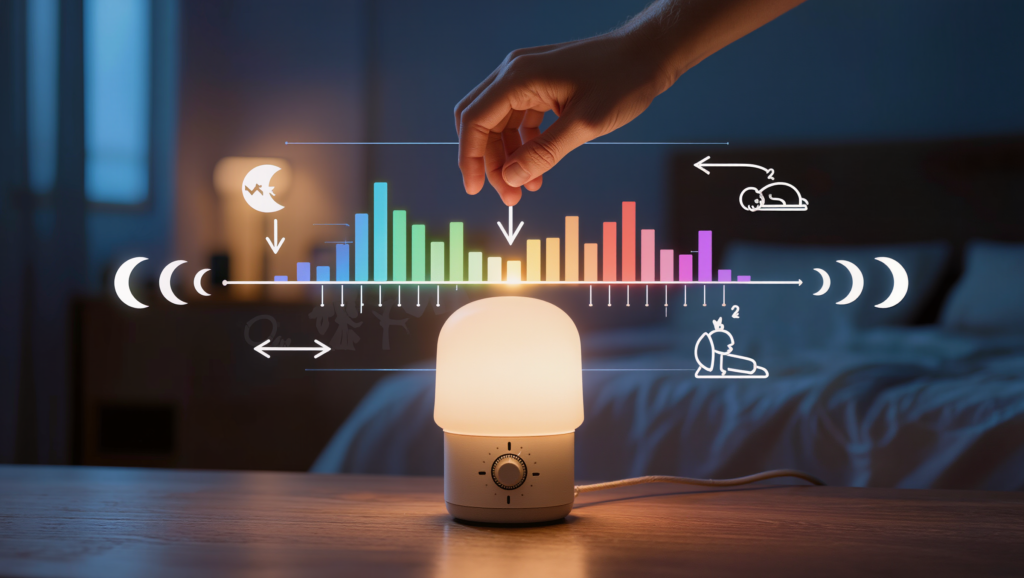
Because of this, red or amber light is often recommended for nightlights, evening lamps, and low-level bedroom lighting.
Green, yellow, and orange light: middle ground
Green light (around 500–570 nm) falls between blue and red in terms of melatonin suppression. Some studies show it suppresses melatonin less than blue but more than red.
Yellow and orange light (around 570–620 nm) are generally better than blue and green, especially when dim. Warm-colored lights (2200K–2700K) contain less of the blue-cyan content that most strongly activates melatonin-suppressing pathways.
So while red is optimal, warm yellow and orange are acceptable alternatives if red is not available.
The Science Behind Bedroom Light Color And Circadian Rhythms
Your circadian rhythm is your body’s internal 24-hour clock, regulating sleep-wake cycles, hormone release, body temperature, and other physiological processes. Light is the strongest external cue for this clock.
Specialized retinal cells containing the photopigment melanopsin are particularly sensitive to short-wavelength (blue) light. When these cells detect blue light, they send a strong “daytime” signal to the SCN, which then suppresses melatonin production from the pineal gland.
Red light, by contrast, has a weaker effect on melanopsin and the SCN, so it causes less melatonin suppression and less circadian disruption at the same brightness.
This is why the color of your nightlight matters more than you might think.
Is Any Nightlight Okay – Or Should You Sleep In Total Darkness?
Ideally, the best color light for sleep is no light at all. Darkness signals to your circadian rhythm that it is nighttime and time to sleep. Even dim light can have some effect, especially if you are sensitive or exposed for long periods.
However, many people need a small amount of light for:
- Safety (e.g., navigating to the bathroom at night).
- Comfort (e.g., children afraid of the dark).
- Caregiving (e.g., checking on a baby or elderly relative).
In these cases, the goal is to choose a light that provides enough visibility without significantly disrupting melatonin.
Best practices for nightlights
- Choose red or amber. Red light (620–700 nm) has the least impact on melatonin and circadian timing. Dim red or amber nightlights are ideal.
- Keep it dim. Brightness matters more than color. Even red light can suppress melatonin if it is too bright. Use the lowest intensity that still provides needed visibility.
- Position it low. Place nightlights near the floor rather than at eye level to reduce direct exposure to your eyes.
- Avoid blue, white, and green. These colors are more stimulating to your circadian system, even at low brightness.
- Use timers or motion sensors. Limit exposure by having the light turn on only when needed.
If you can sleep in complete darkness, that is optimal. But if you need a nightlight, red or warm amber is the safest choice.
Do Screens And Bedroom Lighting Also Affect Sleep Rhythm?
Nightlights are not the only source of problematic light. Evening exposure to:
- Phones, tablets, and computers.
- LED room lights and overhead fixtures.
- TVs and gaming consoles.
can all suppress melatonin and delay sleep onset.
To protect your sleep:
- Dim lights 1–2 hours before bed.
- Use warm-colored bulbs (2200K–2700K) in evening lamps.
- Enable “night mode” or blue-light filters on devices.
- Consider blue-light-blocking glasses if you must use screens in the evening.
- Keep bedrooms as dark as possible during sleep.
Special Considerations For Children And Shift Workers
Children
Children’s eyes may be more sensitive to light, and their circadian systems are still developing. A dim red or amber nightlight can provide comfort without strongly disrupting melatonin. Avoid blue or white nightlights in kids’ rooms, and keep brightness low.
Shift workers
People who work at night face a different challenge: they need to stay alert during biological night and sleep during the day. In this case, strategic use of bright light (including blue-enriched light) during the night shift can help maintain alertness, while dark, cool, red-dim environments during daytime sleep can support rest.
Practical Tips For Sleep-Friendly Lighting
To optimize your sleep environment:
- Bedroom: Aim for darkness. Use blackout curtains, cover electronic LEDs, and remove unnecessary light sources.
- Nightlight: Choose dim red or amber. Place it low and use only if needed.
- Evening lighting: Use warm bulbs (2200K–2700K), dim them in the last hour before bed, and avoid bright overhead lights.
- Screens: Reduce use 1–2 hours before bed, or use blue-light filters and night modes.
- Bathroom and hallway: Install dim, warm, or red nightlights to minimize sleep disruption during nighttime trips.
Bottom line
Yes, your nightlight could be sabotaging your sleep if it emits the wrong color. Blue, white, and green lights strongly suppress melatonin and shift your circadian rhythm, making it harder to fall asleep and stay asleep. Red and warm amber lights, by contrast, have minimal impact on melatonin and are the safest choices for nighttime illumination.
The pineal gland and its melatonin output are highly sensitive to light, especially short-wavelength blue light. Protecting this system in the evening and at night is one of the simplest yet most powerful ways to support healthy sleep.
If you need a nightlight, choose dim red or amber, keep it low and minimal, and prioritize darkness whenever possible. Your brain—and your sleep—will thank you.
Sources
- https://pmc.ncbi.nlm.nih.gov/articles/PMC2905913/
- https://pmc.ncbi.nlm.nih.gov/articles/PMC12827953/
- https://pmc.ncbi.nlm.nih.gov/articles/PMC12113466/