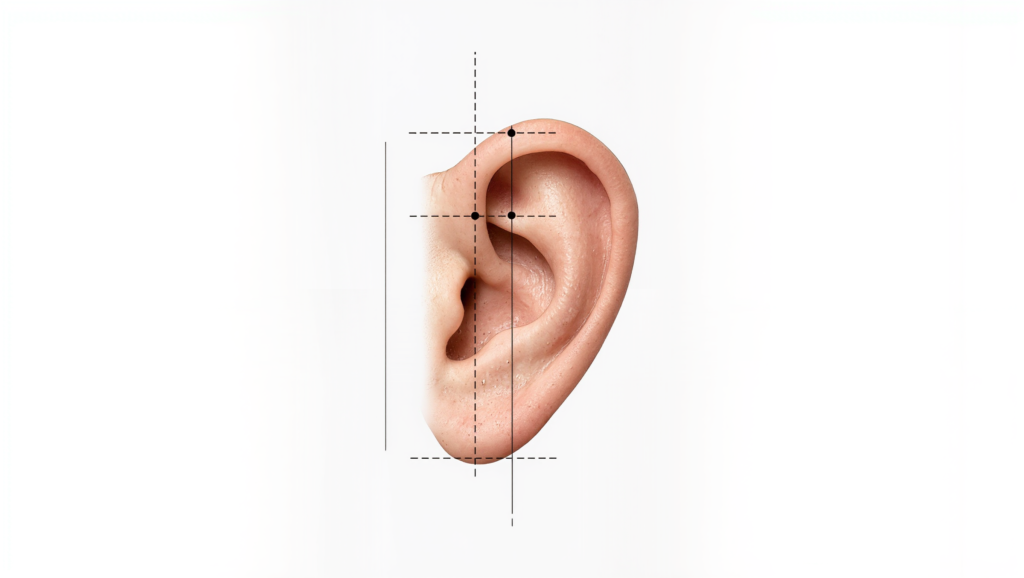












You probably glance in the mirror every day to check your hair, skin, or maybe even your teeth. But have you ever really looked at your earlobes? It turns out that a simple diagonal crease running across your earlobe—something most people dismiss as just another wrinkle of aging—might actually be whispering important clues about your heart health.
This subtle line, known in medical circles as a diagonal earlobe crease (DELC) or “Frank’s sign,” has intrigued researchers for more than 50 years. First described in 1973 by physician Sanders T. Frank, this crease has been repeatedly linked to coronary artery disease (CAD), peripheral vascular disease, and even stroke risk in numerous studies and meta-analyses.
While it is not a diagnostic test on its own, emerging evidence suggests that an earlobe crease may be a visible marker of vascular aging and accelerated biological wear—potentially flagging people who could benefit from earlier or more aggressive cardiovascular screening.
What Is An Earlobe Crease (Frank’s sign)?
Frank’s sign is defined as a diagonal wrinkle, sulcus, or deep groove that extends backward from the tragus (the small bump in front of the ear canal) to the outer edge of the earlobe, typically at about a 45-degree angle.
Key features include:
- A visible line or fold across the earlobe.
- Often bilateral (present on both ears), though it can be unilateral.
- Varying depths, from faint lines to deep, well-defined creases.
- Increasing prevalence with age, but also seen in younger individuals with cardiovascular risk.
Historically, some dismissed the crease as simply a sign of aging or sleeping position. However, multiple studies now suggest that the relationship between DELC and coronary artery disease is independent of chronological age and other traditional risk factors.
The Evidence Connecting Earlobe Areases and Heart Disease Risk
Over the past five decades, dozens of studies have explored the link between earlobe creases and cardiovascular disease. Here is what the research shows:
Meta-analyses and large reviews
- A meta-analysis of 12 studies including 2,415 cases and 2,545 controls found that patients with DELC had a 4.61-fold increased likelihood of having coronary artery disease (CAD). Importantly, this association remained significant even after adjusting for age and other cardiovascular risk factors.
- Another large meta-analysis involving more than 31,100 patients reported an overall sensitivity of 62% and specificity of 67% for earlobe crease as a marker of CAD. This means 62% of patients with CAD would be expected to have an earlobe crease, while 67% of those without CAD would not. The risk of CAD was 3.3-fold higher in patients with an earlobe crease compared with those without.
- A systematic review of 21 studies found that 19 reported a correlation between earlobe crease and coronary heart disease (CHD), supporting its role as a potential marker.
Prospective population studies
- A landmark prospective study following 10,885 individuals for 35 years found that earlobe crease, along with other visible age-related signs (like male pattern baldness and xanthelasmata), was associated with increased risk of ischemic heart disease (IHD) and myocardial infarction (MI), independent of chronological age and traditional risk factors. The risk increased stepwise with the number of visible age-related signs present.
- Individuals with three to four visible age-related signs (including earlobe crease) had a 40% higher risk of IHD and a 57% higher risk of MI compared to those with none, after adjusting for age and cardiovascular risk factors.
Autopsy and imaging studies
- An autopsy study found a strong association between Frank’s sign and critical atherosclerotic coronary artery occlusion. Even after adjusting for age, sex, and ethnicity, Frank’s sign remained a strong independent predictor of critical coronary occlusion, with an adjusted odds ratio of 7.77.
- A coronary computed tomography study reported that Frank’s sign was present in 71% of patients with documented coronary artery disease, demonstrating a statistically significant association.
Stroke and peripheral vascular disease
- Frank’s sign has also been linked to peripheral vascular disease (PVD) and ischemic stroke. One study found that Frank’s sign was a statistically significant predictor of ischemic stroke, even in patients without known ischemic heart disease.
- Bilateral diagonal earlobe crease has been positively correlated with both CAD and PVD, suggesting it may reflect systemic vascular aging rather than just coronary-specific pathology.
Why An Earlobe Crease Might Signal Heart Risk?
The exact mechanism linking earlobe creases to cardiovascular disease is still not fully understood, but several plausible theories exist:
1. Microvascular changes and tissue ischemia
One leading hypothesis is that DELC reflects microvascular changes in the earlobe similar to those occurring in coronary arteries. Reduced blood flow and chronic low-grade ischemia in the earlobe’s small vessels could lead to tissue breakdown and crease formation, paralleling atherosclerotic changes in larger vessels.
2. Accelerated biological aging
Earlobe creases are rare in children and become more common with age, but they also appear prematurely in some individuals with cardiovascular risk. This has led researchers to propose DELC as a marker of accelerated biological aging, potentially linked to:
- Telomere shortening (a marker of cellular aging).
- Increased oxidative stress and inflammation.
- Cumulative exposure to cardiovascular risk factors over time.
Studies have found that biomarkers of inflammation and oxidative stress are elevated in patients with DELC, supporting the idea that the crease may reflect systemic aging processes that also affect the cardiovascular system.
3. Collagen and elastin degradation
The earlobe is rich in collagen and elastin, structural proteins that maintain skin integrity. Atherosclerosis and vascular aging are also associated with changes in collagen structure and elastin fragmentation. It is possible that the same processes driving vascular stiffening and plaque formation also contribute to earlobe tissue breakdown and crease formation.
4. Shared risk factors and systemic inflammation
Traditional cardiovascular risk factors—such as hypertension, diabetes, smoking, dyslipidemia, and obesity—are associated with both CAD and the presence of DELC. Chronic inflammation and endothelial dysfunction, common to all these conditions, may underlie both vascular disease and earlobe changes.
A 2024 study found that being male, older than 55, obesity, type 2 diabetes, hypertension, smoking, and dyslipidemia were all associated with the presence of diagonal earlobe crease, suggesting that DELC may simply reflect the cumulative burden of these well-known risk factors.
What Science Research Says About Earlobe Crease And Heart Health Risks
While the association between earlobe creases and cardiovascular disease is robust across many studies, it is important to understand the limitations:
Diagnostic accuracy is modest
- Sensitivity and specificity for DELC as a standalone diagnostic tool range widely (26–90% and 32–96%, respectively), with most studies reporting moderate values around 60–70%.
- A 2021 systematic review concluded that the diagnostic accuracy of DELC for detecting anatomically significant coronary stenosis is insufficient to affect clinical management on its own. It only slightly changes pre-test probability in patients with high clinical likelihood of obstructive CAD.
Not a causal factor
- The relationship between DELC and CAD is observational, meaning the crease does not cause arterial plaque. It is best viewed as a marker or “red flag” rather than a direct cause of disease.
- Age remains a strong predictor of both Frank’s sign and CAD risk, and some studies suggest age may be a stronger predictor than the earlobe crease itself.
Best used as a supportive clue
- Experts emphasize that an earlobe crease alone cannot confirm or rule out heart problems. It should be considered alongside traditional risk factors like cholesterol, blood pressure, smoking, diabetes, and family history
- In clinical practice, DELC may be most useful as a simple, visible prompt to consider more thorough cardiovascular assessment, especially in younger patients or those with borderline risk profiles.
What Should You Do If You Notice An Earlobe Crease?
If you spot a diagonal line across your earlobe—especially if it is deep, bilateral, or appears at a relatively young age—here is a practical, evidence-based approach:
1. Do not panic
An earlobe crease is not a diagnosis. Many people with DELC never develop heart disease, and many with heart disease do not have DELC. It is best seen as a small clue, nothing more.
2. Review your cardiovascular risk factors
Take stock of your traditional risk factors:
- Blood pressure
- Cholesterol levels (LDL, HDL, triglycerides)
- Blood sugar and diabetes status
- Smoking history
- Weight and waist circumference
- Family history of premature heart disease
- Physical activity and diet
3. Consider earlier or more aggressive screening
If you have an earlobe crease plus other risk factors—or if you are younger (e.g., under 50) with a prominent crease—talk to your doctor about:
- Lipid panel and HbA1c testing.
- Blood pressure monitoring.
- Possibly coronary calcium scoring or other imaging if your overall risk is intermediate.
- Lifestyle interventions (diet, exercise, smoking cessation) even if your numbers are “borderline.”
4. Focus on modifiable risks
Regardless of earlobe status, the most powerful steps you can take for heart health are:
- Maintain a healthy weight and waist circumference.
- Exercise regularly (at least 150 minutes of moderate activity per week).
- Eat a diet rich in vegetables, fruits, whole grains, lean proteins, and healthy fats.
- Avoid smoking and limit alcohol.
- Manage stress and prioritize sleep.
The bigger picture: visible aging signs and cardiovascular health
Earlobe creases are just one of several visible signs that may signal accelerated vascular aging. Others include:
- Male pattern baldness (especially frontoparietal and crown baldness).
- Xanthelasmata (yellowish cholesterol deposits around the eyes).
- Arcus corneae (gray or white ring around the cornea).
- Premature graying of hair.
A prospective study found that the risk of ischemic heart disease and myocardial infarction increased stepwise with the number of visible age-related signs present, independent of chronological age and traditional risk factors. This suggests that “looking older than your age” may indeed be a marker of poorer cardiovascular health.
Bottom line
The diagonal earlobe crease—Frank’s sign—is far more than a cosmetic quirk. Decades of research link this simple, visible mark to increased risk of coronary artery disease, peripheral vascular disease, and stroke, independent of age and traditional risk factors in many studies.
While it is not a diagnostic test and should never replace proper cardiovascular evaluation, an earlobe crease can serve as a helpful, low-cost “red flag” that prompts earlier attention to heart health—especially when combined with other risk factors or visible signs of aging.
So the next time you catch your reflection, take a quick glance at your earlobes. That small crease might just be your body’s way of nudging you to check in with your heart.
Sources:
- https://pmc.ncbi.nlm.nih.gov/articles/PMC4697048/
- https://pmc.ncbi.nlm.nih.gov/articles/PMC12501647/
- https://pmc.ncbi.nlm.nih.gov/articles/PMC8268092/