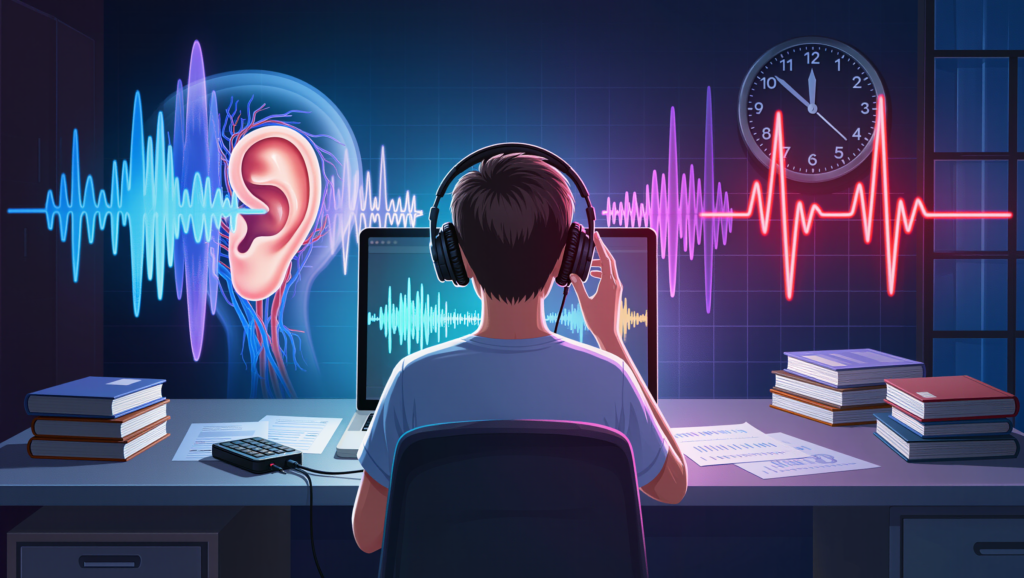












Loud music in your headphones feels harmless—almost like a private little reward for getting through the day. But inside your ears and blood vessels, something very different is happening. Chronic high‑volume listening doesn’t just risk “a bit of hearing loss when I’m old”; it’s linked to permanent noise‑induced hearing damage, higher blood pressure, more cardiovascular strain, and increased long‑term mortality
That’s why public health agencies now talk about headphone safety the way they talk about smoking or high blood pressure: as a modifiable risk factor that can literally change how long—and how well—you live. The problem is silent and slow. You don’t feel hair cells dying in your inner ear or your blood pressure creeping up. You just nudge the volume higher every year and assume it’s fine.
Let’s break down how loud listening damages your body, what the research says about lifespan and cardiovascular risk, and how to keep your music without trashing your future hearing or heart.
Your Ears Are Vascular Organs (And They Don’t Grow Back)
Inside your inner ear sits the cochlea, a tiny, fluid‑filled structure carpeted with delicate hair cells that convert sound vibrations into electrical signals your brain can understand. These cells are highly vascularized—they rely on a dense network of tiny blood vessels to deliver oxygen and nutrients.
When you blast them with loud sound for too long:
- The hair cells and supporting structures are damaged by mechanical stress and metabolic overload.
- Free radicals and oxidative stress increase, especially with chronic exposure.
- Once hair cells die, they do not regenerate in humans.
The World Health Organization estimates that more than 1.5 billion people worldwide have some degree of hearing loss, with around 430 million experiencing disabling impairment. A big chunk of modern, non‑occupational hearing loss is now driven by personal listening devices—headphones and earbuds at high volume for many hours per week.
Harvard’s guidance on “healthy headphone use” puts it bluntly: if you routinely listen at unsafe levels or for long durations, you are “risking permanent damage to your hearing
The Volume–Time Math: How Much Is “Too Loud”?
Sound damage is not just about how loud; it’s loudness × time.
Occupational and health agencies converge around 85 dB (decibels) as the threshold where sustained exposure starts to become dangerous:
- OSHA uses 85 dB as the level where employers must offer hearing protection if exposure exceeds 8 hours per day.
- WHO’s “Make Listening Safe” guidelines translate this into weekly limits, showing how quickly safe time collapses as volume rises.
WHO safe listening standards (approximate):
- 80 dB – safe up to 40 hours/week
- 85 dB – safe up to 12.5 hours/week
- 90 dB – safe up to 4 hours/week
- 95 dB – safe up to 1.5 hours/week
- 100 dB – safe up to 20 minutes/wee
Many smartphones + earbuds can hit 100–105 dB at maximum volume. That means:
- If you live at the top of the volume slider for your commute, workout, and workday, you can blow through your entire weekly “safe dose” in a day or two.
- Online headphone engineers estimate that 60–65% of maximum volume on many devices is roughly 85 dB, the beginning of the risk zone.
The silent trap: your ears adapt. As low‑level hearing damage creeps in, music at a given volume feels quieter, so you turn it up—exactly the wrong direction.
Hearing Loss and Lifespan: It’s Not “Just Your Ears”
For decades, hearing loss was treated as a quality‑of‑life issue. Annoying, yes, but not life‑threatening. That’s changing.
A large population study published in 2025 examined hearing loss, cardiovascular disease, and mortality in thousands of adults. Key points:
- Previous meta‑analyses show that hearing loss is significantly associated with increased all‑cause mortality, even after adjusting for demographics and comorbidities.
- A dose–response relationship has been observed: mortality risk roughly doubles for every 30 dB increase in hearing loss severity.
- Hearing loss often travels with diabetes, hypertension, atherosclerosis, smoking and obesity, suggesting shared vascular and metabolic pathways.
The new study itself found:
- In crude (unadjusted) models, people with hearing loss had much higher odds of myocardial infarction, stroke, heart failure and other cardiovascular conditions.
- After adjusting for age, sex and classic risk factors, many associations weakened, but hearing loss remained significantly linked to diabetes, and hearing‑impaired individuals had higher all‑cause mortality over nearly 7 years of follow‑up.
In other words: hearing loss is either a marker of deeper vascular problems, a contributor, or both—but it definitely correlates with dying earlier.
Several systematic reviews back this up, concluding that hearing impairment is associated with higher all‑cause mortality, even after confounders, and that the risk rises with severity.
So when you treat your hearing as expendable, you’re not just risking having to ask people to repeat themselves at 70. You’re also signaling that your microvasculature and general vascular health may be under strain, which is the frontline of lifespan‑limiting disease.
Noise, Blood Pressure, and Your Heart
Even if you somehow escaped hearing loss, chronic loud sound has another pathway into your lifespan: your cardiovascular system.
Most of the best data come from occupational noise (factories, construction, industrial settings), but the body doesn’t care if the sound comes from a jackhammer or your earbuds at similar dB levels.
A 2016 systematic review and meta‑analysis on occupational noise and cardiovascular outcomes found:
- Persistent noise exposure at work was strongly associated with hypertension, with a pooled hazard ratio of 1.68 (68% higher risk) for high blood pressure.
- Noise exposure was also linked with increased risk of cardiovascular disease events (RR 1.34) and a modest increase in cardiovascular mortality (HR 1.12).
A 2020 systematic review and meta‑analysis focusing specifically on noise ≥80 dB(A) concluded:
- Workers exposed to noise ≥80 dB(A) had a pooled effect size of 1.81 for hypertension compared with those at ~70 dB(A)—an 81% higher risk.
- Using dose–response modeling, exposure to 85 dB(A) doubled the risk of hypertension after about 15.9 years.
A more recent cross‑sectional study confirmed that participants with high occupational noise exposure (≥85 dBA) had about 30% higher odds of hypertension, and the association was even stronger in younger adults.
Mechanisms include:
- Chronic stress activation: noise is a subtle but constant stressor, elevating cortisol and sympathetic tone.
- Vascular dysfunction: repeated surges in blood pressure and heart rate can promote endothelial damage and arterial stiffness.
- Sleep disruption: if you wear headphones late or fall asleep with them, sound can fragment sleep and worsen cardiometabolic risk.
Again, your body doesn’t tag noise as “music, so it’s fine.” High volume is high volume.
Now combine this with headphone use:
- Many people are hitting 85–95+ dB directly into their ear canal for hours per day, day after day.
- Add traffic noise, nightlife, gyms, and you get a 24/7 sound bath your arteries never fully escape.
Over years, that’s a real nudge toward hypertension, cardiovascular disease, and reduced lifespan—even before you count the mortality correlations with hearing loss itself.
“But It’s Just Music, Not Noise…”
From a sensory standpoint, yes, music is more pleasant than machinery. From a risk standpoint, your tissues mostly care about decibels and duration.
A 2020 study on college students looked at music listening behaviors, cardiovascular risk factors, and hearing sensitivity, highlighting that:
- Many young listeners already showed early high‑frequency hearing changes associated with loud personal listening.
- Cardiovascular risk factors (smoking, obesity, dyslipidemia) combined with loud music exposure amplified the odds of hearing problems.
That’s the deadly combo: modern lifestyles stack risks—poor diet, inactivity, stress, and now loud, constant sound. The same people overusing headphones often have other unhelpful habits, which makes the whole picture worse.
Loud music also frequently:
- Fires up the sympathetic nervous system.
- Nudges you toward higher heart rate and blood pressure (especially with high‑energy genres during workouts).
- Keeps your brain in a more aroused state late into the evening, indirectly impacting sleep and recovery.
Over time, that’s not just an ear issue; it’s a whole‑body load.
How Loud Music Deducts Years From Your Life
Putting the pieces together:
- Direct ear damage
- Chronic high volume → noise‑induced hearing loss.
- Hearing loss is associated with higher all‑cause mortality, with some analyses suggesting risk doubles for every 30 dB severity increase.
- Cardiovascular strain
- Long‑term noise ≥80–85 dB(A) nearly doubles the risk of hypertension and raises cardiovascular event risk.
- Hypertension is a major driver of shortened lifespan.
- Shared risk pathways
- Noise exposure, hypertension, diabetes and vascular dysfunction cluster together.
- Hearing loss in many studies appears as either an early warning sign of systemic vascular problems or a co‑traveler with them.
- Lifestyle compounding
- Loud music often rides alongside sedentary time, late bedtimes, and stress.
- Sleep fragmentation + chronic stress + vascular load = faster biological aging.
So no, your headphones are not the only thing that determines your lifespan. But they may be a silent multiplier of other risks you already carry.
How to Keep Your Music and Protect Your Future
You don’t need to go full monk and give up headphones. You do need to treat them like a drug: dose, time, and context matter.
1. Follow the 60/60 (or better) rule
A practical consumer version of WHO/NIOSH data:
- Keep volume at ≤60% of maximum on your device.
- Limit continuous headphone use to 60 minutes at a time, then take a break.
This roughly keeps you near or under the 80–85 dB window for manageable exposure.
2. Use volume‑limiting and noise‑isolating gear
- For kids, hardware‑limited headphones capped at 85 dB are ideal; WHO and pediatric bodies peg this as the upper limit for several hours/week.
- For adults, noise‑isolating or ANC (active noise cancelling) headphones let you listen comfortably at lower volumes, because you’re not competing with traffic or gym noise.
Loudness often creeps up simply to drown out the environment—remove that need and you automatically drop risk.
3. Respect your weekly “dose”
Using WHO’s weekly limits as a rough guide:
- If you often listen around 90 dB, you’re at only ~4 hours/week of safe time.
- Bumping to 95–100 dB slashes that to 1.5 hours or less/week.
If you’re unsure about your typical level:
- Many phones now show “Headphone audio levels” in settings. Check your averages.
- If you can’t hear someone talking near you, your volume is too high.
4. Give your ears quiet time
Your auditory and cardiovascular systems need recovery, just like muscles:
- Build sound‑free windows into your day: reading, walking without headphones, quiet evenings.
- Never sleep with loud music or white noise blasting directly into your ears; if you like sound for sleep, keep it low and room‑based.
5. Get hearing and blood pressure checked regularly
Because hearing loss and hypertension often travel together—and both correlate with mortality—screening is a smart move.
- If you’re a heavy headphone user, ask for periodic audiometry (hearing tests), even if you feel “fine.”
- Watch your blood pressure, especially if you work in noisy environments and listen loud in your off‑time.
Catching either problem early buys you more time to reverse or mitigate damage.
The Real Flex: Enjoying Music Now Without Sacrificing Later
Loud music feels good in the moment—there’s no denying it. But the science is clear: chronic high‑volume listening is not a neutral hobby. It’s a slow‑burn stressor on your ears, your arteries, and, ultimately, your lifespan.
You don’t have to give up your playlists. You just have to stop treating your hearing and cardiovascular system as expendable. Turn it down, limit the hours, choose smarter gear, and build in quiet. Think of it as future‑proofing your favorite hobby—so you can still hear, feel, and enjoy the music decades from now, instead of paying for today’s volume with tomorrow’s health.
Sources: