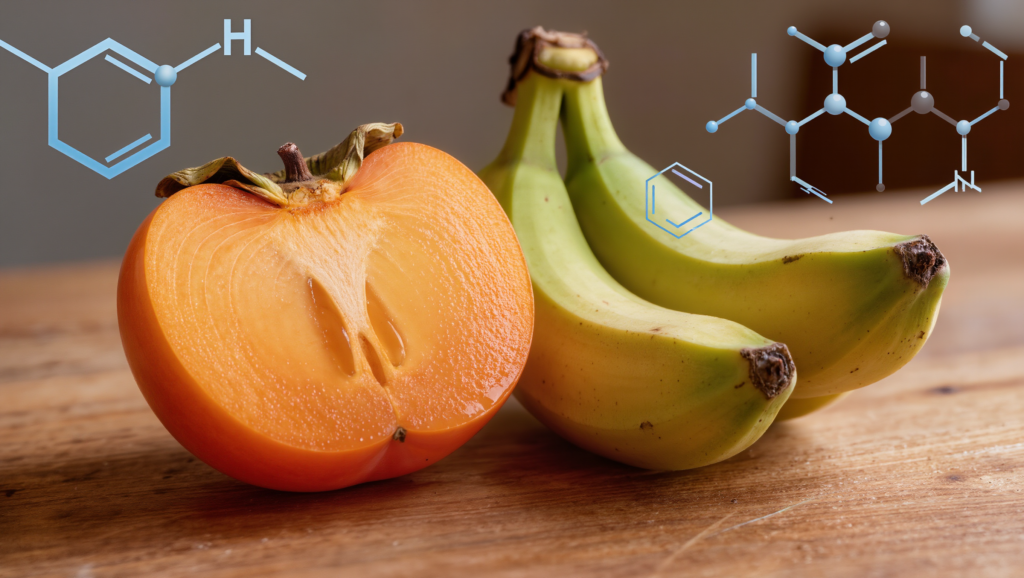












That dry, puckering sensation you get from certain fruits isn’t a lack of water—it’s chemistry. When you bite into an unripe persimmon, a sour banana, or a young grape, you’re experiencing astringency, a sensory phenomenon caused by plant compounds called tannins that bind to and remove the natural lubricants in your saliva.
Astringency is not a taste like sweet, sour, salty, bitter, or umami. It’s a tactile sensation—a feeling of dryness, roughness, constriction, or even a sandpapery texture on your tongue and the inside of your mouth. And while it can be unpleasant in some fruits, it’s actually a protective mechanism that helps plants survive.
The Science: Why Astringency Happens
Astringency occurs when polyphenolic compounds, especially tannins, bind to proteins in your saliva—specifically to proteins called PRPs (proline-rich proteins) that normally keep your mouth lubricated. When tannins bind to these proteins, they cause them to clump together and precipitate out of solution, which removes the slippery layer that saliva provides.
This process is often described as “denaturing” or “coagulating” salivary proteins. The result is increased friction between your tongue and the tissues in your mouth, creating that unmistakable dry, puckery feeling.
It’s a bit like when red wine makes your mouth feel dry. The tannins in red wine work the same way as the tannins in unripe fruit—they stick to your saliva proteins and reduce lubrication.
What Makes Fruits Astringent?
The main compounds responsible for astringency in fruits are:
- Tannins (especially condensed tannins like proanthocyanidins)
- Catechins
- Epicatechins
- Chlorogenic acid
- Neochlorogenic acid
These are all polyphenolic secondary metabolites, and the strength of astringency is closely related to the content of condensed tannins.
Plants synthesize these compounds through three main biochemical pathways:
- The phenylpropane pathway
- The flavonoid pathway
- The phenolic acid pathway
Key enzymes in these pathways include PAL, LAR, ANR, HCT, and C3H.
Tannins are not just about flavor—they serve important biological functions for plants, including:
- Resistance to biotic stresses (like insects and fungi)
- Antioxidant activity
- Protection against predators
Moderate concentrations of tannins can actually improve flavor, but excessive astringency is undesirable.
Why Do Plants Make Astringent Fruits?
Astringency is a natural defense mechanism. Unripe fruits are often high in tannins to deter animals from eating them before they’re ready to be dispersed. The dry, puckering mouthfeel acts as a warning signal: “Don’t eat me yet—I’m not ripe!”
Once the fruit ripens, the tannins either:
- Polymerize (become larger and less soluble)
- Bind to other cell components
- Break down into less astringent compounds
This is why astringency usually decreases as fruits mature.
Fruits That Are Commonly Astringent
Some fruits are notorious for their astringent quality when unripe:
| Fruit | Astringency Cause | Notes |
|---|---|---|
| Persimmon | High proanthocyanidins (tannins) | Astringent until fully ripe; must be eaten when soft |
| Banana | Tannins in skin and immature flesh | Tannins polymerize as fruit ripens and lose astringency |
| Grapes (especially red) | Tannins in skin and seeds | More astringent when unripe |
| Blackthorn | High tannin content | Known for strong astringency |
| Quince | Tannins | Must be cooked to reduce astringency |
| Banana skin | Tannins | Skin is more astringent than flesh |
Persimmons are the most famous example. Certain varieties must be fully ripe before eating, otherwise they will be intensely astringent.
Astringency vs. Acidity: Don’t Confuse Them
A common mistake is thinking that astringent fruits are just sour or acidic. But acidity and astringency are different sensations:
- Acidity tastes sharp and sour (like lemon).
- Astringency feels dry and rough (like unripe persimmon).
A fruit can be both acidic and astringent, but they’re not the same thing.
Non-Astringent Fruits: The Sweet Side
Non-astringent fruits either lack tannins or contain them in a form that doesn’t produce astringency. This can happen because:
- The tannins are structurally different
- They’re bound to other compounds in the fruit
- They’re present in very low concentrations
Examples of non-astringent fruits include:
- Most ripe bananas
- Ripe persimmons (especially “sweet” varieties)
- Many apples (depending on variety)
- Most citrus fruits (though some have mild astringency)
Does Ripening Always Remove Astringency?
Not always. While astringency usually decreases as fruits mature, some varieties are inherently more astringent regardless of ripeness. For example:
- Some persimmon varieties are astringent and must be fully ripe or treated.
- Others are non-astringent and can be eaten crisp.
In bananas, tannins polymerize as the fruit ripen and lose their astringency naturally.
How to Reduce Astringency in Fruits
If you accidentally bite into an astringent fruit, here are some ways to reduce the sensation:
- Wait for ripening: Most fruits become less astringent as they mature.
- Cook the fruit: Heat can break down or bind tannins.
- Add fat or dairy: Fat binds to tannins, reducing their effect (think of eating cheese with wine).
- Sweeten it: Sugar can mask some of the astringency.
For persimmons, you can also use techniques like alcohol treatment or cold storage to remove astringency before eating.
Why Astringency Matters Beyond Taste
Astringency isn’t just a sensory quirk—it has real health implications:
- Antioxidant activity: Tannins have antioxidant properties that can benefit health.
- Gut health: Some studies suggest tannins may affect gut microbiota.
- Cardiovascular health: Tannins in fruits like grapes and persimmons may support heart health.
That’s why moderate concentrations of tannins can actually improve flavor and health value, even if they create astringency.
Bottom Line
Some fruits make your mouth feel dry because they contain tannins—polyphenolic compounds that bind to and precipitate the proteins in your saliva that normally keep your mouth lubricated. This creates increased friction and that unmistakable dry, puckering sensation known as astringency.
Astringency is a natural protective mechanism for plants, deterring animals from eating unripe fruit. As fruits mature, tannins usually polymerize or break down, reducing astringency.
If you’ve ever experienced that strange dry mouth from a persimmon or unripe banana, you now know it’s not a lack of juice—it’s chemistry. And while it can be unpleasant, astringency is also a sign that your fruit is packed with antioxidants and protective compounds that may benefit your health.
Sources:
- https://en.wikipedia.org/wiki/Astringency
- https://pubmed.ncbi.nlm.nih.gov/34619522/
- https://pubmed.ncbi.nlm.nih.gov/25599149/