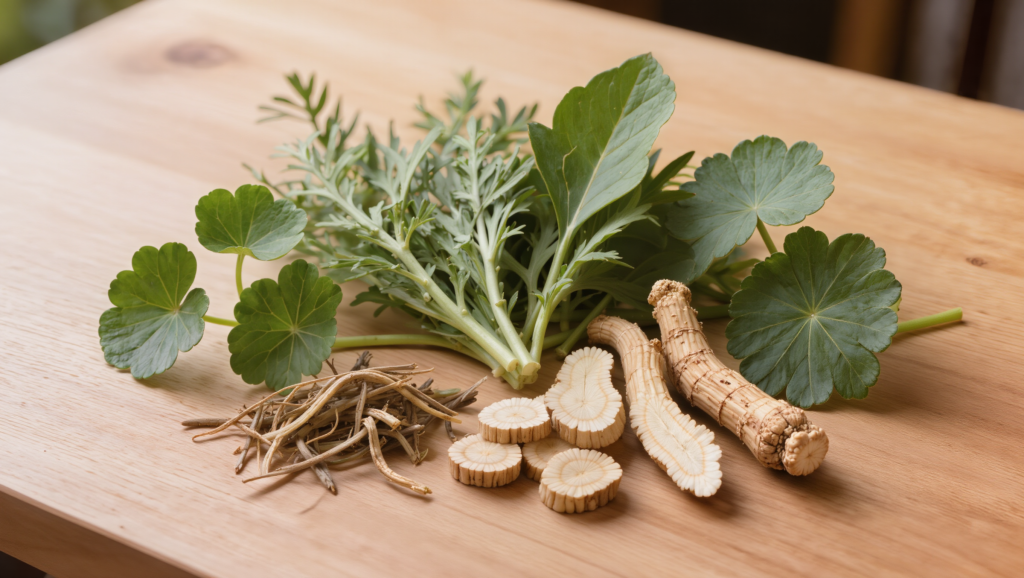












Brahmi, Gotu Kola, and Ashwagandha are often called the Ayurvedic brain power trio because they work together to support memory, focus, stress resilience, and overall nervous system health.
Individually, each herb has a long history in Ayurveda as a medhya rasayana, or rejuvenative for the mind, and modern research is increasingly backing up their cognitive and calming benefits.
Why Brahmi Gotu Kola and Ashwagandha Are Grouped Together
Ayurveda has always treated the brain, nervous system, and stress response as interconnected. You do not just “boost memory” in isolation; you support the whole terrain that memory depends on: sleep, stress, neurotransmitters, blood flow, and neural plasticity.
That is why Brahmi, Gotu Kola, and Ashwagandha are often combined:
- Brahmi is known for memory, learning, and mental clarity.
- Gotu Kola supports cognition, neuroregeneration, and mental calm.
- Ashwagandha helps the body handle stress, improves sleep, and supports cognitive speed and focus.
Together, they cover the major bases of brain health: information processing, memory formation, stress load, and nervous system recovery.
Brahmi: The Classic Memory Herb
Brahmi, or Bacopa monnieri, is one of the most celebrated herbs in Ayurveda for cognitive enhancement and nervous system support. It is described as a medhya rasayana, a rejuvenative tonic specifically for the mind and intellect, and it has been used for over 3,000 years to support memory and learning.
Modern research has focused on its effects on:
- Memory formation and recall.
- Learning speed and processing.
- Anxiety and stress-related mental fatigue.
- Synaptic plasticity and neural protection.
The primary active compounds in Brahmi are bacosides, which are believed to:
- Enhance synthesis and repair of synaptic proteins in the hippocampus.
- Increase dendritic branching in hippocampal neurons.
- Modulate serotonin, dopamine, and acetylcholine.
- Inhibit acetylcholinesterase, the enzyme that breaks down acetylcholine.
- Reduce cortisol and protect neural tissue from oxidative stress.
Clinical trials have shown improvements in verbal learning, delayed word recall, and anxiety reduction with Bacopa monnieri supplementation. An important point is that Brahmi’s cognitive effects are cumulative; benefits tend to build over 8–12 weeks of consistent use, rather than acting like a fast stimulant.
That makes Brahmi a long-term neural tonic rather than a quick-fix.
Gotu Kola: The Calm, Clear Mind Herb
Gotu Kola, or Centella asiatica, is another revered Ayurvedic herb for cognition and mental clarity. It is often discussed alongside Brahmi as a brain-boosting herb, and both are used to enhance learning, memory, and concentration.
Key benefits highlighted in research and traditional use include:
- Support for cognitive function in older adults with mild cognitive impairment.
- Antioxidant and anti-inflammatory effects that protect brain cells.
- Potential support for neuroregeneration and mental clarity.
One randomized controlled trial looked at Gotu Kola supplementation combined with multicomponent exercise in older adults with mild cognitive impairment and examined effects on cognitive function, inflammation, and oxidative stress. That kind of study is important because it connects Gotu Kola not just to “brain health” in general, but to real-world aging and cognitive decline.
Ayurvedic sources also describe Gotu Kola as:
- A calming cognitive enhancer.
- A herb that supports focus without overstimulation.
- A partner to Brahmi for deeper, steadier mental clarity.
If Brahmi is the memory specialist, Gotu Kola is often thought of as the clarity and neuro-support partner.
Ashwagandha: The Stress-Resilience Foundation
Ashwagandha, or Withania somnifera, is famous in Ayurveda as a powerful adaptogen that helps the body and mind handle stress. It is often recommended for people who feel mentally scattered, anxious, or exhausted, because it supports the nervous system at a foundational level.
Modern research and Ayurvedic texts highlight Ashwagandha for:
- Lowering cortisol and modulating the stress response.
- Enhancing GABA activity, which promotes calmness.
- Reducing neural inflammation.
- Improving cognitive speed, spatial memory, focus, and attention.
- Supporting healthy sleep patterns, which indirectly improve cognition.
Ashwagandha balances elevated Vata, which is often associated with anxiety, restlessness, and age-related cognitive changes. It is described as a slow-acting herb that may take about a week to show appropriate results and longer to reach full effect, which is why it is often taken over extended periods.
In practical terms, Ashwagandha helps create the calm, stable nervous system environment that Brahmi and Gotu Kola then build on for memory and focus.
How Brahmi, Gotu Kola, and Ashwagandha Work Together
The synergy of these three herbs is more than just “three brain herbs in one.” They address different layers of the same system:
- Brahmi strengthens memory pathways and synaptic function.
- Gotu Kola supports cognitive clarity, antioxidant protection, and neuroregeneration.
- Ashwagandha reduces stress load, improves sleep, and stabilizes the nervous system.
Ayurvedic practitioners often combine them because:
- Stress undermines memory and focus.
- Poor sleep undermines learning.
- Oxidative stress and inflammation undermine neural health.
By tackling all three, the trio supports a more resilient, calmer, and sharper mind over time.
What Science Says About Using The Combo Of Brahmi, Gotu Kola, and Ashwagandha
The evidence base varies by herb, but all three have meaningful research support.
Brahmi (Bacopa monnieri)
Bacopa monnieri has one of the strongest evidence profiles among herbal nootropics. Multiple randomized controlled trials have shown:
- Improvements in verbal learning and memory.
- Better delayed recall.
- Reduced anxiety in some populations.
- Possible benefits for attention and processing speed.
Bacopa is a calming cognitive enhancer with a high therapeutic index and generally good tolerability, with most side effects being mild and gastrointestinal.
Gotu Kola
Gotu Kola research includes studies on:
- Cognitive function in older adults with mild cognitive impairment.
- Anti-inflammatory and antioxidant effects relevant to brain aging.
- Potential support for neuroregeneration and mental clarity.
While the evidence is not as extensive as for Bacopa, it is growing, particularly in the context of aging and cognitive support.
Ashwagandha
Ashwagandha has been studied for:
- Stress and anxiety reduction.
- Cortisol modulation.
- Sleep quality.
- Cognitive speed, memory, and attention.
Ashwagandha’s role in easing anxiety and improving focus cannot be over emphasized, and modern research supports its effects on stress markers and cognitive performance in some contexts.
How To Use The Combo Of Brahmi, Gotu Kola, and Ashwagandha
There are several ways to use these herbs:
Brahmi
Common forms include:
- Standardized extract (often 20% bacosides): around 300–450 mg daily with meals.
- Powder (churna): around 3–6 g daily in warm milk or water.
- Tincture: around 3–5 ml twice daily.
- Fresh juice or tea preparations in traditional practice.
Most protocols recommend allowing 8–12 weeks for full cognitive benefit.
Gotu Kola
Gotu Kola is often taken as:
- Capsules or tablets.
- Tea or infusion.
- Combined formulas with Brahmi and other nervine herbs.
It is frequently paired with Brahmi for enhanced cognitive support and mental clarity.
Ashwagandha
Typical use includes:
- Around 1 g daily of powder or equivalent in capsules.
- Often taken with warm milk or water.
- Used over longer periods to rejuvenate the mind and nervous system.
It could about a week to begin showing results and sometimes longer to reach full effect.
Who benefits The Most From Using The Combo Of Brahmi, Gotu Kola, and Ashwagandha
These herbs are often used by people who:
- Feel mentally fatigued or foggy.
- Struggle with stress-related brain fog.
- Want to support memory and learning over time.
- Experience anxiety or overthinking that interferes with focus.
- Are navigating age-related cognitive changes.
Students, professionals, and older adults are common groups that seek out this trio, but it can be useful for anyone whose mental performance is being dragged down by stress, poor sleep, or chronic overload.
Safety And Considerations When Using The Combo Of Brahmi, Gotu Kola, and Ashwagandha
These herbs are generally well tolerated, but they are not risk-free.
- Brahmi is usually well tolerated, with the most common side effects being mild gastrointestinal issues like increased stool frequency, nausea, or cramps; pregnancy use is often cautioned due to insufficient safety data.
- Gotu Kola is generally considered safe at typical doses, but people with liver conditions or those on sedatives should be cautious and consult a clinician.
- Ashwagandha can interact with certain medications and conditions, and people with autoimmune disorders, thyroid issues, or those who are pregnant should seek medical guidance before use.
Because these herbs affect the nervous system, it is wise to start low, go slow, and monitor how you feel over several weeks.
Bottom line
Brahmi, Gotu Kola, and Ashwagandha form a powerful Ayurvedic brain power trio because they work on memory, clarity, and stress resilience together.
Brahmi strengthens memory and learning pathways, Gotu Kola supports cognitive clarity and neuroprotection, and Ashwagandha calms the stress response and improves sleep, creating a stable foundation for mental performance.
Used thoughtfully and consistently, this trio can help shift your brain from a state of scattered, stressed survival to a more focused, resilient, and clear state of mind.
Sources:
- https://pmc.ncbi.nlm.nih.gov/articles/PMC4778428/
- https://pmc.ncbi.nlm.nih.gov/articles/PMC9650315/
- https://www.ncbi.nlm.nih.gov/books/NBK589635/
- https://pubmed.ncbi.nlm.nih.gov/27651261/