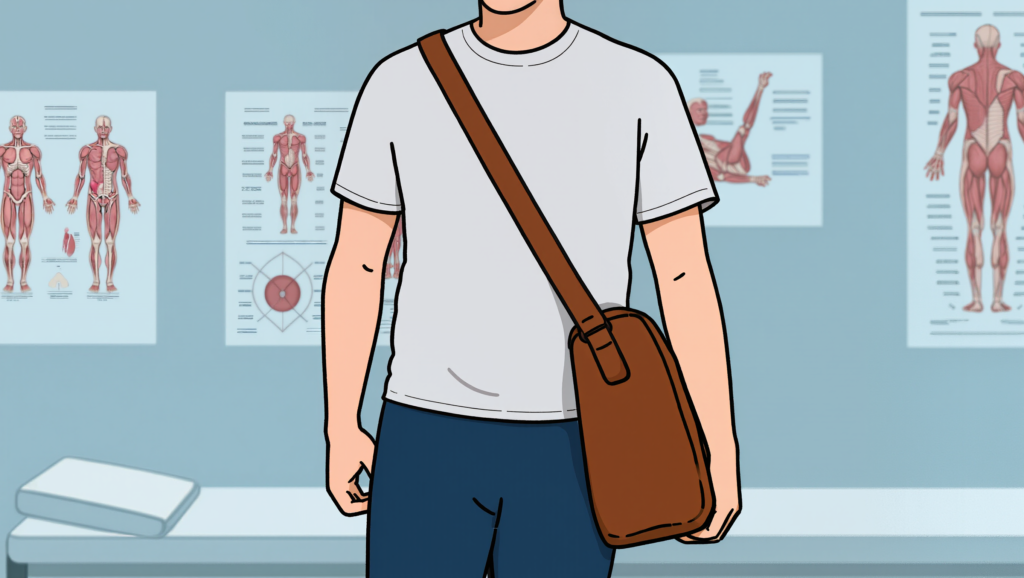












That oversized tote, messenger bag, or single-strap backpack may feel convenient, but it is quietly forcing your spine, shoulders, and hips to work harder than they should. Carrying a bag on one shoulder creates an asymmetric load, which means your body has to constantly compensate for the uneven weight. Over time, those small compensations can add up to real discomfort, postural changes, and increased strain on the spine.
Research on load carriage and posture shows that even relatively light one-shoulder loads can change spinal alignment, increase muscle activity on one side, and alter the way you walk. The effect is not just about “feeling tired.” It is about how your muscles, joints, and nervous system adapt to an unbalanced situation day after day.
What Happens When You Carry A Bag On One Side?
When you place a bag on one shoulder, your body instinctively tries to keep you upright and balanced. To do that, it:
- Elevates the shoulder carrying the bag.
- Tilts the torso away from the bag.
- Shifts the pelvis to counterbalance the weight.
- Changes the swing of your arms.
- Adjusts the way your feet hit the ground.
A 2026 study on people with and without chronic low back pain found that asymmetric load carriage creates disproportionately high mechanical and neuromuscular demands. The study concluded that unilateral carrying—such as a one-shoulder bag—generates frontal-plane moments that require greater lateral stabilization than symmetric bilateral load distribution.
In plain language: your body has to work harder to keep you from tipping over to one side.
How The Spine Handles Asymmetric Load
Your spine is designed to carry load, but it is most efficient when that load is balanced. When you carry a bag on one shoulder, the spine experiences uneven compression and shear forces. Computational modeling studies suggest that asymmetric loading substantially increases lumbar spine compression and shear forces compared to equivalent symmetric loads, with peak stresses occurring during the contralateral stance phase.
This means that during the part of your step when the opposite leg is on the ground, your lower back may be under more stress than when both legs share the load evenly.
A study on school backpacks found that carrying a load on the right shoulder significantly increased the thoracic lateral curvature in the frontal plane and decreased the thoracic kyphosis in the sagittal plane. The researchers concluded that even carrying a 17% load causes significant changes in spinal alignment.
That is important because it shows that even moderate loads can alter spinal posture when they are carried asymmetrically.
Muscle Imbalances And Overuse
One of the most consistent findings in this area is that one-shoulder carrying increases muscle activity on the side carrying the bag. A study on asymmetrical loading and walking time found that weight was a significant factor in influencing electromyography activity on the ipsilateral side of the lumbar paraspinal muscles. High correlations were found between the carried load and both overall and low-back ratings of perceived exertion.
In other words, the heavier the bag, the harder the muscles on that side have to work, and the more effort people report in their lower back.
Carrying a shoulder bag on one shoulder can cause the trapezius muscle on that side to become bigger and tighter, while the opposite side remains underused. This asymmetry can lead to one shoulder sitting higher than the other and increased tension in the neck, upper back, and shoulder area.
Over time, these imbalances can contribute to:
- Neck pain.
- Upper-back tightness.
- Shoulder strain.
- Headaches.
- Lower-back discomfort.
- Hip and knee pain due to altered gait.
Postural Changes And Spinal Curvature
Repeated asymmetric loading can lead to postural adaptations that may become habitual. A study on unilateral backpack load in adolescents concluded that carrying a bag on one shoulder has a negative effect on posture, with more asymmetry during dominant-side loading. Repetitive periods of postural asymmetry can lead to asymmetric muscular activity and spinal curvature, which may contribute to the development of functional scoliosis and back pain over time.
Functional scoliosis is a side-to-side curvature that arises from muscle imbalance and posture rather than from a structural bone abnormality. It is often reversible if the underlying cause is addressed, but it can become entrenched if the asymmetry continues for years.
A heavy one-shoulder bags can cause or exacerbate spinal misalignments, leading to conditions like scoliosis or chronic back pain. While not every one-shoulder carrier will develop scoliosis, the repeated lateral shift and muscle imbalance can encourage the spine to adopt a curved posture as a compensation.
Gait, Pelvis, And Hips
Your spine does not work in isolation. It is connected to the pelvis, hips, and legs, so changes in spinal posture can affect how you walk. A study on one-shoulder carrying and gait found that pelvic tilt, which was preserved by a two-shoulders distributed load, was strongly reduced in the asymmetrical condition. The authors suggested that even a low weight carried on a single shoulder generates postural modifications, including reduction of pelvic tilting, which is known to be associated with low back pain.
That means a relatively light bag can still change pelvic mechanics in a way that may predispose some people to low-back discomfort.
A heavy bag on one side forces the spine to tilt, creating muscular imbalance and joint irritation. This repeated asymmetry can lead to chronic discomfort, and the altered gait can cause lower-back and hip pain that may seem unrelated to the bag.
Shoulder, neck, and nerve compression
The strap of a heavy bag pressing into one shoulder can compress nerves that run from the neck into the arm. This can cause numbness, tingling, or aching that radiates down to the hand.
Carrying a heavy purse can cause the trapezius muscle to spasm and tighten, along with the muscles that go from the shoulder to the base of the neck. This can cause stiffness in the upper back, shoulder area, and neck, and may even contribute to a decreased curve in the neck, sometimes called “military neck.”
Research on shoulder arthritis risk suggests that consistently carrying a bag on one shoulder can lead to muscle imbalances, with the muscles on the carrying side becoming overworked while those on the opposite side remain underused. This imbalance can cause strain on the shoulder joint and surrounding tissues, potentially increasing the risk of developing shoulder arthritis over time.
How Much Weight Is Too Much For The Spine?
There is no single “safe” weight that applies to everyone, but several studies suggest that even loads around 10% of body weight can induce negative changes in spinal posture when carried asymmetrically.
A study on asymmetrical backpack load in school children found that even a load of 10% of body mass may induce negative changes in spinal posture, including a significant reduction of thoracic kyphosis.It is important that children be educated on ergonomics, including instructions on carrying a backpack and the effects of disregarding basic rules on body posture.
For adults, the same principle applies: the heavier the bag and the longer you carry it on one side, the greater the cumulative strain.
Cross-Body And Two-shoulder Load Carriage Options
Not all bags are created equal. A study on same-sided and cross-body load carriage found significantly less impact on spinal posture from cross-body loading as compared to same-sided loading. The authors concluded that there are significant three-dimensional changes in back shape in response to asymmetrical loading and that further work is needed to evaluate the optimal carriage type and maximal body load that results in the least spinal impact.
Carrying a bag on one shoulder exerts more pressure on the spine compared to using a backpack with an equivalent load. Over time, consistently relying on one side can subtly alter posture and gait, leading to imbalances that extend beyond mere discomfort.
Switching to a two-strap backpack, a cross-body bag, or alternating shoulders can reduce the asymmetry and distribute the load more evenly.
Practical Tips To Protect Your Spine When Carrying Load
You do not have to abandon your favorite bag, but small changes can make a big difference.
- Lighten the load. Remove items you do not need every day.
- Use two straps. A backpack with both straps distributes weight more evenly.
- Go cross-body. A cross-body bag reduces the one-sided pull.
- Alternate shoulders. If you must use a one-shoulder bag, switch sides regularly.
- Adjust strap length. Keep the bag close to your body and not hanging too low.
- Strengthen your core. A stronger core can better support your spine under load.
- Take breaks. Put the bag down when you can.
- Watch for symptoms. If you notice persistent pain, numbness, or posture changes, seek professional advice.
Uneven weight distribution is one of the most common everyday triggers of back and neck pain. Many people do not realize that the way they carry their everyday items can have a major impact on posture and spinal health.
Who Is Most At Risk When Carrying Asymmetric Load?
Some people are more vulnerable than others.
- Children and adolescents, whose spines are still developing.
- People with existing back, neck, or shoulder pain.
- Individuals with scoliosis or other spinal conditions.
- Those who carry heavy loads daily for long periods.
- People with weak core or postural muscles.
A study on students carrying rucksacks noted that approximately 40 million students in the United States and a similar number in Europe carry school rucksacks, with the average student carrying a rucksack weighing almost one fourth of his or her body weight. This has led to thousands of emergency department referrals each year related to carrying school bags.
While adults may not carry quite that proportion, the principle remains: heavy, asymmetric loads increase risk.
Bottom line
Carrying your bag on one shoulder is more than a fashion choice. It is a biomechanical decision that affects your spine, shoulders, pelvis, and gait. Research shows that asymmetric load carriage creates disproportionately high mechanical and neuromuscular demands, increases lumbar spine compression and shear forces, and can lead to postural changes, muscle imbalances, and chronic discomfort.
The hidden cost is not always immediate pain. It is the slow accumulation of strain that shows up as tightness, headaches, shoulder pain, or low-back ache months or years later.
Lightening your load, using two straps or a cross-body style, and alternating shoulders can all help reduce the strain. If you already have persistent pain or posture changes, a physical therapist, chiropractor, or spine specialist can help you assess your bag-carrying habits and design a plan to protect your spine long term.
Sources:
- https://pubmed.ncbi.nlm.nih.gov/17108420/
- https://pmc.ncbi.nlm.nih.gov/articles/PMC12837317/
- https://pmc.ncbi.nlm.nih.gov/articles/PMC7975905/
- https://pubmed.ncbi.nlm.nih.gov/18810027/
- https://pubmed.ncbi.nlm.nih.gov/25425595/