











Vajikarana is one of Ayurveda’s most intriguing and practical branches because it focuses on vitality, stamina, sexual wellness, and reproductive health all at once. In plain English, it is the Ayurvedic approach to rebuilding strength, supporting healthy desire, and nourishing the tissues associated with fertility and long-term energy.
What makes Vajikarana so interesting is that it is not just about libido. It’s a broader rejuvenative system that includes herbs, diet, lifestyle, stress management, and tissue nourishment, especially of shukra dhatu — the reproductive tissue connected with fertility and vitality. That gives Vajikarana a much bigger role than a simple aphrodisiac category.
What Does Vajikarana Mean?
The word Vajikarana comes from Sanskrit roots often translated along the lines of “to make potent like a horse,” which reflects the ancient idea of strength, virility, and reproductive power. Vaji refers to a horse and karana to producing, symbolizing potency and vitality.
Vajikarana is a dedicated branch of Ayurveda focused on improving sexual function, increasing libido, and promoting overall reproductive health in men, while also using diet and lifestyle support. Vajikarana Chikitsa is a holistic treatment approach for fertility, sexual function, and broader well-being.
So the core meaning is not mysterious:
- Strengthening sexual vitality.
- Supporting reproductive tissues.
- Improving stamina and energy.
- Addressing both body and mind.
Why Vajikarana Is More Than “An Aphrodisiac”
People often reduce Vajikarana to “Ayurvedic Viagra,” but that is too narrow and not really accurate. The sources repeatedly describe it as a rejuvenation strategy, not just a short-term boost.
That matters because Ayurvedic sexual wellness is not framed as isolated from digestion, stress, sleep, or overall tissue health. Good digestion is essential because the body has to absorb nutrients properly for the therapy to work. It also points out that stress, anxiety, and depression can strongly affect sexual health and that Vajikarana formulas often include calming herbs and broader lifestyle support.
In other words, Vajikarana is really saying: if the body is depleted, the reproductive system usually feels it first.
The Role Of Shukra Dhatu in Vajikarana
One of the most important concepts in Vajikarana is shukra dhatu, the reproductive tissue. Vajikarana strengthens the reproductive organs and nourishes shukra dhatu, which is associated with fertility and vitality. These therapies nourish and strengthen the body’s tissues and specifically support the reproductive tissue in men.
This is where Ayurveda becomes more systemic than modern symptom-only thinking. Instead of asking only, “How do we increase performance tonight?” it asks, “How do we nourish the tissues that support healthy performance over time?” That is a much more conservative and restorative model.
How Vajikarana Is Said To Work
The sources describe Vajikarana as working through several overlapping pathways:
- Balancing the doshas, especially when imbalances contribute to sexual dysfunction.
- Nourishing tissues and improving digestion so nutrients are properly absorbed.
- Reducing stress and anxiety, which can interfere with sexual function.
- Enhancing libido and reproductive performance.
- Supporting sperm health, count, and motility in some formulations.
That multi-angle approach is the big Ayurvedic idea. It is not one herb doing one job. It is the whole system being supported so the reproductive function can express itself more naturally.
The Herbs Most Often Mentioned in Vajikarana
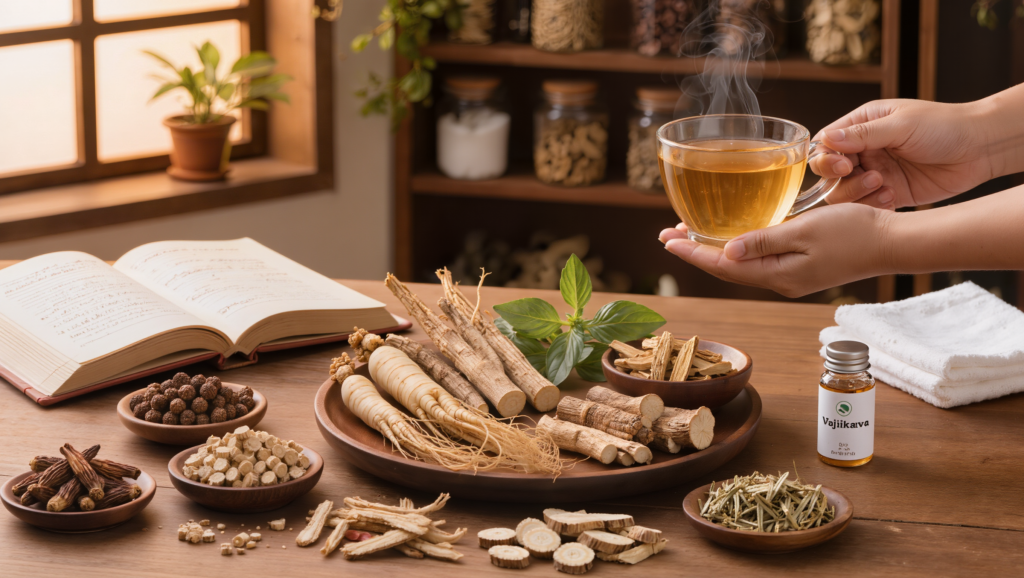
Several herbs show up again and again in Vajikarana discussions. The source material highlights:
- Ashwagandha for strength, stamina, and stress reduction.
- Shatavari for reproductive nourishment and female fertility support.
- Kapikacchu / Mucuna pruriens for libido and sperm support.
- Gokshura / Tribulus terrestris for energy and reproductive performance.
- Shilajit for energy, stamina, and tissue regeneration.[
Some sources also mentions Brahmi and Vacha in its formulation discussion for stress and nervous system calm, while some emphasize shilajit resin with hot milk, ghee, or honey as part of virility and vitality support.
What these herbs have in common is that they are not usually framed as instant stimulants. They are generally positioned as nourishers, tonics, or adaptogens that support resilience.
Men, Women, And Reproductive Health
Although Vajikarana is often marketed around male sexual health, the broader Ayurvedic tradition is not limited to men. Vajikarana Chikitsa can support issues such as low libido, early ejaculation, erectile concerns, and poor erection in men, while also referencing sterility and frigidity in women.
Shatavari as a herb that enhances female fertility. That is important because it reminds us that Vajikarana is really about reproductive vitality in a broader sense, even if most commercial marketing zooms in on male performance.
The deeper Ayurvedic point is that reproductive vitality is connected to overall nourishment, emotional balance, and tissue quality — not just one gender or one symptom.
Lifestyle Matters Just As Much As Herbs
This is where Vajikarana gets more interesting than a supplement shelf. Vajikaran Rasayan approach includes herbal formulas, diet, lifestyle modification, and even specific meditation practices. The therapy is also a comprehensive system that addresses physical, mental, and spiritual health.
That means the herbs are only one part of the picture. The lifestyle side typically includes:
- Regular sleep.
- Lower stress and anxiety.
- Better digestion.
- Balanced diet.
- Mental calm and reduced performance pressure.
In practical terms, that makes a lot of sense. If someone is depleted, stressed, sleep-deprived, and underfed, no herb in the world is going to fully compensate.
Why Digestion Is So Central
A key point to note is that digestion has to work well for Vajikarana to work well, because nutrient absorption is foundational to tissue nourishment. This is classic Ayurveda: agni, or digestive fire, is what turns food into usable vitality.
That means a Vajikarana protocol is usually not just “take this tonic.” It is more like:
- Improve digestion.
- Reduce stress.
- Nourish tissues.
- Support the reproductive system.
- Rebuild vitality over time.
That sequence matters because it reflects a root-cause approach rather than a symptom chase.
What The Modern Science Research Says About Vajikarana
A review on Vajikarana says it is an important Ayurvedic treatment modality with proposed benefits including increased sexual capacity and improved health of future progeny. That gives the tradition some formal academic framing, even if modern clinical evidence is still not as extensive as people might want for many of the individual formulations.
So the honest scientific interpretation is this:
- Vajikarana is a real traditional Ayurvedic framework.
- It has plausible mechanisms tied to nourishment, stress reduction, and reproductive support.
- Specific herbs have varying levels of modern support.
- The tradition as a whole is broader than any one ingredient.
That is a more grounded position than either blind belief or total dismissal.
A Practical Way To Think About Vajikarana
If you strip away the Sanskrit and the marketing, Vajikarana is basically saying that sexual vitality depends on overall vitality. That means the basics still rule:
- Eat enough.
- Digest well.
- Sleep deeply.
- Manage stress.
- Nourish the tissues.
- Use herbs strategically, not randomly.
That framework is appealing because it is both ancient and surprisingly modern. Many people with low energy or reduced libido are not actually looking for a “performance hack.” They are looking for a way to feel replenished again.
Bottom Line
Vajikarana is Ayurveda’s rejuvenative system for vitality, stamina, sexual wellness, and reproductive health. The sources describe it as a therapy that strengthens reproductive tissue, supports digestion, reduces stress, and uses herbs like ashwagandha, shatavari tonic, kapikacchu, gokshura, and shilajit to nourish the body over time.
The big idea is simple: when the body is better nourished, calmer, and more resilient, reproductive vitality tends to improve too. Vajikarana is not just about desire — it is about rebuilding the kind of deep energy that desire depends on in the first place.
Sources: