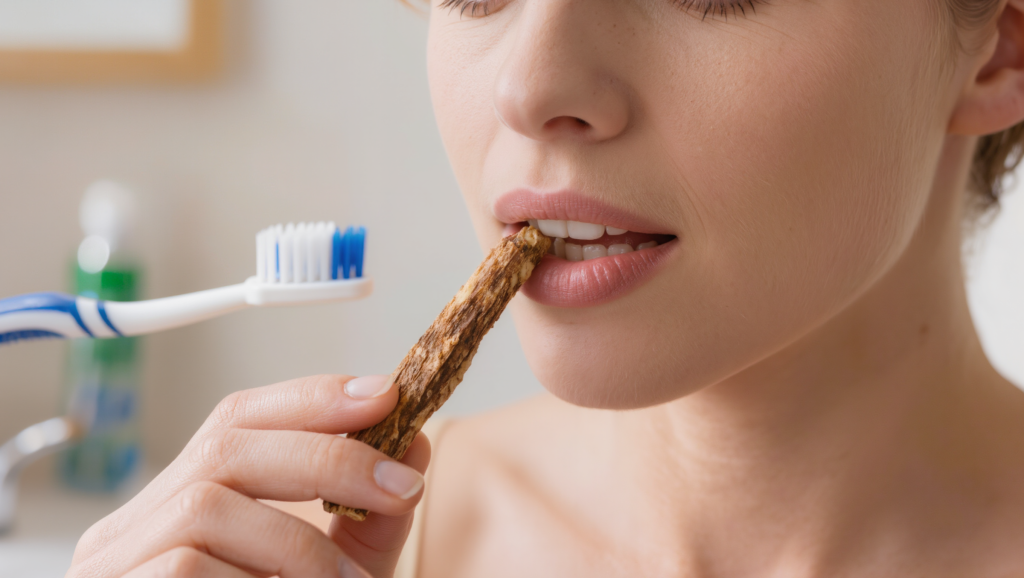












Licorice root has a surprisingly solid case in oral care, in our previous article we dove deep into using Licorice root to heal ulcers and sooth GERD. In this article we are diving deeper into it’s uses for fresher breath and fighting cavities. Research suggests licorice root can help fight the bacteria linked to cavities, gum disease, and bad breath, while also offering anti-inflammatory benefits for the mouth. But it is not a replacement for brushing and flossing — think of it as a smart sidekick, not a miracle substitute.
The reason licorice root gets so much attention is simple: it contains bioactive compounds such as licoricidin and licorisoflavan A, which have shown antibacterial activity against several oral pathogens. That makes it one of the more interesting traditional remedies to cross over into modern dental research.
What Licorice Root Does In The Mouth
Licorice root comes from the Glycyrrhiza plant family and has been used for centuries in traditional medicine. In oral health research, the attention is not really on the candy flavor — it is on the plant compounds inside the root.
According to a widely cited studies, two compounds in licorice, licoricidin and licorisoflavan A, were especially effective at killing major bacteria responsible for tooth decay and gum disease. Licorice contains several compounds — including glycyrrhizin, glabridin, licochalcone A, licoricidin, and licorisoflavan A — that may help prevent or treat common oro-dental diseases.
That means licorice is not just “soothing” in a vague herbal way. It appears to have a genuine antimicrobial profile that matters in the mouth.
Why Cavities And Gum Disease Start In The First Place
To understand why licorice root is interesting, it helps to know what it is trying to fight. Cavities and gum disease are both largely driven by bacteria that live in dental plaque. When these bacteria feed on sugars and stick to tooth surfaces, they produce acids and inflammatory byproducts that damage enamel and irritate gums.
The licorice compounds studied are relevant because they target the microbes associated with:
- Dental caries.
- Gingivitis.
- Periodontitis.
- Certain other oral infections.
So licorice root is not magic. It is more like a botanical pressure point aimed at the bacteria and inflammation that make mouths unhappy.
The Science Behind The Antibacterial Effect
The best-known oral-health study found that licoricidin and licorisoflavan A killed two major cavity-causing bacteria and two bacteria associated with gum disease, with licoricidin also killing a third gum-disease bacterium. That is a pretty big result for a natural compound.
Licorice’s potential beneficial effects in oro-dental diseases and its impact on both oral microbial pathogens and the host immune response. That second part matters because oral health is not just about killing bacteria; it is also about calming the tissue response that turns plaque into inflamed gums and chronic irritation.
In plain English, licorice may help on two fronts:
- It may suppress problematic bacteria.
- It may help calm inflammatory responses in the mouth.
That combination is why licorice root keeps showing up in oral-care discussions.
Can Licorice Root Really Freshen Breath?
Possibly, yes. Breath problems are often driven by bacterial overgrowth in the mouth, especially on the tongue, in gum pockets, and around decaying teeth. If a substance reduces the bacteria contributing to that environment, it can indirectly improve halitosis.
A preliminary study suggested a mouthwash containing licorice extract might improve halitosis and reduce halitosis-causing bacteria. That is promising, though the wording matters: “preliminary” means useful, not definitive.
So licorice root may help breath because it may:
- Lower odor-producing bacteria.
- Reduce inflammation that worsens oral imbalance.
- Support a cleaner microbial environment in the mouth.
If your breath issues come from gum disease or bacterial buildup, licorice may be more helpful than a minty rinse that just covers the smell for ten minutes.
How Licorice Compares To Brushing
Let’s be very clear: licorice does not beat brushing in the real-world sense of daily oral hygiene. Brushing physically removes plaque, and flossing clears food debris and bacterial buildup from places your toothbrush cannot reach. Licorice cannot mechanically scrub your teeth.
What it can do is add an extra antimicrobial layer. That is why dental sources discussing licorice consistently frame it as part of a full routine, not as a replacement. Licorice may help reduce gum disease and cavities when used as part of a complete oral health routine that includes brushing, flossing, and regular dental visits.
So the more accurate headline is not “beats brushing.” It is “may complement brushing in a clever, natural way.”
Where It Fits Best
Licorice root seems most useful in a few specific situations:
- As a mouth rinse or gargle.
- As a lozenge or extract form.
- As a short-term adjunct for breath, gum irritation, or minor oral imbalance.
Licorice mouth rinse or gargle might reduce ulcer size and pain in recurrent canker sores, and a licorice gargle or lozenge may help reduce sore throat after intubation. That broader oral-soothing profile supports the idea that licorice has more than just antibacterial value.
For dental care, that makes it especially interesting as:
- A rinse for bacterial control.
- A soothing option for irritated tissues.
- A natural adjunct to standard hygiene.
What Researches On Licorice Root Still Does Not Prove
This is where healthy skepticism is important. Licorice root has promise, but the evidence does not mean every licorice product is automatically effective or safe although some uses remain preliminary and need more research.
That means we should avoid overclaiming things like:
- Licorice cures cavities.
- Licorice replaces dental cleanings.
- Licorice can fix advanced gum disease on its own.
- Licorice candy has the same effect as licorice root extract.
The studied benefits come from the root and its extracts, not from sugary licorice candy, which can actually feed the bacteria you are trying to discourage.
Safety And Common-Sense Cautions When Using Licorice Root
Licorice root is not risk-free. The science and health sources consistently caution that users should talk to a healthcare provider before taking licorice root because it can have undesirable effects and interactions with prescription medications.
That warning matters because licorice can affect blood pressure and potassium balance when taken internally in significant amounts. So if the plan is to use licorice for oral health, topical or rinse-style use is usually the more cautious and targeted approach than casually eating large amounts of it.
The practical rules are:
- Do not confuse licorice root with candy.
- Do not use it as a substitute for brushing.
- Check safety if you have medical conditions or take medications.
- Use it as part of a dental routine, not the whole routine.
Why This Remedy Keeps Coming Back
Licorice root has staying power because it sits at the intersection of tradition and plausible modern science. It has been used in ancient herbal systems for a long time, and modern research is now showing why people kept noticing benefits.
That does not mean every traditional remedy is worth keeping. It means licorice root happens to have a plausible mechanism, a decent research trail, and a real-world oral-care application. That combination makes it a lot more interesting than many “natural dental hacks” floating around online.
Best Ways To Use Licorice Root For Oral Health
If you want the benefit without the fantasy, think of licorice root this way:
- Brush twice daily with toothpaste.
- Floss or use interdental cleaning daily.
- Consider licorice extract or rinse as an extra support step.
- Keep sugary snacks and sticky candies low.
- See a dentist regularly for cleanings and evaluation.
That’s the real-life version. Licorice may help change the mouth environment, but it works best when the mouth is already being kept clean.
Bottom Line
Licorice root is a genuinely interesting oral-health herb because research suggests its compounds can fight cavity-causing and gum-disease bacteria, and early evidence also suggests it may help freshen breath. It is not a substitute for brushing, flossing, or professional dental care, but it may be a useful natural add-on for people who want more antimicrobial support in their oral routine.
So yes, this ancient oral hack has real science behind it. Just keep the hype in check, use the root rather than candy, and treat it like a helper — not a toothbrush replacement.
Sources:
- https://pubmed.ncbi.nlm.nih.gov/21851508/
- https://www.nccih.nih.gov/health/licorice-root?uid=f9125f99s16&page=reviewshum-raw-beauty-review&qutm=1&uid=2f6473a795&qutm=1