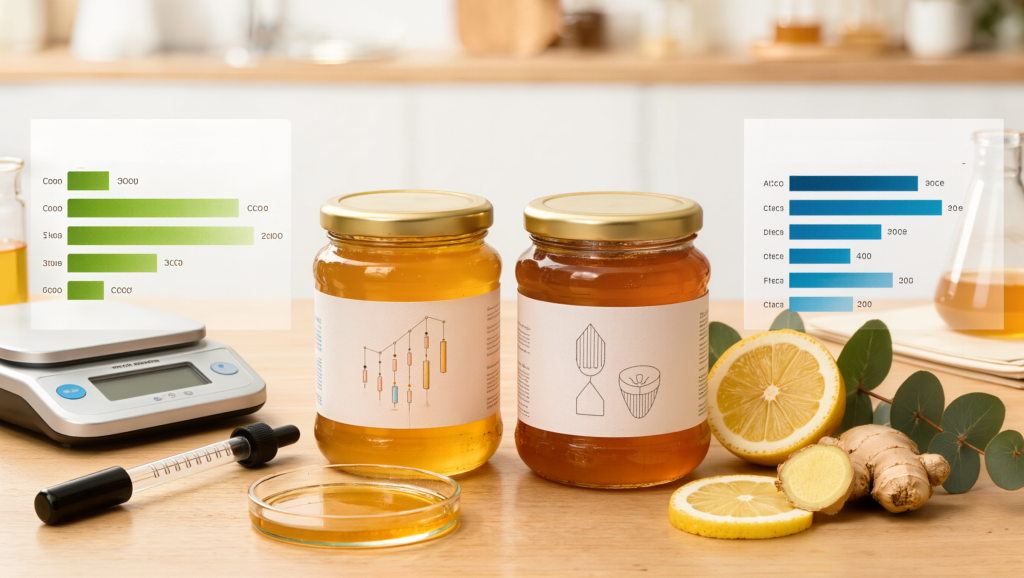












Manuka honey is special because it is not just sweet; it is biologically active in a way that most regular honey is not. Its standout compounds — especially methylglyoxal, or MGO — give it strong non-peroxide antibacterial activity, which is why it gets so much attention for wound care, sore throats, oral health, and other therapeutic uses.
Regular honey still has value, but it is mostly a general-purpose natural sweetener with mild antimicrobial activity that usually comes from hydrogen peroxide. Manuka honey goes further because its antimicrobial power persists even when peroxide activity is removed, thanks to compounds unique to the Leptospermum nectar it comes from.
What Is Manuka Honey
Manuka honey comes from bees that collect nectar from the Leptospermum scoparium plant, also called the manuka bush or tea tree, native to Australia and New Zealand. That origin is important because the flower chemistry is what gives the honey its unusual profile.
Unlike regular honey, which can come from many flowers, genuine Manuka is typically monofloral, meaning it is largely derived from that single plant source. That consistency is one reason it can be tested, graded, and sold as a premium functional food.
Why Manuka Is Different From Regular Honey
All honey has some natural antimicrobial qualities, but most of those come from hydrogen peroxide generated in the honey. Manuka honey has that too, but it also has something more stable: non-peroxide activity, which remains active even when hydrogen peroxide is removed or degraded.
The major actor here is MGO, or methylglyoxal. MGO develops from dihydroxyacetone, a compound found in high concentrations in manuka nectar. The higher the MGO level, the stronger the antibacterial effect.
That is the core of the Manuka story:
- Regular honey has general antimicrobial support.
- Manuka honey has unique bioactive chemistry.
- MGO is the signature compound driving much of its potency.
The Science Behind The “Power” Of Manuka Honey
Manuka honey’s reputation is not just marketing fluff. The Australian Manuka Honey Association says numerous scientific studies show Manuka honey can kill superbugs and stimulate wound healing, and that researchers identified MGO as the key antibacterial component. Also manuka’s antibacterial activity persists even when hydrogen peroxide is removed, which is why it is considered unique among honeys.
That matters because many microorganisms can deal with weak, unstable antimicrobial effects. Manuka’s non-peroxide activity is more robust, which may help explain why it has been studied for wound healing, mouth health, and infection-related uses.
A useful way to think about it is this:
- Regular honey is like a mild multitool.
- Manuka honey is like that multitool plus a specialized blade.
The UMF And MGO Ratings Of Manuka Honey
Manuka honey is one of the few honeys with a real grading system for bioactivity. UMF™ reflects the concentration of MGO, DHA, and leptosperin, and that a minimum UMF 10+ is generally considered therapeutic.
The Australian Manuka Honey Association also says MGO replaced NPA as the critical indicator of strength. In practical terms, that means you are not just buying “Manuka” as a name; you are buying a measurable potency level.
This helps consumers compare products, because not all Manuka honey is equally strong. A lower-grade jar may be delicious and still useful, but it will not have the same antibacterial punch as a higher-MGO batch.
Manuka Vs. Regular Honey
Here is the simple comparison:
| Feature | Manuka Honey | Regular Honey |
|---|---|---|
| Floral source | Mostly Leptospermum scoparium | Many possible flowers |
| Main antimicrobial driver | MGO and non-peroxide activity | Mostly hydrogen peroxide |
| Potency rating | UMF / MGO grading | Usually no standard potency rating |
| Typical uses | Wound care, sore throat, oral health, skin support | Sweetener, mild soothing, general wellness |
| Consistency and flavor | Thicker, darker, more robust | Usually lighter and milder |
| Research attention | Very high | Moderate |
That table is the whole story in one glance. Manuka is not “better honey” across every use, but it is much more specialized and better studied for therapeutic purposes.
Why Is Manuka Honey Used For Healing
Manuka honey gets the “healer” label because its bioactive properties may support wound healing, reduce bacterial load, and soothe irritated tissues. Studies show it kills superbugs and stimulates wound healing. It may also help with small wounds, sore throats, oral health, acne, and hydration of skin.
The reasons it gets used in care settings include:
- Antibacterial activity.
- Anti-inflammatory effects.
- Antioxidant content.
- The ability to stay active even when peroxide is not the main mechanism.
That does not mean it replaces medical treatment. But it does mean it has enough unique properties to justify its reputation.
Why Is Manuka Honey So Expensive
Manuka honey is more expensive than regular honey because it is rare, tightly sourced, and tested for authenticity and potency. The supply is tied to a specific plant, a specific geographic region, and a specific set of quality markers.
That rarity makes it premium by default. But scarcity alone would not justify the price if the chemistry were ordinary. The reason people keep paying for it is that the chemistry is not ordinary.
Taste And Texture Differences
Manuka is usually darker, thicker, and more robust in flavor than regular honey. Some descriptions note a slight bitterness or earthy depth, which is often associated with its higher phenolic acid content.
Regular honey is generally lighter, runnier, and milder. So if you just want something for tea or toast, standard honey may be perfectly fine. If you want a functional ingredient with a medicinal edge, Manuka makes more sense.
What Science Research Says About Manuka Honey
Manuka honey has strong support for antibacterial activity, wound care potential, and anti-inflammatory and antioxidant effects. However, that does not mean every bold wellness claim made about it is equally proven.
A good evidence-based reading is:
- Stronger evidence for topical and antimicrobial uses.
- Promising evidence for oral and throat support.
- More cautious evidence for gut health and broader systemic claims.
That is still impressive. It just means the science is strongest where the honey directly contacts tissues or microbes.
How To Buy The Real Manuka Honey
Because Manuka is premium, counterfeits and weak imitations are a real concern. The science and industry sources emphasize identifying genuine Manuka through markers like MGO, UMF, leptosperin, and DNA-verified origin.
If you are shopping, look for:
- A clear UMF or MGO rating.
- Traceable sourcing from Australia or New Zealand.
- Authenticity testing or certification.
- A product labeled as genuine monofloral Manuka.
Without those markers, you may just be buying honey with a fancy label.
Bottom Line
Manuka honey is special because it combines rare floral origin with uncommon bioactive chemistry, especially MGO-driven non-peroxide antibacterial activity. That is why it stands apart from regular honey, which is still useful but generally more of a sweetener than a targeted healing food.
So if regular honey is the reliable everyday option, Manuka is the premium functional one. It is not magic, but it is definitely not just honey with better branding.
Sources: