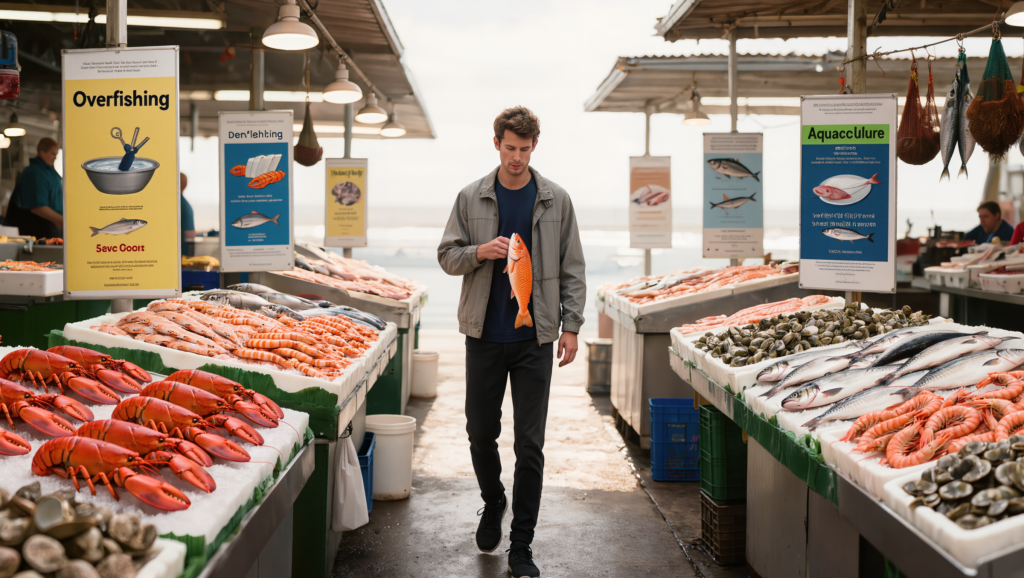












Sustainable seafood is not a myth, but it is also not a simple feel-good label. The truth is that some seafood can be harvested or farmed with relatively low environmental impact, while a lot of fish on the market still comes from systems that damage ecosystems, create bycatch, or depend on feed and infrastructure that are not especially green.
The hardest part is that “fish is good” and “fish is bad” are both oversimplifications. Whether you are a pescatarian or not and you care about the environment, the real question is not whether seafood is inherently sustainable, but which seafood, from where, caught or farmed how, and under what management system.
Why The Sustainable Seafood Debate Keeps Getting Messy
Seafood sits in an awkward middle ground. On one hand, wild fisheries and aquaculture can provide highly nutritious food with a lower land footprint than many terrestrial animal products. On the other hand, poorly managed fishing can overexploit stocks, damage habitats, and accidentally catch non-target species, while some aquaculture operations create pollution, disease spread, or feed dependence problems.
That is why you see such polarized takes online. Some people argue fish is the most environmentally responsible animal protein; others point to overfishing, bycatch, and marine pollution and say seafood is basically a disaster. The truth is somewhere in between.
What “Sustainable Seafood” Actually Means
At its best, sustainable seafood means taking fish or shellfish at a rate that allows populations to replenish, while minimizing ecosystem damage and maintaining strong management systems. The standard rests on three pillars: healthy fish populations, minimal ecosystem impact, and effective management.
That definition matters because it makes sustainability a system property, not a species slogan. A species like tuna or salmon is not automatically sustainable or unsustainable everywhere. The same fish can be responsibly managed in one region and heavily depleted in another. So when people ask whether sustainable seafood is a myth, the honest answer is that the label can be real—but only if the underlying management is real too.
The Environmental Case For Eating Fish
There are good reasons environmentalists still defend some seafood. FAO’s 2024 State of World Fisheries and Aquaculture report says aquatic animal food production reached 185 million tons in 2022, with aquaculture surpassing capture fisheries for the first time. That matters because aquatic foods are increasingly central to feeding people with relatively efficient use of feed and water compared with many land-based animal systems.
Stopping fishing altogether is not realistic and could shift demand to land-based proteins, increasing deforestation and carbon emissions. In other words, if fish were removed from diets entirely, the replacement food would matter a lot. Swapping seafood for beef is not an environmental win.
Seafood also provides nutrients that are harder to get elsewhere, especially omega-3 fatty acids, iodine, and some highly bioavailable minerals. That does not make fish indispensable, but it does explain why many public-health and food-security discussions still include well-managed seafood as part of the solution.
The Environmental Case Against Fish
Now the less convenient part: many fisheries and aquaculture systems still create serious environmental problems. Overfishing remains a central concern, and the broader ocean-health picture is shaped by bycatch, habitat degradation, and uneven management.
The European Environment Agency says overfishing, bycatch, and habitat degradation are primary drivers of declining marine biodiversity. That is not a small issue. Bycatch can kill turtles, seabirds, dolphins, sharks, and juvenile fish that were never the target in the first place. Habitat damage from some gear types can also alter seabeds and coastal ecosystems.
Aquaculture is not a free pass either. Some farming systems can be relatively efficient, but others depend on feed made from wild fish, create waste in coastal waters, or require antibiotics and dense stocking conditions. So “farm raised” does not automatically mean “environmentally responsible.” It depends on the species, feed source, and production method.
Why The Old Advice To “Eat More Fish” Got Challenged
One of the most interesting points in this debate is that health advice can have ecological consequences. Back in 2009, Canadian scientists argued that telling people in developed countries to eat more fish was shortsighted because it could intensify pressure on limited marine supplies.
Their argument was simple: if everyone chases fish for omega-3s, demand rises faster than sustainably managed supply. That can push fisheries harder and create ecological tradeoffs that public-health messaging often ignores. The lesson is not that fish is unhealthy; it is that nutritional advice cannot be separated from resource limits.[
Wild-Caught Versus Farmed: Neither Is Automatically Better
A lot of environmental eaters try to solve the dilemma by saying, “I only eat wild” or “I only eat farmed.” That is still too blunt. Wild-caught seafood is not automatically sustainable, and farmed seafood is not automatically bad.
Wild fisheries can be excellent when catch limits are science-based and enforcement is strong. But wild fisheries can also be overfished, poorly monitored, or destructive if gear and governance are weak.
Aquaculture can be very efficient, especially in well-managed systems, but some operations rely on feed from wild-caught fish, which creates a hidden pressure upstream. Coastal fish farms can also alter habitats and ecosystems, which affects local biodiversity. So the environmental question is not wild versus farmed; it is well-managed versus badly managed.
Certifications Help – But They Are Not Magic
Seafood certifications like MSC are designed to help consumers identify seafood that meets independent standards. That is useful because the average shopper cannot personally audit fisheries, trace supply chains, or assess stock dynamics.
Still, certifications are not a perfect shield. They are better than marketing claims, but they depend on the rigor of the standard, the integrity of the audits, and how closely the certified fishery continues to operate within the rules. So if you are trying to eat sustainably, look for credible third-party labels, but treat them as a good starting point, not the final word.
Seafood Watch plays a similar role by providing science-based recommendations used by businesses, chefs, and consumers. That is another reminder that sustainability is best handled as a decision-making process, not a slogan.
What Environmentalists Should Actually Do
If you want to eat fish in a way that matches environmental values, the best approach is to eat less, but eat better. That means choosing seafood from credible sources, paying attention to species and region, and avoiding the assumption that all fish is equally good or bad.
A practical framework looks like this:
- Prefer fisheries with independent certification or strong public science-based management.
- Avoid species or regions known to be overfished or poorly managed.
- Be skeptical of vague claims like “wild-caught” or “natural” without traceability.
- Consider farmed seafood when the production system is efficient and well regulated.
- Use fish as part of a broader low-impact diet, not as the default protein for every meal.
That approach is less emotionally satisfying than a blanket yes-or-no answer, but it is much more accurate.
Is Seafood Part Of A Climate-Smart Diet?
Potentially yes, but only in context. A 2024 report emphasizes aquatic foods as important to food security, nutrition, and future supply planning, and highlights the role of Blue Transformation in improving sustainability. That suggests seafood can be part of a climate-conscious food system if managed properly.
The catch is that sustainability is not guaranteed by the fact that food comes from water. You still have to account for feed, fuel, habitat, bycatch, pollution, and labor systems. A responsible seafood diet is therefore less about moral purity and more about choosing the least harmful, most traceable options available.
Is Sustainable Seafood Sort Of A Myth?
No, but the way it is marketed often is. Sustainable seafood is real when it comes from fisheries or farms that are genuinely managed to replenish stocks, reduce ecosystem damage, and keep supply chains transparent. What is mythical is the idea that “seafood” as a whole can be given one environmental verdict.
The honest conclusion is uncomfortable but useful: eating fish as an environmentalist is not automatically good or bad. It is a series of tradeoffs. If you choose carefully, seafood can fit into a responsible diet. If you choose casually, you can easily end up supporting overfishing or damaging aquaculture instead.
Bottom line
Sustainable seafood is not a myth, but it is also not a free pass. Some seafood systems are genuinely better for people and the planet; others are absolutely not.
So if you are an environmentalist deciding whether to eat fish, the best answer is not “always” or “never.” The best answer is: know the source, trust the science, look for real certification, and treat seafood as one carefully chosen part of a broader sustainable diet.
Sources: